
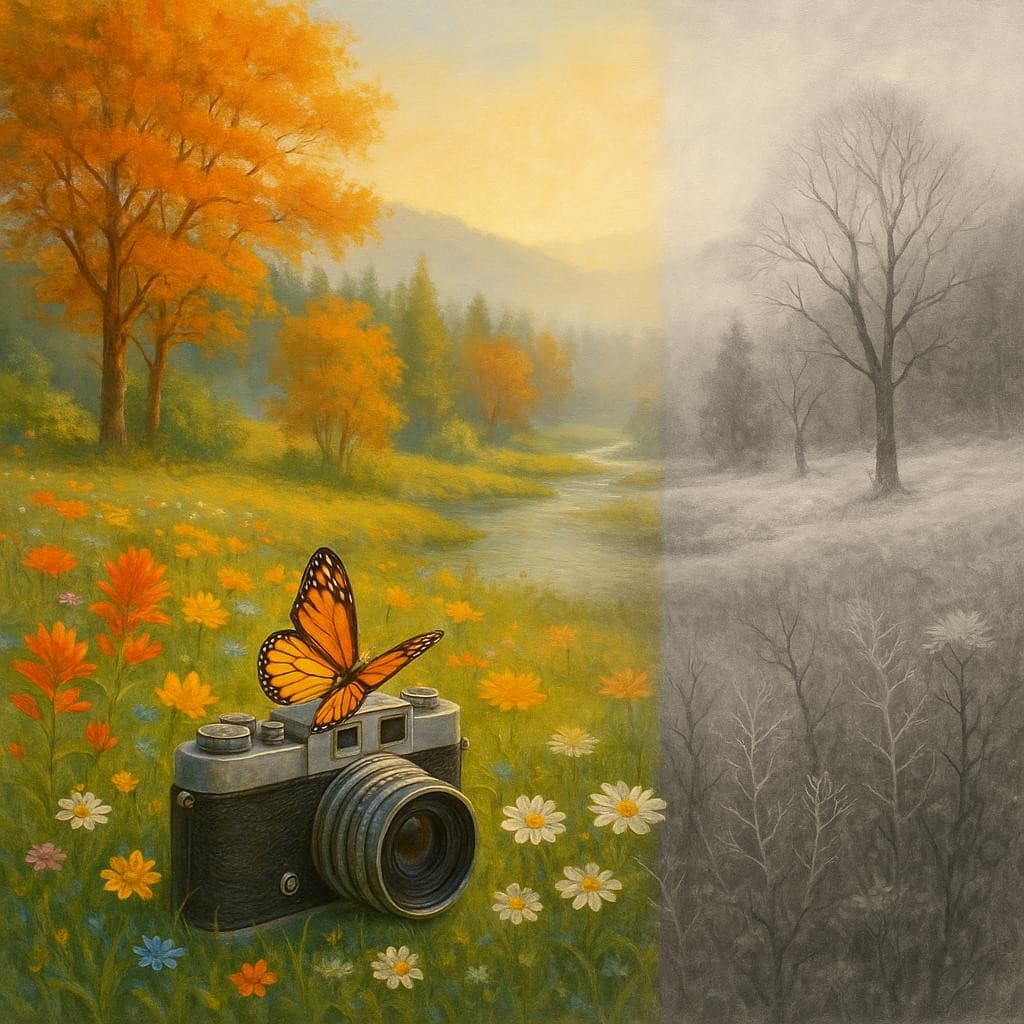
Life is like a camera. Focus on what’s important, capture the good times, develop from the negatives, and if things don’t work out, take another shot. — Ziad K. Abdelnour
—What lingers after this line?
Focusing on What Truly Matters
Much like a skilled photographer selectively sharpens their lens on a subject, Ziad K. Abdelnour urges us to prioritize what holds genuine value in our lives. In an age overwhelmed by distractions, clarity of focus allows us to distinguish between the trivial and the essential. This principle echoes ancient wisdom, such as the Stoic philosopher Epictetus’s reminder to concentrate on what lies within our control, helping us to live more intentional and meaningful lives.
Capturing and Cherishing Joyful Moments
Transitioning from focus, the next lesson encourages us to actively ‘capture the good times.’ Photographers immortalize fleeting moments to revisit memories long after the scene has faded. Similarly, taking time to appreciate and mentally record our positive experiences fosters gratitude and resilience. As psychologist Martin Seligman discusses in his work on positive psychology, such practices reinforce well-being and help us build a reservoir of happiness to draw upon during challenging periods.
Learning and Developing from Negatives
Part and parcel of life—and photography—are the ‘negatives’ we inevitably encounter. Rather than shunning these difficulties, Abdelnour’s metaphor reminds us to develop from them, much as film once required negatives to produce vibrant photographs. This idea dovetails with the concept of post-traumatic growth: the notion that adversity, when processed constructively, becomes a catalyst for personal evolution. For instance, Nobel laureate Viktor Frankl, in 'Man’s Search for Meaning' (1946), argued that our response to suffering can lead to extraordinary personal strength.
Embracing Failure as a Path to Improvement
Not every attempt results in the perfect picture or outcome. Just as photographers take numerous shots to achieve their vision, Abdelnour reassures us that if things don’t work out, it’s always possible to ‘take another shot.’ This mindset champions perseverance over perfection. Throughout history, innovators from Thomas Edison to J.K. Rowling have demonstrated that repeated effort—following setbacks—often precedes success, reinforcing the value of persistence in any creative or personal endeavor.
Integrating the Metaphor into Everyday Life
Together, the camera metaphor invites us to approach each day as an opportunity for mindful action, joyful presence, and lifelong learning. By focusing, cherishing, developing, and persevering, we adopt a perspective that transforms life’s trials and triumphs into a coherent narrative. This holistic approach encourages us to find purpose and beauty in both the successes and the stumbles—making each moment, much like each photograph, a unique and valuable part of our human story.
Recommended Reading
As an Amazon Associate, we earn from qualifying purchases.
One-minute reflection
Where does this idea show up in your life right now?
Related Quotes
6 selectedGrowth feels scary because comfort feels warm, but you can take one small step. Change doesn't crush you; staying still slowly does. — Justin Welsh
Justin Welsh
At first glance, Justin Welsh captures a tension nearly everyone recognizes: comfort feels safe precisely because it is familiar. Routine wraps itself around us like warmth, making even imperfect situations feel preferab...
Read full interpretation →Life is like a camera. Focus on what’s important, capture the good times, develop from the negatives, and if things don’t work out, take another shot. — Ziad K. Abdelnour
Ziad K. Abdelnour
The analogy begins by emphasizing the importance of focus—a key principle in both photography and life. Just as a camera produces the clearest images when it is centered on its subject, individuals achieve clarity and pu...
Read full interpretation →Your choices must begin to reflect not just the person you are, but also the one you are becoming. — Brianna Wiest
Brianna Wiest
At its core, Brianna Wiest’s statement reframes identity as something unfinished. Rather than treating the self as a fixed fact, she suggests that who we are is continually revised through action.
Read full interpretation →Do not mistake exhaustion for a lack of talent; even the deepest wells need time to refill their waters. — Maya Angelou
Maya Angelou
At its core, Maya Angelou’s line asks us to make a crucial distinction: being drained is not the same as being deficient. People often interpret a season of low output as proof that they have lost their gifts, yet Angelo...
Read full interpretation →True strength is not about never falling—it is about staying composed, learning from challenges, and continuing forward with a calm and focused mind. — Ben Okri
Ben Okri
At first glance, strength is often imagined as invulnerability, the ability to resist every blow without wavering. Ben Okri’s insight gently overturns that assumption by suggesting that real strength appears not in perfe...
Read full interpretation →Recovery isn't linear. You are not behind; you are rebuilding. — Anne Wright
Anne Wright
At its core, Anne Wright’s quote pushes back against a common and damaging assumption: that healing should move neatly upward, without setbacks or pauses. By saying recovery “isn’t linear,” she reframes difficult days no...
Read full interpretation →More From Author
More from Ziad K. Abdelnour →Your current situation is not your final destination. — Ziad K. Abdelnour
This quote emphasizes that no matter how difficult a situation may be now, it is not permanent. It encourages optimism and faith in better days ahead.
Read full interpretation →Dreaming is one thing, and working towards it is another. — Ziad K. Abdelnour
This quote highlights the distinction between merely dreaming about success and actively working toward achieving it. While dreams provide direction, action is necessary to turn them into reality.
Read full interpretation →Surround yourself with those who see the greatness within you, even when you don’t see it yourself. — Ziad K. Abdelnour
This quote highlights how crucial it is to be around people who uplift and believe in you, especially during times when you might not believe in yourself. A positive and encouraging circle can help individuals reach thei...
Read full interpretation →Life is like a camera. Focus on what’s important, capture the good times, develop from the negatives, and if things don’t work out, take another shot. — Ziad K. Abdelnour
The analogy begins by emphasizing the importance of focus—a key principle in both photography and life. Just as a camera produces the clearest images when it is centered on its subject, individuals achieve clarity and pu...
Read full interpretation →