
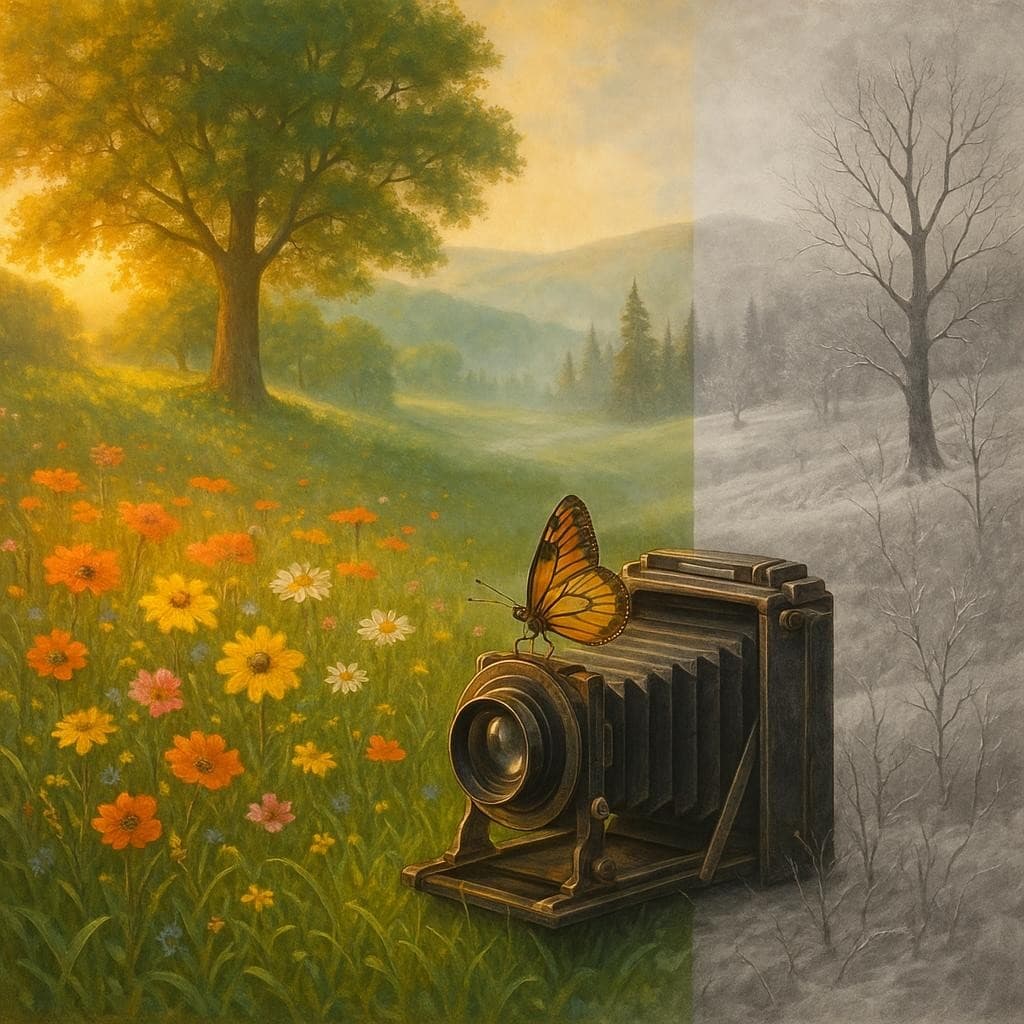
Life is like a camera. Focus on what’s important, capture the good times, develop from the negatives, and if things don’t work out, take another shot. — Ziad K. Abdelnour
—What lingers after this line?
Focusing on What Truly Matters
The analogy begins by emphasizing the importance of focus—a key principle in both photography and life. Just as a camera produces the clearest images when it is centered on its subject, individuals achieve clarity and purpose by prioritizing what genuinely matters. This act of focusing can involve setting goals and filtering out distractions, allowing us to direct energy toward meaningful pursuits and relationships. Throughout history, great thinkers have echoed this advice, most notably Stephen Covey in ‘The 7 Habits of Highly Effective People’ (1989), where he urges us to ‘put first things first.’
Capturing the Good Times
Transitioning seamlessly, the metaphor reminds us to acknowledge and cherish life’s joys. Much like a photographer striving to immortalize beautiful moments, we are encouraged to savor experiences that bring happiness. This perspective nurtures gratitude and resilience; as psychologist Martin Seligman posits in his work on positive psychology, reflecting on positive events builds emotional resources to better handle future adversities.
Developing from the Negatives
Yet, the analogy does not shy away from life’s hardships. By urging us to ‘develop from the negatives,’ the quote invokes the photographic process where negatives are essential for producing vivid images. Similarly, adversities and challenges often yield the most profound growth. This idea echoes in Viktor Frankl’s ‘Man’s Search for Meaning’ (1946), where suffering becomes a catalyst for finding deeper purpose and strength.
Resilience in the Face of Failure
Furthermore, the suggestion to ‘take another shot’ offers reassurance for moments when efforts fall short. Like a photographer unafraid of clicking the shutter again, we are encouraged to approach failures not as endpoints but as opportunities for renewal. This resilience is central to the growth mindset popularized by psychologist Carol Dweck, who asserts that embracing mistakes leads to continued self-improvement and eventual success.
Living Life with Creative Agency
Ultimately, the camera metaphor underscores our agency in shaping our experiences. Life, like photography, offers us a creative process—our choices influence the images we capture and the stories we tell. By balancing focus, gratitude, learning from hardship, and persistence, we craft a unique narrative much like an artist curates a photographic portfolio. In blending these lessons, Abdelnour’s quote invites us to view existence not as a passive series of events, but as an ongoing, intentional act of creation.
Recommended Reading
As an Amazon Associate, we earn from qualifying purchases.
One-minute reflection
What's one small action this suggests?
Related Quotes
6 selectedDo not mistake exhaustion for a lack of talent; even the deepest wells need time to refill their waters. — Maya Angelou
Maya Angelou
At its core, Maya Angelou’s line asks us to make a crucial distinction: being drained is not the same as being deficient. People often interpret a season of low output as proof that they have lost their gifts, yet Angelo...
Read full interpretation →Life is like a camera. Focus on what’s important, capture the good times, develop from the negatives, and if things don’t work out, take another shot. — Ziad K. Abdelnour
Ziad K. Abdelnour
Much like a skilled photographer selectively sharpens their lens on a subject, Ziad K. Abdelnour urges us to prioritize what holds genuine value in our lives.
Read full interpretation →True strength is not about never falling—it is about staying composed, learning from challenges, and continuing forward with a calm and focused mind. — Ben Okri
Ben Okri
At first glance, strength is often imagined as invulnerability, the ability to resist every blow without wavering. Ben Okri’s insight gently overturns that assumption by suggesting that real strength appears not in perfe...
Read full interpretation →Recovery isn't linear. You are not behind; you are rebuilding. — Anne Wright
Anne Wright
At its core, Anne Wright’s quote pushes back against a common and damaging assumption: that healing should move neatly upward, without setbacks or pauses. By saying recovery “isn’t linear,” she reframes difficult days no...
Read full interpretation →Where you stand determines what you see and what you do not see; a change in where you stand changes everything. — Megan McKinzie
Megan McKinzie
Megan McKinzie’s line begins with a simple physical truth and expands it into a philosophical one: where we stand shapes what enters our field of vision. From one place, certain details appear obvious; from another, they...
Read full interpretation →Being happy doesn't mean that everything is perfect. It means that you've decided to look beyond the imperfections. — Gerard Way
Gerard Way
At its core, Gerard Way’s quote reframes happiness not as a reward for flawless circumstances, but as an act of perception. He suggests that joy begins when a person stops waiting for life to become perfectly arranged an...
Read full interpretation →More From Author
More from Ziad K. Abdelnour →Your current situation is not your final destination. — Ziad K. Abdelnour
This quote emphasizes that no matter how difficult a situation may be now, it is not permanent. It encourages optimism and faith in better days ahead.
Read full interpretation →Dreaming is one thing, and working towards it is another. — Ziad K. Abdelnour
This quote highlights the distinction between merely dreaming about success and actively working toward achieving it. While dreams provide direction, action is necessary to turn them into reality.
Read full interpretation →Surround yourself with those who see the greatness within you, even when you don’t see it yourself. — Ziad K. Abdelnour
This quote highlights how crucial it is to be around people who uplift and believe in you, especially during times when you might not believe in yourself. A positive and encouraging circle can help individuals reach thei...
Read full interpretation →Life is like a camera. Focus on what’s important, capture the good times, develop from the negatives, and if things don’t work out, take another shot. — Ziad K. Abdelnour
Much like a skilled photographer selectively sharpens their lens on a subject, Ziad K. Abdelnour urges us to prioritize what holds genuine value in our lives.
Read full interpretation →