
Not All Those Who Wander Are Lost - J.R.R. Tolkien
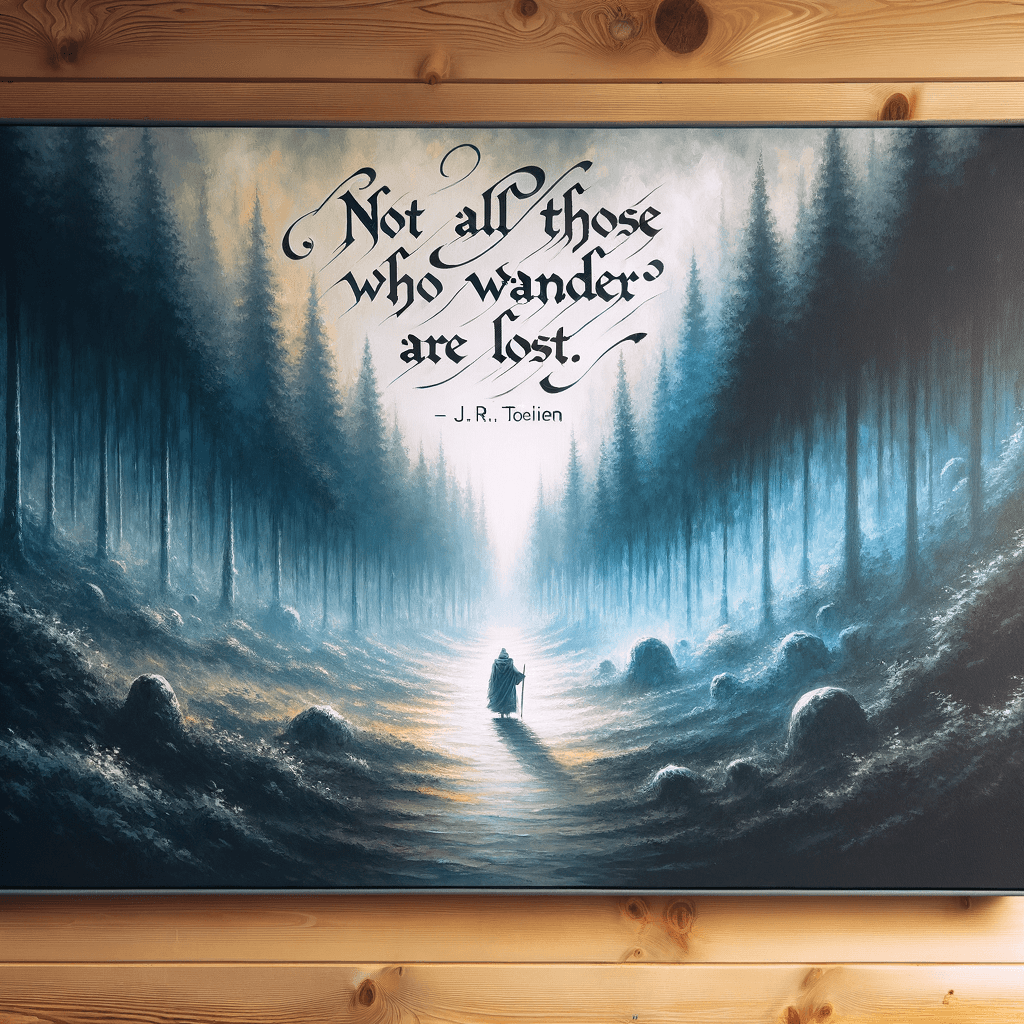
Not all those who wander are lost. - J.R.R. Tolkien
—What lingers after this line?
Exploration vs. Aimlessness
This quote implies that wandering, or exploring, does not necessarily mean one lacks direction or purpose. Some individuals wander to discover, learn, and grow, rather than because they are lost.
Personal Growth
It highlights the idea that personal growth often comes from exploration and embracing the unknown. By wandering, individuals experience new things and gain insights that they wouldn't have if they simply stayed put.
Nonconformity
The quote suggests that following a non-traditional path doesn't mean one is confused or misguided. Instead, it may indicate a pursuit of one's unique path and individuality.
Literary Context
J.R.R. Tolkien included this line in his poem 'All that is gold does not glitter,' which appears in 'The Fellowship of the Ring.' It refers to Aragorn, a character who initially appears as a mysterious wanderer but is revealed to be a purposeful and noble leader.
Philosophical Perspective
Philosophically, the quote speaks to the idea that life's journey doesn't always have a clear path. Wandering symbolizes the various experiences and decisions that shape an individual's life, each with its own meaning and purpose.
Recommended Reading
As an Amazon Associate, we earn from qualifying purchases.
One-minute reflection
What does this quote ask you to notice today?
Related Quotes
6 selectedNot all those who wander are lost. - J.R.R. Tolkien
J.R.R. Tolkien
This quote points out that wandering or taking an unconventional path doesn’t necessarily mean a person is directionless or lacks purpose. It celebrates the idea of seeking one's unique path in life.
Read full interpretation →Not all those who wander are lost. - J.R.R. Tolkien
J.R.R. Tolkien
This quote suggests that wandering, or exploring, is a valuable process that doesn't imply aimlessness. It highlights the idea that exploration can lead to self-discovery and personal growth.
Read full interpretation →Not all those who wander are lost. - J.R.R. Tolkien
J.R.R. Tolkien
This quote suggests that wandering, or exploring without a set destination, is not inherently directionless or purposeless. It highlights the value of the journey and the exploration of the unknown.
Read full interpretation →Not until we are lost do we begin to understand ourselves. - Henry David Thoreau
Henry David Thoreau
This quote suggests that it is only when we face significant challenges or confusion that we truly start to understand our own capabilities, values, and identities.
Read full interpretation →Wanderer, there is no path, the path is made by walking. - Antonio Machado
Antonio Machado
This quote emphasizes the unique journey each person undertakes in life. There is no pre-defined path to follow; instead, individuals create their own paths through their actions and decisions.
Read full interpretation →Not until we are lost do we begin to understand ourselves. - Henry David Thoreau
Henry David Thoreau
This quote suggests that it is often through experiencing loss or confusion that we come to truly understand our own identity and inner strengths. Adversity serves as a catalyst for self-discovery.
Read full interpretation →More From Author
More from J.R.R. Tolkien →Faithless is he that says farewell when the road darkens. — J.R.R. Tolkien
Tolkien’s line draws a sharp boundary between affection that is convenient and fidelity that is real. Saying farewell “when the road darkens” suggests abandoning a person, cause, or duty precisely at the moment it demand...
Read full interpretation →Forge ahead where maps end; the brave craft new paths as they go. — J.R.R. Tolkien
Tolkien’s line evokes the moment when the comfort of the known world runs out—when the map quite literally ends. At such boundaries, most people turn back, trusting only what has been charted before.
Read full interpretation →Shape wonder into shelter; imagination becomes home when it is shared. — J.R.R. Tolkien
Tolkien’s image of shaping wonder into shelter echoes his idea of “sub-creation,” the human craft of making secondary worlds within the primary one. In On Fairy-Stories (1939), he argues that stories offer recovery, esca...
Read full interpretation →Not all those who wander are lost. - J.R.R. Tolkien
This quote highlights the value of exploration and discovery. It suggests that wandering, or exploring new paths, can lead to personal growth and understanding, even if it appears aimless to others.
Read full interpretation →