
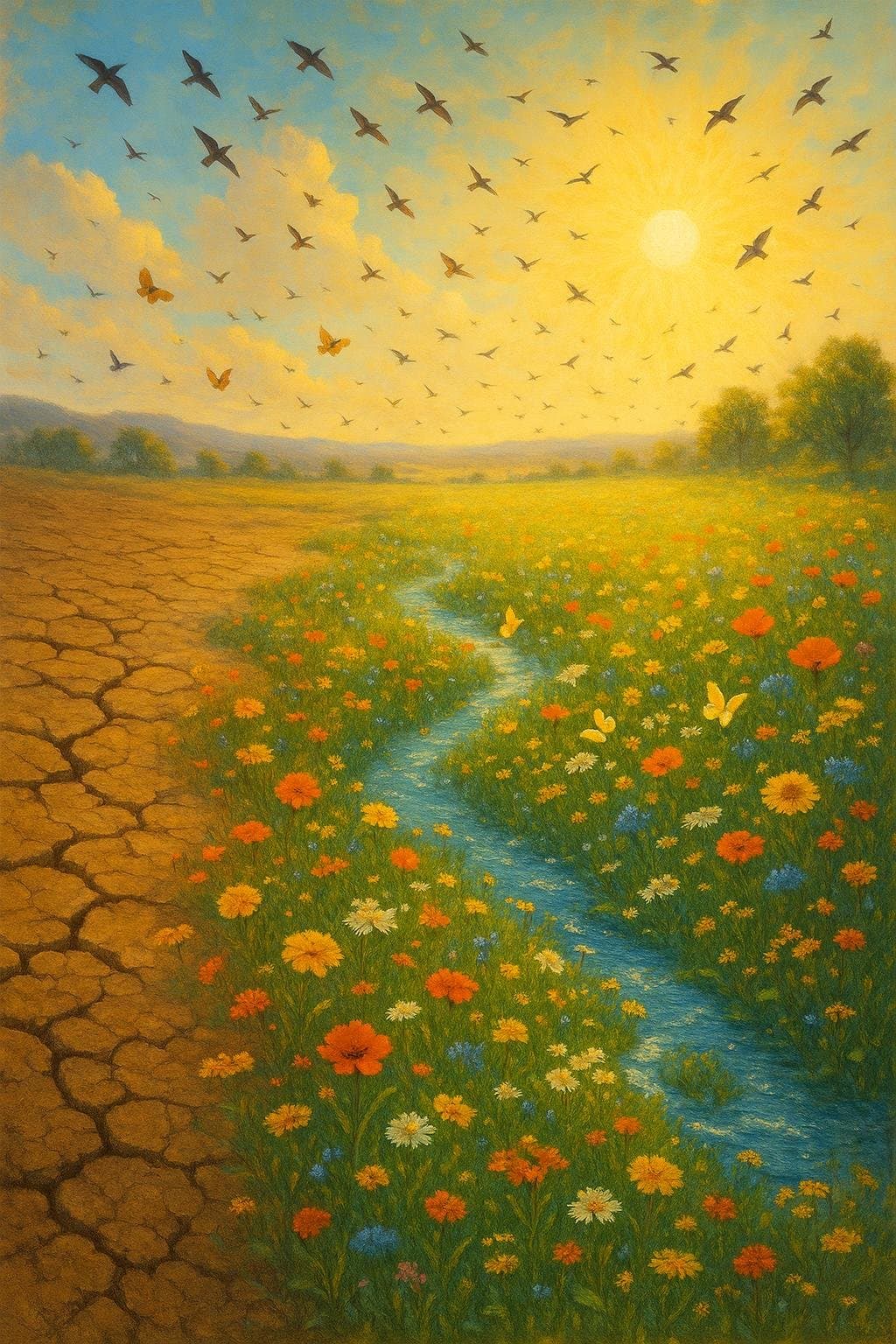
True wealth is the ability to fully experience life. — Henry David Thoreau
—What lingers after this line?
Redefining Wealth Beyond Material Possessions
Henry David Thoreau’s insight challenges the conventional association of wealth with money and material goods. Rather than measuring prosperity by financial assets or possessions, Thoreau posits that true richness comes from one’s capacity to embrace and savor life’s moments. This notion invites readers to reconsider what it means to be wealthy, shifting focus from external abundance to internal fulfillment.
Philosophical Roots in Simple Living
Building on this theme, Thoreau’s own experiment at Walden Pond epitomizes his philosophy. In *Walden* (1854), he recounts how stripping away superfluous comforts enabled him to be more present and appreciative of nature’s subtle wonders. This embrace of simplicity reveals a broader wisdom: that shedding life's excesses can enhance, rather than diminish, one's experience.
The Transformative Power of Presence
Transitioning from material simplicity, Thoreau’s words call attention to the quality of our attention. Mindful living—being truly present for mundane and extraordinary experiences alike—is central to his definition of wealth. Modern mindfulness practices echo this principle, with psychologists like Jon Kabat-Zinn advocating for the ‘full catastrophe living’ that enables people to find richness in every moment, regardless of circumstance.
Contrasts with Modern Consumer Culture
In today’s fast-paced, consumer-driven world, Thoreau's perspective stands as a counterpoint. Society often equates wealth with status and accumulation, yet studies in positive psychology, such as those by Daniel Kahneman, show that beyond a certain point, greater income does not lead to greater happiness. Instead, meaningful experiences and deep engagement in life are more reliable predictors of well-being.
Lasting Fulfillment Through Deep Engagement
Ultimately, Thoreau’s message endures because it speaks to the universal quest for meaning. Life’s richest moments—whether found in quiet contemplation or shared adventure—are accessible to those who choose to engage wholeheartedly. Thus, true wealth emerges not from what we own, but from our willingness to immerse ourselves fully in the tapestry of lived experience.
Recommended Reading
As an Amazon Associate, we earn from qualifying purchases.
One-minute reflection
What's one small action this suggests?
Related Quotes
6 selectedIt is the heart that makes a man rich. He is rich according to what he is, not according to what he has. — Henry Ward Beecher
Henry Ward Beecher
At first glance, Henry Ward Beecher’s statement overturns the usual measure of success. Instead of tying wealth to possessions, status, or financial accumulation, he locates it in the heart—in character, generosity, comp...
Read full interpretation →We are so busy running toward our future that we rarely stop to notice that we are already standing in the middle of a life. — Pico Iyer
Pico Iyer
Pico Iyer begins with a familiar modern habit: the constant sprint toward what comes next. We organize our days around goals, promotions, milestones, and imagined better versions of ourselves, often assuming that real li...
Read full interpretation →Gratitude is a currency that we can mint for ourselves, and spend without fear of bankruptcy. — Fred De Witt Van Amburgh
Fred De Witt Van Amburgh
Fred De Witt Van Amburgh frames gratitude as “currency,” immediately shifting it from a vague virtue into something practical: a form of value we can generate and exchange in everyday life. Unlike compliments we wait to...
Read full interpretation →The most important, the primordial relationship in your life is your relationship with the Now. — Eckhart Tolle
Eckhart Tolle
Eckhart Tolle’s line shifts the idea of “relationship” away from a person and toward a lived condition: the quality of attention you bring to this moment. In that framing, the Now isn’t a background setting—it’s the part...
Read full interpretation →Drink your tea slowly and reverently, as if it is the axis of the world. — Thich Nhat Hanh
Thich Nhat Hanh
Thich Nhat Hanh’s invitation to drink tea “slowly and reverently” turns an ordinary act into a meditation. By calling tea “the axis of the world,” he suggests that the present moment—however small—can become the stable c...
Read full interpretation →Stop trying to turn yourself into a better person, and start leading an absorbing life. — Oliver Burkeman
Oliver Burkeman
Oliver Burkeman’s line challenges the modern reflex to treat life as a project of constant upgrades. The phrase “trying to turn yourself into a better person” points to a familiar cycle: measuring, refining, and correcti...
Read full interpretation →More From Author
More from Henry David Thoreau →In the long run, men hit only what they aim at. Therefore, they had better aim at something high. — Henry David Thoreau
Thoreau’s statement begins with a simple but demanding truth: over time, people tend to arrive where their intentions point them. In other words, even imperfect effort has a direction, and that direction matters.
Read full interpretation →Me thinks that the minute my legs begin to move my thoughts begin to flow. — Henry David Thoreau
At first glance, Thoreau’s remark seems simple: as soon as his body starts moving, his mind comes alive. Yet the line captures a deeper truth about the intimate bond between physical motion and mental clarity.
Read full interpretation →It is not enough to be industrious; so are the ants. What are you being industrious about? — Henry David Thoreau
Thoreau’s remark begins by puncturing a common illusion: activity is not the same as purpose. Ants are famously industrious, yet their labor is automatic, instinctive, and unquestioned.
Read full interpretation →A man is rich in proportion to the number of things which he can afford to let alone. — Henry David Thoreau
Thoreau’s line turns the usual definition of wealth inside out. Instead of measuring richness by what someone owns, he measures it by what someone can ignore without feeling deprived.
Read full interpretation →