
Resilience and Growth: Lessons from the Cactus
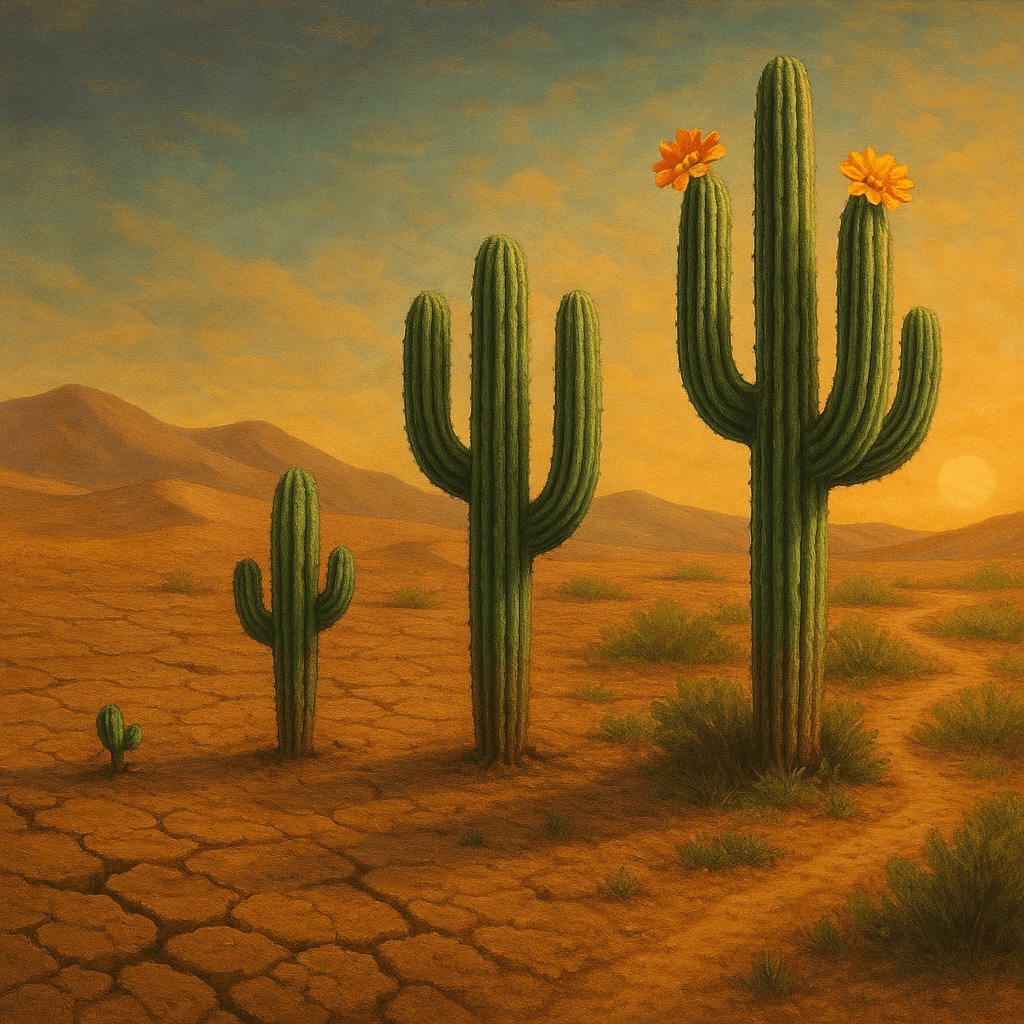
The cactus teaches us that with a little water and a lot of patience, we can thrive despite harsh surroundings. — Paulo Coelho
—What lingers after this line?
The Cactus as a Symbol of Endurance
Paulo Coelho’s metaphor draws upon the cactus, a plant celebrated for its ability to survive in the world’s most inhospitable landscapes. Enduring relentless sun, scarce rainfall, and arid soil, cacti adapt by conserving water and growing slowly. Their very existence reminds us that perseverance, even in the toughest circumstances, is possible if we are resourceful and patient.
Adapting to Challenging Environments
Building on this analogy, the cactus’s adaptations highlight the importance of flexibility in the face of adversity. Just as the cactus modifies its structure—growing thick skins and storing water—to suit desert life, people, too, must sometimes change their approaches or expectations when navigating hardships. This adaptive spirit often separates those who falter from those who overcome.
Patience as a Pathway to Success
Transitioning from resilience to virtue, Coelho emphasizes patience as fundamental to thriving. Cacti do not rush; they grow steadily, sometimes taking years to blossom. In human terms, this suggests that meaningful growth often requires sustained effort over long periods. The ancient proverb ‘Rome wasn’t built in a day’ echoes this truth, affirming that endurance and patience are vital to achievement.
Small Efforts Yield Significant Results
The minimal water required by cacti symbolizes how even small interventions, undertaken consistently, can produce remarkable outcomes over time. This notion is echoed in psychological studies, such as Angela Duckworth’s research on grit, which shows that persistent, modest actions often lead to the most rewarding accomplishments. In tough times, even the smallest step forward is meaningful.
Inspiration for Personal Growth
Ultimately, the cactus teaches us that our circumstances do not define our fate. By combining patience with resourcefulness and welcoming incremental progress, we can flourish even in the harshest environments. As Coelho’s words suggest, true thriving depends less on our surroundings and more on the quiet strength we cultivate within ourselves.
Recommended Reading
As an Amazon Associate, we earn from qualifying purchases.
One-minute reflection
What feeling does this quote bring up for you?
Related Quotes
6 selectedTurn setbacks into sketches for a stronger design. — Paulo Coelho
Paulo Coelho
Paulo Coelho’s line treats setbacks not as verdicts but as inputs—like rough marks on a page that later become structure. A sketch is imperfect by nature, yet it carries information: what doesn’t fit, what collapses, wha...
Read full interpretation →Turn obstacles into maps that point toward your next horizon. — Paulo Coelho
Paulo Coelho
Paulo Coelho’s line invites a fundamental shift in perspective: what blocks our way can also show us where to go next. Rather than treating difficulties as final verdicts, he suggests reading them as signposts.
Read full interpretation →Plant generosity in small places; watch resilience bloom in vast fields. — Helen Keller
Helen Keller
Helen Keller’s line frames generosity as something you cultivate deliberately, like planting seeds in overlooked corners of daily life. Instead of portraying resilience as a trait you simply “have,” she suggests it is a...
Read full interpretation →Instead of trying to return to how things were, build a flexible structure that can handle constant change. — Favor Mental Health
Favor Mental Health
The quote begins by challenging a common instinct: when life is disrupted, we often try to restore an earlier version of stability. Yet “how things were” is usually a moving target, shaped by circumstances that may not r...
Read full interpretation →Quietly cracking does not have to be your permanent state. — Dr. Sarah McQuaid
Dr. Sarah McQuaid
Dr. Sarah McQuaid’s line begins by giving language to a common but often invisible experience: feeling like you’re “quietly cracking.” It suggests a slow, internal strain—functioning on the outside while something splint...
Read full interpretation →The oak fought the wind and was broken, the willow bent when it must and survived. — Robert Jordan
Robert Jordan
At its heart, Robert Jordan’s line sets up a vivid contrast between two kinds of strength. The oak appears powerful because it resists, standing firm against the wind, yet that very stubbornness becomes its weakness.
Read full interpretation →More From Author
More from Paulo Coelho →Your 'yes' has no value until you learn to say 'no'. — Paulo Coelho
Paulo Coelho’s line hinges on a simple contrast: a “yes” only carries weight when an alternative is genuinely available. If you can’t—or won’t—say “no,” agreement becomes automatic rather than chosen, and it starts to re...
Read full interpretation →Dare to begin where fear says to stop; the first step redraws the map — Paulo Coelho
Paulo Coelho’s line treats fear less as a warning and more as a border we mistakenly accept as permanent. When fear says “stop,” it often isn’t pointing to actual danger; it’s signaling uncertainty, inexperience, or the...
Read full interpretation →Maybe the journey isn't so much about becoming anything. Maybe it's about un-becoming everything that isn't really you. — Paulo Coelho
Paulo Coelho’s line reframes personal growth as an act of subtraction. Instead of imagining the self as a project that must be upgraded with new traits, titles, or achievements, he suggests the deeper task is removing wh...
Read full interpretation →Freedom is not the absence of commitments, but the ability to choose what is best for me. — Paulo Coelho
Paulo Coelho’s line begins by overturning a common assumption: that freedom means having nothing tying you down. Instead, he frames freedom as a capacity—an inner authority to select what aligns with your well-being.
Read full interpretation →