
When It Is Dark Enough, You Can See The Stars - Ralph Waldo Emerson
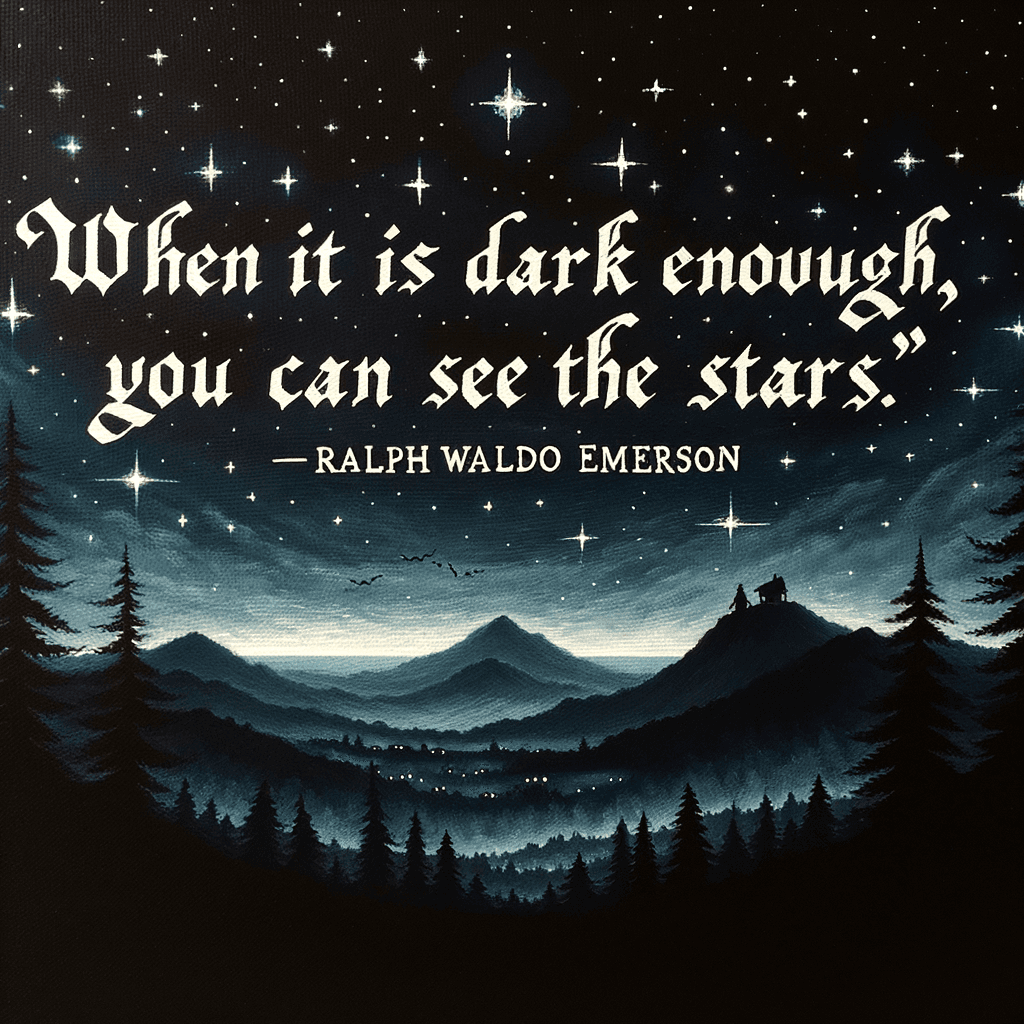
When it is dark enough, you can see the stars. - Ralph Waldo Emerson
—What lingers after this line?
Hope in Adversity
This quote suggests that during the darkest times in life, the most beautiful and hopeful things can become visible. Adversity often reveals opportunities or truths that are not apparent in better times.
Perspective on Challenges
It emphasizes that challenging situations can lead to moments of clarity and insight, much like stars are best seen against the dark night sky.
Optimism
The quote promotes an optimistic mindset, encouraging people to find the silver lining during difficult periods. It implies that even in the most trying times, there is something positive to be found.
Dependence on Context
This emphasizes the idea that certain positives (like stars) can only truly be appreciated when contrasted with their opposites (like darkness), showing how context and contrast are essential in understanding and valuing experiences.
Historical Context
Ralph Waldo Emerson, an American essayist, lecturer, and poet who led the transcendentalist movement in the mid-19th century, often wrote about nature and the human spirit. This quote reflects his philosophy that even in nature, great beauty and inspiration are often found in unexpected places.
Recommended Reading
As an Amazon Associate, we earn from qualifying purchases.
One-minute reflection
Where does this idea show up in your life right now?
Related Quotes
6 selectedInstead of trying to return to how things were, build a flexible structure that can handle constant change. — Favor Mental Health
Favor Mental Health
The quote begins by challenging a common instinct: when life is disrupted, we often try to restore an earlier version of stability. Yet “how things were” is usually a moving target, shaped by circumstances that may not r...
Read full interpretation →Quietly cracking does not have to be your permanent state. — Dr. Sarah McQuaid
Dr. Sarah McQuaid
Dr. Sarah McQuaid’s line begins by giving language to a common but often invisible experience: feeling like you’re “quietly cracking.” It suggests a slow, internal strain—functioning on the outside while something splint...
Read full interpretation →The oak fought the wind and was broken, the willow bent when it must and survived. — Robert Jordan
Robert Jordan
At its heart, Robert Jordan’s line sets up a vivid contrast between two kinds of strength. The oak appears powerful because it resists, standing firm against the wind, yet that very stubbornness becomes its weakness.
Read full interpretation →Some years ask you to survive before they ask you to dream. — Maggie Smith
Maggie Smith.
At its core, Maggie Smith’s line recognizes a painful truth: not every season of life is built for possibility. Some years demand endurance first, asking us to pay attention to basic emotional, financial, or physical sur...
Read full interpretation →There is hope, even when your brain tells you there isn't. — John Green
John Green
John Green’s line begins by acknowledging a familiar conflict: the mind can deliver convincing arguments for despair, yet hope can still exist alongside them. Rather than treating hope as a naïve feeling, he frames it as...
Read full interpretation →Plants and animals don't fight the winter; they don't pretend it's not happening. They prepare. They adapt. They perform extraordinary acts of metamorphosis to get through. — Katherine May
Katherine May
Katherine May frames winter as something the living world neither battles nor denies. Plants and animals don’t waste energy arguing with the season’s arrival; they accept its terms and respond accordingly.
Read full interpretation →More From Author
More from Ralph Waldo Emerson →The years teach much which the days never know. — Ralph Waldo Emerson
Emerson’s line points to a difference between living through moments and understanding what those moments mean. A single day can be full of activity—work completed, conversations had, problems solved—yet still leave us w...
Read full interpretation →The sky is the daily bread of the eyes. - Ralph Waldo Emerson
This quote suggests that the sky provides essential visual nourishment to our eyes, much like bread feeds our bodies. It emphasizes the importance of nature in our daily lives.
Read full interpretation →Do not go where the path may lead, go instead where there is no path and leave a trail. — Ralph Waldo Emerson
Emerson encourages individuals to forge their own paths rather than following the conventional routes. This promotes the idea of individualism and nonconformity, suggesting that personal success and fulfillment come from...
Read full interpretation →The sky is the daily bread of the eyes. - Ralph Waldo Emerson
This quote suggests that the sky, much like bread for the body, is essential for nourishing the soul and the senses. It highlights the importance of nature in our daily lives.
Read full interpretation →