
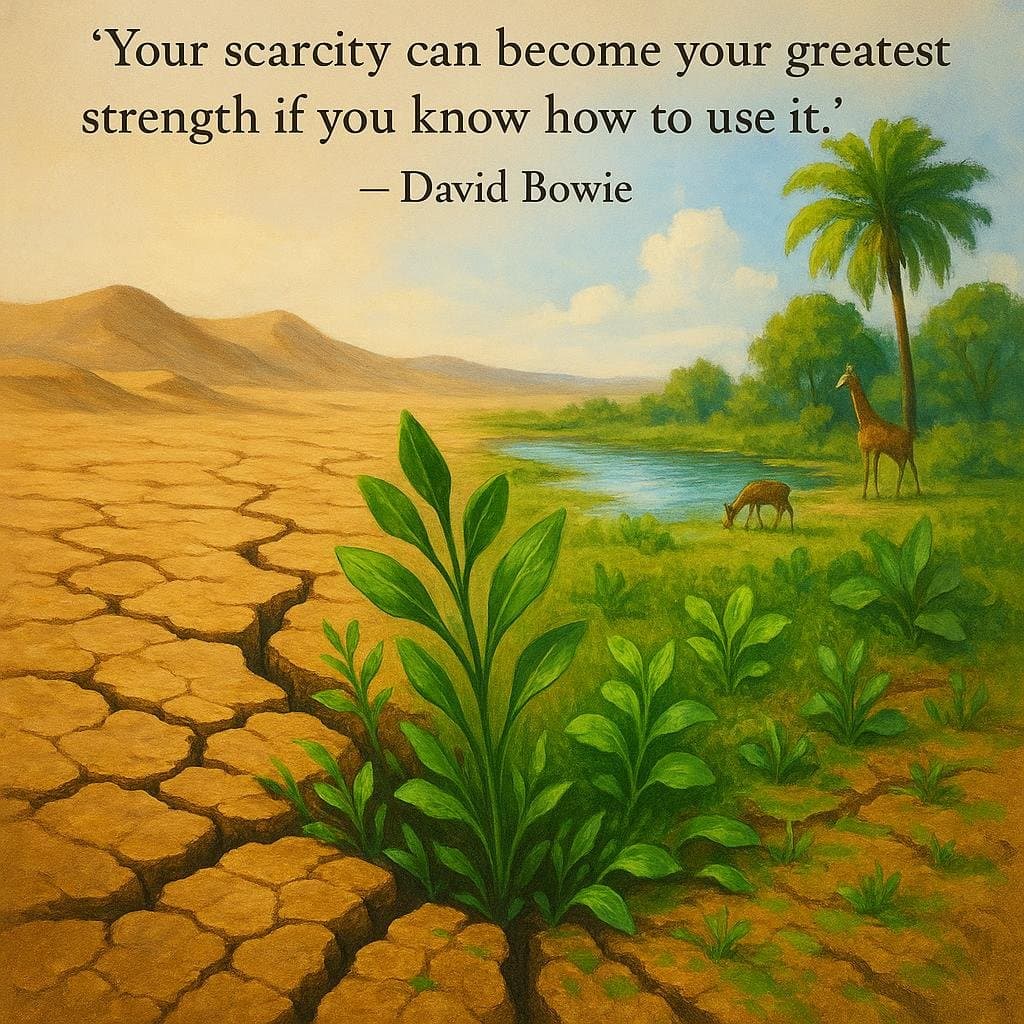
Your scarcity can become your greatest strength if you know how to use it. — David Bowie
—What lingers after this line?
Redefining Scarcity as Opportunity
David Bowie’s insight urges us to reconsider scarcity—not as a barrier, but as a unique asset. Most people view a lack of resources as an impediment, a source of frustration or inadequacy. However, Bowie advocates for a shift in perspective: by recognizing the hidden advantages within our limitations, we can transform them into stepping stones toward success.
Innovation Born from Constraints
This philosophy finds resonance throughout creative history, where constraints often inspire the most original solutions. For instance, in cinema, the low budget of 'Jaws' led Steven Spielberg to reveal the shark sparingly, which heightened suspense and ultimately became a hallmark of the film. Scarcity forced innovation, proving that limitations can fuel ingenuity when embraced.
Personal Growth Through Adversity
Building on this idea, the experience of working with scarcity fosters resilience and adaptability. In Viktor Frankl’s memoir, 'Man’s Search for Meaning' (1946), he reflects on how people facing extreme deprivation discover reserves of strength and creativity previously unknown. Thus, adversity becomes a crucible in which character and resourcefulness are forged.
Bowie’s Own Creative Journey
Transitioning to Bowie’s personal narrative, his early career was marked by limited opportunities and financial struggles. Rather than yielding to discouragement, Bowie channeled these experiences into his music and persona, crafting distinctive characters like Ziggy Stardust. His scarcity of mainstream acceptance drove him to innovate, becoming a defining trait of his artistic legacy.
Embracing Scarcity for Lasting Impact
Ultimately, harnessing scarcity involves a conscious decision to see limitations as possibilities. Whether in business, art, or personal development, those who approach scarcity as fertile ground for growth set themselves apart. By shifting our mindset from deficiency to potential, as Bowie suggests, we discover that lack can indeed be our most valuable strength.
One-minute reflection
What does this quote ask you to notice today?
Related Quotes
6 selectedTurn scarcity into a classroom; scarcity teaches creative abundance. — Paulo Coelho
Paulo Coelho
Coelho reframes scarcity from a sentence into a syllabus: when resources tighten, life becomes a classroom that forces attention, prioritization, and ingenuity. Instead of seeing lack as only deprivation, he suggests we...
Read full interpretation →The measure of who we are is what we do with what we have. — Vince Lombardi
Vince Lombardi
Vince Lombardi’s line shifts identity away from self-description and toward observable choice. Instead of asking who we are in theory—our intentions, labels, or ambitions—he points to what we actually do when faced with...
Read full interpretation →If the wind will not serve, take to the oars. — Publilius Syrus
Publilius Syrus
Publilius Syrus condenses a whole philosophy of agency into a sailor’s image: when the wind fails, you do not drift and complain—you row. The point is not that circumstances never matter, but that waiting for ideal condi...
Read full interpretation →Either I will find a way or I will make one. — Hannibal
Hannibal
Hannibal’s line is built on a stark refusal to accept paralysis: if a path already exists, he will locate it; if it doesn’t, he will construct it. The phrasing places responsibility squarely on the self, turning obstacle...
Read full interpretation →Turn the tools you have into bridges; small hands can cross wide gaps. — Helen Keller
Helen Keller
Helen Keller’s line begins with a subtle shift in perspective: tools are not merely objects for completing tasks, but potential bridges for reaching what once felt unreachable. A tool can be a book, a skill, a routine, a...
Read full interpretation →Refuse to wait for permission to make beauty from what you have. — Haruki Murakami
Haruki Murakami
Murakami’s line urges a quiet but radical defiance: stop waiting for someone else to authorize your creativity. Rather than treating institutions, experts, or distant gatekeepers as judges of what is worthy, he suggests...
Read full interpretation →More From Author
More from David Bowie →If you feel safe in the area you're working in, you're not working in the right area. — David Bowie
David Bowie’s remark reframes unease as a signal rather than a problem: if you feel completely safe, you may be repeating what you already know works. In that sense, “safe” can mean predictable—methods mastered, outcomes...
Read full interpretation →Go slightly out of your depth. When you don't feel that your feet are quite touching the bottom, you're just about in the right place to do something exciting. — David Bowie
David Bowie’s advice hinges on a counterintuitive claim: the sensation of being slightly unsteady is not a warning light but a compass. When your “feet” no longer touch the bottom, you’ve left the reassuring shallows of...
Read full interpretation →I don't know where I'm going from here, but I promise it won't be boring. — David Bowie
David Bowie’s line begins with a disarming admission: he doesn’t know what comes next. Yet instead of treating uncertainty as a weakness, he turns it into a stage—an open space where possibility can thrive.
Read full interpretation →Go out of your way to find the things that make you feel like a person. — David Bowie
Bowie’s line treats personhood less like a default state and more like something you must actively cultivate. “Go out of your way” implies effort, risk, and intention—suggesting that feeling fully alive doesn’t always ha...
Read full interpretation →