
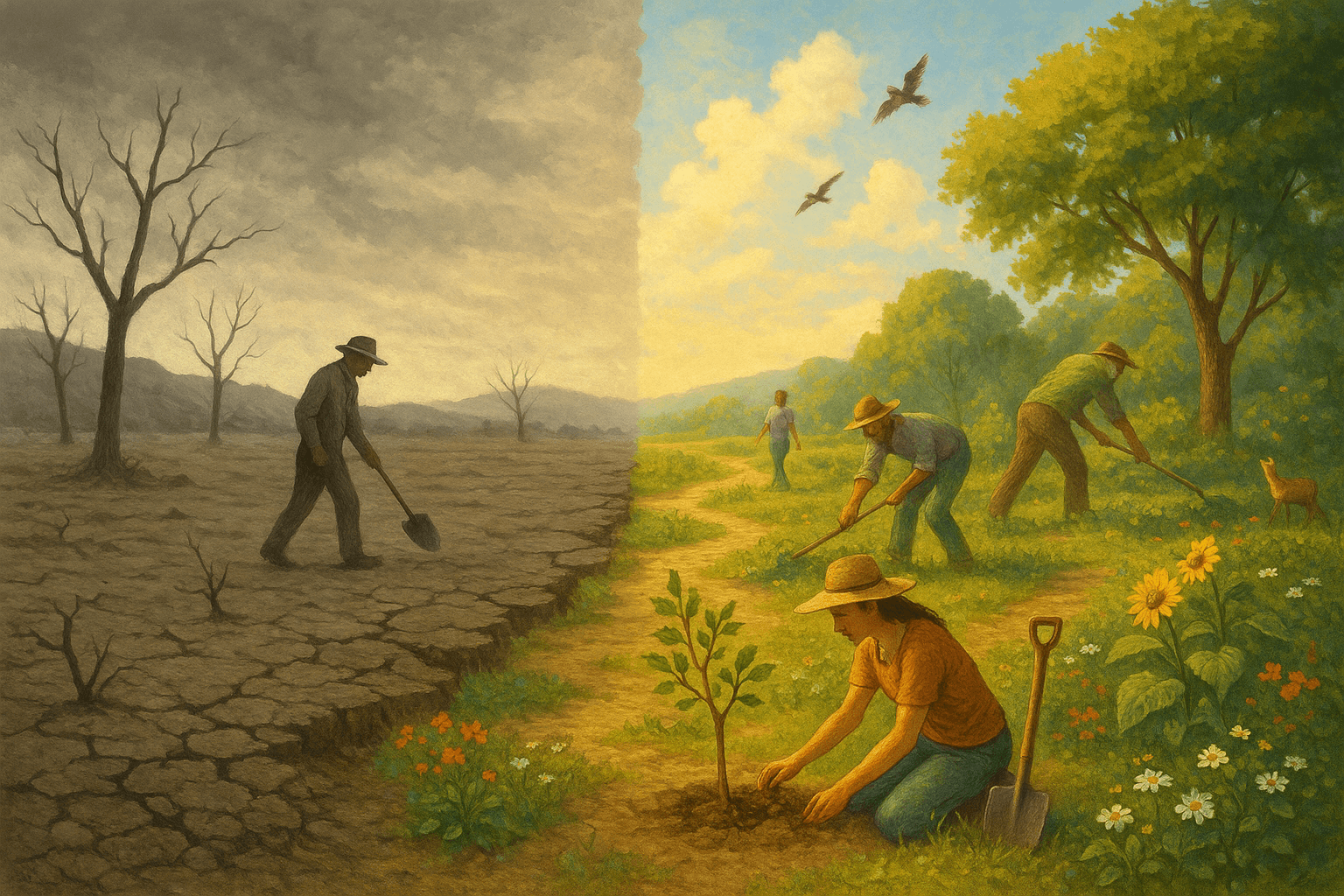
Without work, all life goes rotten. But when work is soulless, life stifles and dies. — Albert Camus
—What lingers after this line?
Camus on the Necessity of Work
Albert Camus, in this astute observation, pinpoints the essential nature of work in human existence. To him, work serves not just as a means of survival, but as a cornerstone of personal growth and purpose. Without productive engagement, Camus argues, our lives become stagnant—'rotten'—as inactivity saps vitality and erodes the sense of self that emerges from contribution and effort.
The Perils of Meaningless Labor
However, Camus’s insight does not paint all forms of work with the same brush. When labor becomes 'soulless,' stripped of meaning or connection to higher purpose, it ceases to nourish the spirit. Instead, it suffocates, stifling passion and hope, much like the existential crises explored in Camus's own novel, 'The Stranger' (1942), where the protagonist’s mechanical routines highlight the emptiness that can pervade daily tasks absent meaning.
Historical Views on Meaningful Occupation
Throughout history, thinkers have echoed this dual warning. For instance, Karl Marx critiqued industrial labor conditions in the 19th century, emphasizing how factory work alienated workers from the products of their labor and from themselves. This sense of alienation underlines Camus's conviction that meaningful, soulful work is essential to human well-being and dignity.
Psychological Consequences of Empty Work
Modern psychological research affirms Camus's distinction: studies show that engaging jobs boost well-being, while monotonous or disconnected work often results in burnout, depression, or a loss of motivation. For example, psychologist Mihaly Csikszentmihalyi’s work on flow highlights how meaningful challenge and purpose in tasks are crucial for flourishing. Without it, life’s energy withers, as Camus so poetically suggests.
Striving for a Balance in Today’s World
Recognizing this balance, societies and organizations today increasingly value purpose-driven missions and employee fulfillment. The rise of 'meaningful work' initiatives, flexible job roles, and opportunities for creativity reflect an understanding that vitality thrives when work connects to deeper human values. Ultimately, as Camus reminds us, to keep life vibrant and alive, our work must engage the heart as well as the hands.
One-minute reflection
Where does this idea show up in your life right now?
Related Quotes
6 selectedWork with your hands and heart; meaning will grow from the labor. — Albert Camus
Albert Camus
At first glance, the line credited to Camus distills his existential insight: meaning is not found, it is forged. In The Myth of Sisyphus (1942), he contends that life’s absurdity does not absolve us of action; rather, l...
Read full interpretation →Choose creation over complaint; meaning grows from what you build. — Albert Camus
Albert Camus
Camus begins with the absurd: a world that offers no final answers to our longing for meaning. Yet rather than collapse into complaint, he urges a turn toward deliberate making.
Read full interpretation →Choose to act with clear eyes; meaning grows from the work you do — Albert Camus
Albert Camus
Camus urges a stance of lucidity: to look at the world as it is, not as hope or fear would prefer. In The Myth of Sisyphus (1942), he calls this clarity the beginning of revolt, a refusal to dull the tension between huma...
Read full interpretation →It's always better to be exhausted from meaningful work than to be tired of doing nothing. — Marc and Angel Chernoff
Marc and Angel Chernoff
At its core, Marc and Angel Chernoff’s quote draws a sharp distinction between physical exhaustion and emotional stagnation. Being tired after meaningful work suggests that one’s energy has been invested in something val...
Read full interpretation →Don't worry about being successful but work toward being significant. If you do work that matters, the rest will follow. — Oprah Winfrey
Oprah Winfrey
Oprah Winfrey’s advice begins by shifting the goalpost. Instead of chasing “success,” a word often measured by status, money, or applause, she points to “significance,” which is measured by meaning and impact.
Read full interpretation →Slow productivity is not about doing less. It is about doing what matters with more intention. — Unknown
Unknown
The quote begins by challenging a common misunderstanding: “slow” sounds like “less,” as if productivity must shrink to become gentler. Instead, it reframes slowness as deliberateness—an approach where pace is chosen to...
Read full interpretation →More From Author
More from Albert Camus →You will never be able to experience everything. So, please, do poetical justice to your soul and simply experience yourself. — Albert Camus
Camus begins from a humbling truth: no person can live every possible life, see every landscape, or test every path. Because existence is finite, the dream of total experience becomes a source of restlessness rather than...
Read full interpretation →Peace is the only battle worth waging. — Albert Camus
At first glance, Camus frames peace through an apparent contradiction: a battle fought not for conquest, but to end the need for conquest itself. By calling peace the only struggle worth pursuing, he redirects human cour...
Read full interpretation →Sometimes carrying on, just carrying on, is the superhuman achievement. — Albert Camus
At first glance, Camus shifts the meaning of heroism away from grand victories and toward something far more ordinary: persistence. By saying that “just carrying on” can be a superhuman achievement, he honors the invisib...
Read full interpretation →In order to understand the world, one has to turn away from it on occasion. — Albert Camus
Camus’ line sounds contradictory at first: how can you understand the world by turning away from it? Yet the paradox points to a familiar truth—immersion can blur perception, while distance can sharpen it.
Read full interpretation →