
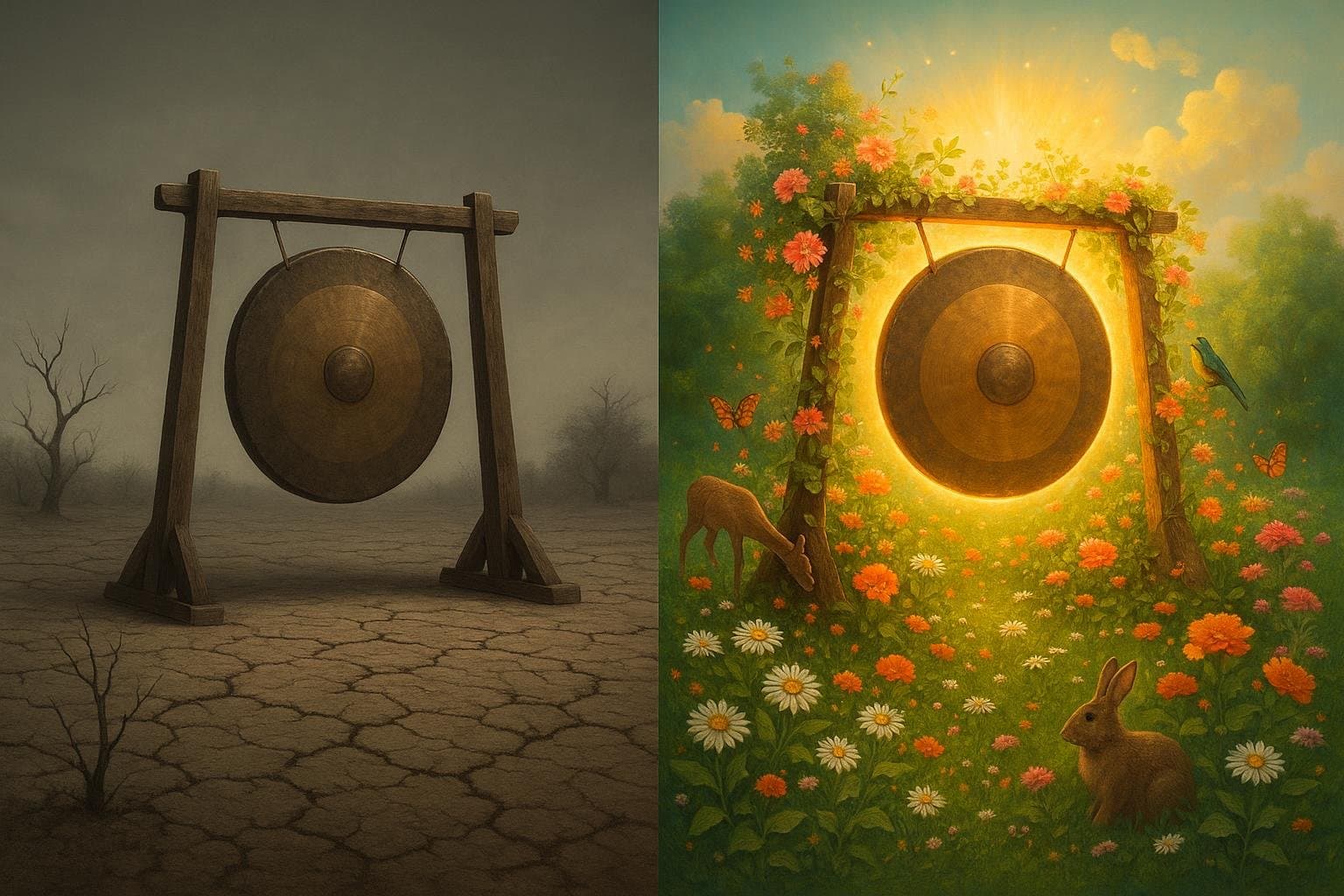
Without trust, words become the hollow sound of a wooden gong. With trust, words become life itself. — Buddha
—What lingers after this line?
The Resonance of Trust in Communication
At the very heart of the Buddha’s insight lies the powerful role of trust in shaping our communication. Words, he suggests, are not self-sufficient vessels of truth or connection; rather, their impact depends entirely on the presence of trust. Without it, our speech is reduced to noise—like the empty echo of a wooden gong—lacking substance or resonance in the listener’s heart.
Historical and Cultural Echoes
This concept does not exist in isolation; throughout history and across cultures, trust has been recognized as the cornerstone of meaningful dialogue. Confucius, for example, taught that a ruler without the trust of his people cannot govern justly (*Analects*, Book XII). Such wisdom reinforces the Buddha’s metaphor, illustrating that trust lends weight and deeper significance to our words, shaping society itself.
From Noise to Nourishment: The Power of Trust
Moving forward, the analogy becomes ever more vivid: without trust, words are as lifeless as an empty instrument, while with trust, they nourish and inspire—‘life itself.’ This transformation can be seen daily in relationships: confessions, promises, or reassurances only soothe anxiety or cultivate joy if the listener trusts the speaker. Otherwise, these utterances ring hollow, failing to achieve their intention.
Modern Lessons in Leadership and Collaboration
In contemporary contexts, effective leadership and collaboration also rest on this principle. Consider high-performing teams in business or sports: their communication thrives on a foundation of mutual trust. Stephen Covey, in *The Speed of Trust* (2006), notes that trust is the engine of efficiency; where trust exists, information flows freely and cooperation flourishes, turning words into catalysts for real-world action.
Building Enduring Trust Through Actions
Finally, the journey from hollow utterances to life-giving words hinges on shared integrity and reliability. As relationships mature, consistency between word and deed is crucial for trust to take root. This eternal lesson, captured so succinctly in the Buddha’s quote, invites each of us to reflect: when we strive to embody what we say, our words transcend mere sound, forging authentic human connection.
Recommended Reading
As an Amazon Associate, we earn from qualifying purchases.
One-minute reflection
Where does this idea show up in your life right now?
Related Quotes
6 selectedThe merit of originality is not novelty; it is sincerity. — Thomas Carlyle
Thomas Carlyle
At first glance, Carlyle overturns a common assumption: that originality means producing something no one has ever seen before. Instead, he argues that the true value of original work lies in sincerity—the honest express...
Read full interpretation →A garden is a grand teacher. It teaches patience and careful watchfulness; it teaches industry and thrift; above all it teaches entire trust. — Gertrude Jekyll
Gertrude Jekyll
Gertrude Jekyll presents the garden not merely as a decorative space but as a living instructor. From the opening phrase, she elevates cultivation into education, suggesting that soil, weather, and seasons quietly shape...
Read full interpretation →There is a peace that comes from trusting the timing of your life. — Sonia Ricotti
Sonia Ricotti
At its heart, Sonia Ricotti’s line suggests that peace does not always come from controlling outcomes, but from releasing the demand to force them. Trusting the timing of your life means accepting that not every door ope...
Read full interpretation →The most important work is not the transmission of information, but the cultivation of habits of attention, conversation, and trust. — Laurie Santos
Laurie Santos
At first glance, Laurie Santos’s statement seems to downplay information itself, yet her deeper point is that facts alone rarely transform people. Knowledge can be delivered quickly, but the conditions that make it meani...
Read full interpretation →You don't need to have it all figured out to move forward. Sometimes you just need to trust the next step. — Susan Gale
Susan Gale
Susan Gale’s quote gently challenges the belief that action must wait for perfect understanding. At first glance, many people assume they need a complete plan before making a change, yet life rarely offers that kind of c...
Read full interpretation →You don't always need a plan. Sometimes you just need to breathe, trust, let go and see what happens. — Mandy Hale
Mandy Hale
Mandy Hale’s quote begins by challenging a modern reflex: the belief that every meaningful step must be mapped in advance. Instead, she proposes that there are moments when planning becomes a form of fear, disguising anx...
Read full interpretation →More From Author
More from Buddha →To keep the body in good health is a duty, otherwise we shall not be able to keep our mind strong and clear. — Buddha
At its core, this saying presents physical care not as vanity or indulgence, but as a duty. The body is treated as the necessary ground on which mental clarity stands, so neglecting it becomes more than a personal lapse—...
Read full interpretation →However many holy words you read, however many you speak, what good will they do you if you do not act upon them? — Buddha
Buddha’s question cuts through spiritual comfort by shifting attention from what we consume—holy texts and pious speech—to what we embody. Reading and reciting can feel like progress because they are visible and repeatab...
Read full interpretation →Better than a thousand hollow words, is one word that brings peace. — Buddha
Buddha’s saying begins with a simple comparison: quantity versus consequence. A thousand words can impress, distract, or even manipulate, yet still remain “hollow” if they do not reduce suffering or clarify the mind.
Read full interpretation →The way is not in the sky. The way is in the heart. — Buddha
Buddha’s line redirects spiritual seeking away from distant, external places—“the sky”—and toward the intimate terrain of lived experience. Instead of imagining truth as something hidden in the heavens or guarded by spec...
Read full interpretation →