
Transforming Fear of the Future Through Hope
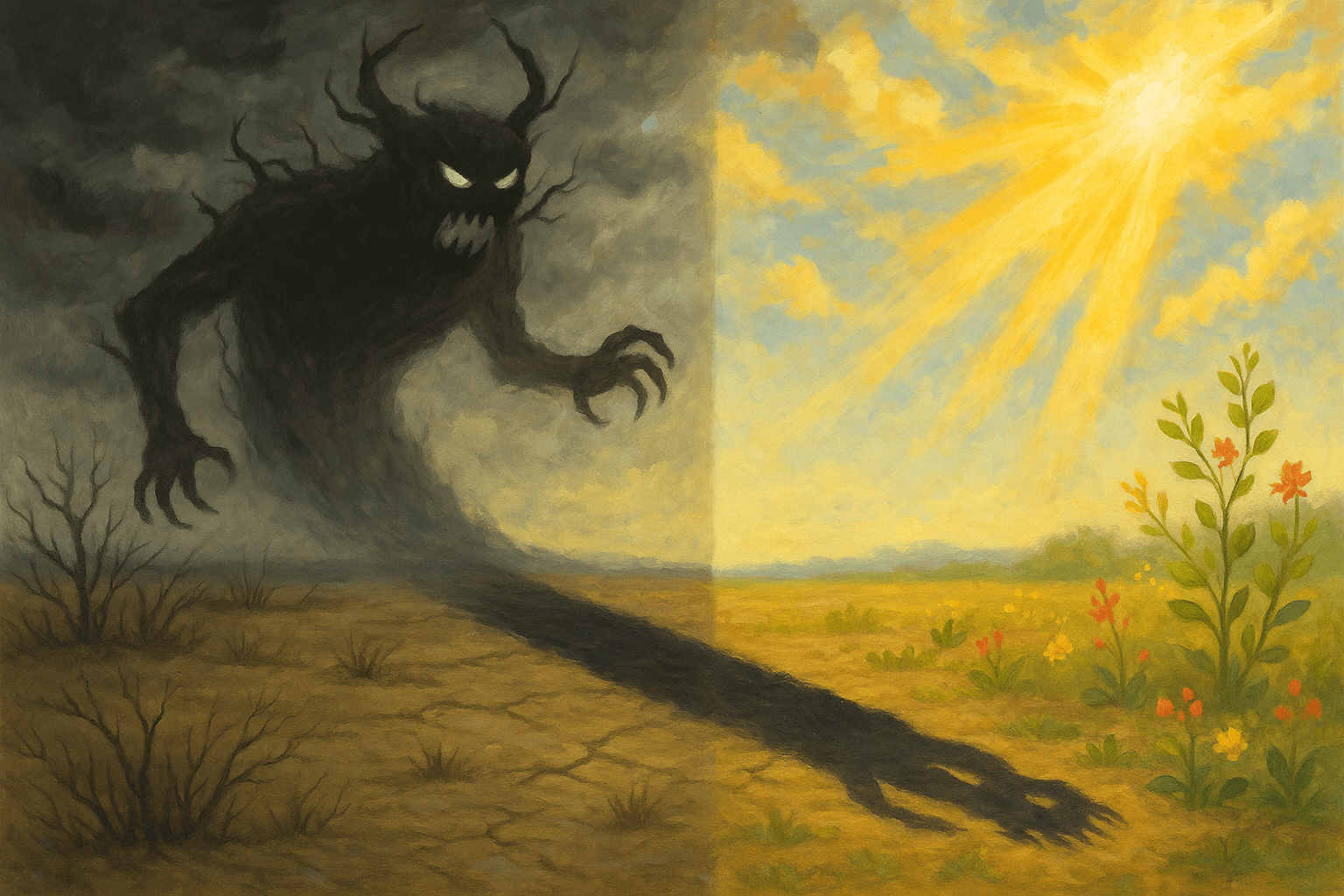
When fear makes a monster of the future, hope turns it back into a shadow. — African Proverb
—What lingers after this line?
Fear’s Tendency to Magnify Uncertainty
This African proverb begins by acknowledging a universal truth: when we peer into the unknown, fear can distort possibilities into menacing threats. The future, inherently uncertain, becomes monstrous in our imagination when dread takes hold. Whether facing personal challenges or broader societal change, individuals often find themselves paralyzed, their anxieties amplifying what lies ahead into something seemingly insurmountable.
The Power of Hope to Reframe Perception
However, the proverb quickly introduces hope as an antidote. Where fear conjures monsters, hope transforms them into mere shadows—present but lacking substance. This transition reveals hope’s ability to shift perception, offering a sense of agency and optimism. Biblical narratives, such as the story of David and Goliath (1 Samuel 17), display this dynamic: while others saw a giant, David’s hope recast Goliath as a defeatable foe.
Cultural Roots of the Proverbial Wisdom
African oral traditions are rich in proverbs that counsel resilience and pragmatic courage. In many cultures across the continent, stories use imagery—like monsters and shadows—to depict emotional realities. These tales serve not only to caution but also to encourage, reminding listeners that the monstrous is often a product of perception, while shadows, though intimidating, cannot do lasting harm.
Psychological Insights Into Hope’s Effect
Modern psychology supports the proverb’s wisdom. Studies in cognitive behavioral therapy (Judith S. Beck, 2011) highlight how catastrophic thinking can inflate imagined futures. Conversely, nurturing hope fosters adaptive coping strategies, shrinking fears to manageable proportions. In essence, hope equips individuals to see challenges as less terrifying, resembling mere shadows rather than overwhelming monsters.
Navigating the Future With Courage and Balance
Bringing these ideas together, the proverb invites us to approach the future with both awareness and optimism. While fear may never fully disappear, recognizing its distorting power enables us to consciously invoke hope. By doing so, we maintain perspective and regain control, ensuring that our journey forward remains guided by courage rather than haunted by exaggerated apprehensions.
Recommended Reading
As an Amazon Associate, we earn from qualifying purchases.
One-minute reflection
What feeling does this quote bring up for you?
Related Quotes
6 selectedCarve out a tomorrow that cleanses today of its sorrows. — African Proverb
African Proverb
This proverb encourages maintaining a hopeful perspective for the future, suggesting that a brighter and more positive tomorrow can heal the pains and sorrows of today.
Read full interpretation →No matter how long the night, the day is sure to come. — African Proverb
African Proverb
This proverb conveys the message that difficult or dark times, symbolized by the night, will eventually pass, and brighter, better days (the day) are inevitable. It encourages holding onto hope, no matter how long the st...
Read full interpretation →In the darkness, there is always a ray of light; that is hope.
Unknown
This quote highlights the idea that no matter how challenging or dire a situation may seem, there is always a glimmer of hope. Hope acts as a guiding light during dark times.
Read full interpretation →Hope is a star in the darkness, illuminating the path ahead when you need it most. Every fall and every drop of sweat contribute to the crowning of ultimate victory. As long as you have dreams in your heart, you will have strength under your feet.
Unknown
This metaphor compares hope to a star that provides light in dark times. It implies that hope helps to navigate through challenges by offering direction and clarity.
Read full interpretation →Some years ask you to survive before they ask you to dream. — Maggie Smith
Maggie Smith.
At its core, Maggie Smith’s line recognizes a painful truth: not every season of life is built for possibility. Some years demand endurance first, asking us to pay attention to basic emotional, financial, or physical sur...
Read full interpretation →There is hope, even when your brain tells you there isn't. — John Green
John Green
John Green’s line begins by acknowledging a familiar conflict: the mind can deliver convincing arguments for despair, yet hope can still exist alongside them. Rather than treating hope as a naïve feeling, he frames it as...
Read full interpretation →More From Author
More from African Proverb →When the roots are deep, there is no reason to fear the wind. — African Proverb
The proverb frames life as weather and character as a tree: when roots run deep, wind becomes something to endure rather than something to dread. In that image, fear is not denied so much as put in its place—storms still...
Read full interpretation →The closer one comes to truth, the simpler everything becomes. — African Proverb
The proverb suggests that truth has a clarifying power: as you approach what is real, the extra clutter—misdirection, anxiety, and needless complication—falls away. In other words, complexity often signals that we are st...
Read full interpretation →The sun does not hurry to rise, yet it never misses its mark. — African Proverb
The proverb begins with an image so familiar it’s easy to overlook: sunrise. The sun appears without strain, without haste, and without visible anxiety about being “on time.” And yet, day after day, it arrives.
Read full interpretation →Do not look where you fell, but where you slipped. — African Proverb
The proverb urges a subtle but powerful change in attention: don’t fixate on the place where you landed in pain or embarrassment; instead, examine the moment your footing first failed. In other words, the visible setback...
Read full interpretation →