
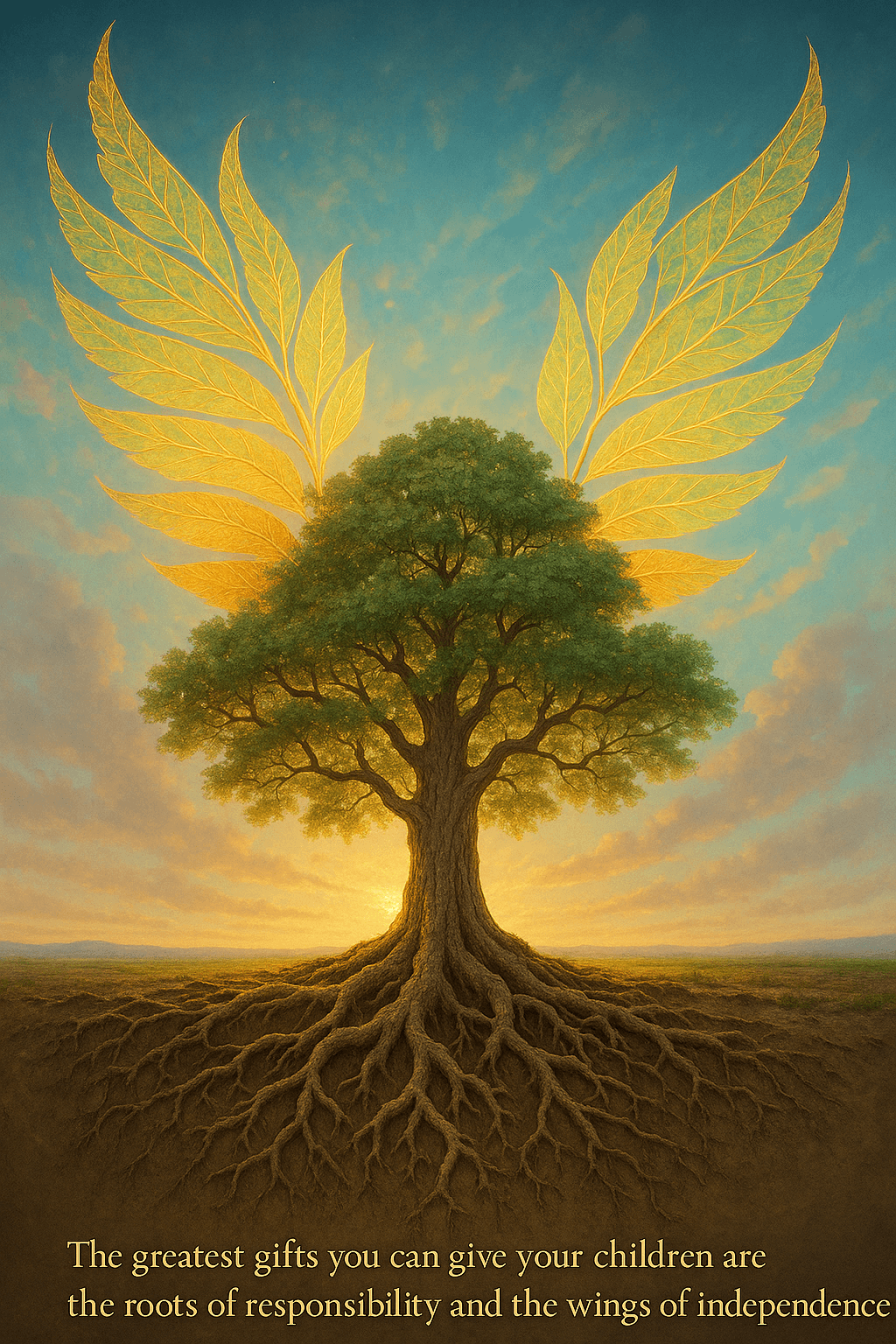
The greatest gifts you can give your children are the roots of responsibility and the wings of independence. — Denis Waitley
—What lingers after this line?
Gifts Beyond Material Possessions
Denis Waitley’s quote prompts us to reconsider what truly benefits children in the long run. While toys and material comforts may bring temporary joy, foundational qualities—responsibility and independence—endure throughout life. These are intangible gifts that shape character, enabling children to thrive amid life’s challenges. Just as the ancient proverb, 'Give a man a fish, and you feed him for a day. Teach a man to fish, and you feed him for a lifetime,' suggests, investing in personal growth leaves a lasting legacy.
Instilling Responsibility: The Role of Roots
Responsibility serves as the 'roots' that ground a child, providing stability and a sense of accountability. Parents and educators can nurture this by assigning age-appropriate tasks, modeling ethical behavior, and allowing natural consequences. For example, Maria Montessori’s educational philosophy (early 20th century) emphasized giving children meaningful roles within their environments, fostering self-discipline and social awareness. By developing these roots, children learn to make decisions based on values and reliability.
Encouraging Independence: Growing Wings
Balanced with responsibility, independence—the 'wings'—empowers children to explore, create, and stand confidently on their own. Allowing children to try new things, sometimes fail, and encouraging problem-solving builds resilience. Psychologist Erik Erikson’s stages of psychosocial development describe how, during early childhood, autonomy must be fostered to avoid doubt and shame. As children gain trust in their capabilities, they are more likely to take healthy risks and pursue their unique passions.
Balancing Guidance and Freedom
Transitioning from roots to wings is a delicate balancing act for caregivers. Too much control can stifle independence; too little guidance can leave children unmoored. Parenting experts like Diane Baumrind (1960s) contend that authoritative parenting, which combines warmth with clear expectations, most effectively cultivates both responsibility and independence. This approach allows children to feel secure while also empowering them to venture outward.
The Lifelong Impact of Roots and Wings
Ultimately, gifting children both roots and wings prepares them to face adulthood with confidence and integrity. As they become responsible and independent adults, they contribute positively to their communities—echoing Waitley’s wisdom long after childhood. This thoughtful balance doesn’t just benefit individuals; it strengthens families and societies for generations, embodying the true spirit of enduring parental love.
One-minute reflection
What does this quote ask you to notice today?
Related Quotes
6 selectedLet us not seek the Republican answer or the Democratic answer, but the right answer. Let us not seek to fix blame for the past. Let us accept our own responsibility for the future. — John F. Kennedy
John F. Kennedy
At its core, John F. Kennedy’s statement urges citizens to rise above partisan identity and focus on what is genuinely right.
Read full interpretation →Stop begging God to increase your territory when you can't even maintain the territory you already have. — Iyanla Vanzant
Iyanla Vanzant
At its core, Iyanla Vanzant’s statement confronts a common contradiction: people often ask for more influence, wealth, opportunity, or responsibility before proving they can care for what is already in their hands. In th...
Read full interpretation →Listen, smile, agree, and then do whatever you were gonna do anyway. — Robert Downey Jr.
Robert Downey Jr.
At first glance, Robert Downey Jr.’s line sounds like pure mischief: listen politely, offer a pleasant smile, nod along, and then proceed with your own plan. Yet beneath the humor lies a sharp observation about human beh...
Read full interpretation →True independence of mind is not found in the noise of the world, but in the quietude of our own judgment. — André Gide
André Gide
At first glance, André Gide’s remark separates two kinds of freedom: the noisy freedom of reacting to the world and the deeper freedom of thinking for oneself. He suggests that real independence is not won by speaking th...
Read full interpretation →The more you love your decisions, the less you need others to love them. — Maxime Lagacé
Maxime Lagace
Maxime Lagacé’s quote begins with a simple but powerful reversal: the more deeply you stand behind your own decisions, the less dependent you become on outside validation. In other words, confidence is not merely a perso...
Read full interpretation →Caretake this moment. Immerse yourself in its particulars. Respond to this person, this challenge, this deed. Quit evasions. — Marcus Aurelius
Marcus Aurelius
At its core, Marcus Aurelius urges us to stop drifting into abstraction and to meet reality as it stands. In his Meditations (c.
Read full interpretation →More From Author
More from Denis Waitley →You must look within for value but must look beyond for perspective. — Denis Waitley
Denis Waitley’s line rests on a subtle but powerful balance: value is something we discover inwardly, while perspective is something we gain by looking outward. In other words, self-worth cannot be borrowed from applause...
Read full interpretation →When you are hit with life-disrupting events, you either cope or you crumble; you become better or bitter; you emerge stronger or weaker. — Denis Waitley
Denis Waitley frames disruption not merely as misfortune, but as a decisive turning point. When life is shaken by loss, failure, illness, or betrayal, ordinary habits no longer suffice, and character is tested in motion.
Read full interpretation →Chase your passion, not your pension. — Denis Waitley
This quote emphasizes the significance of pursuing what you truly love rather than focusing solely on financial security. It suggests that true happiness comes from following your passions.
Read full interpretation →You must welcome change as the rule but not as your ruler. — Denis Waitley
The quote suggests that change is a natural and inevitable part of life, and we should accept it as a constant force. Resistance can lead to stagnation, while openness to change allows for growth and progress.
Read full interpretation →