
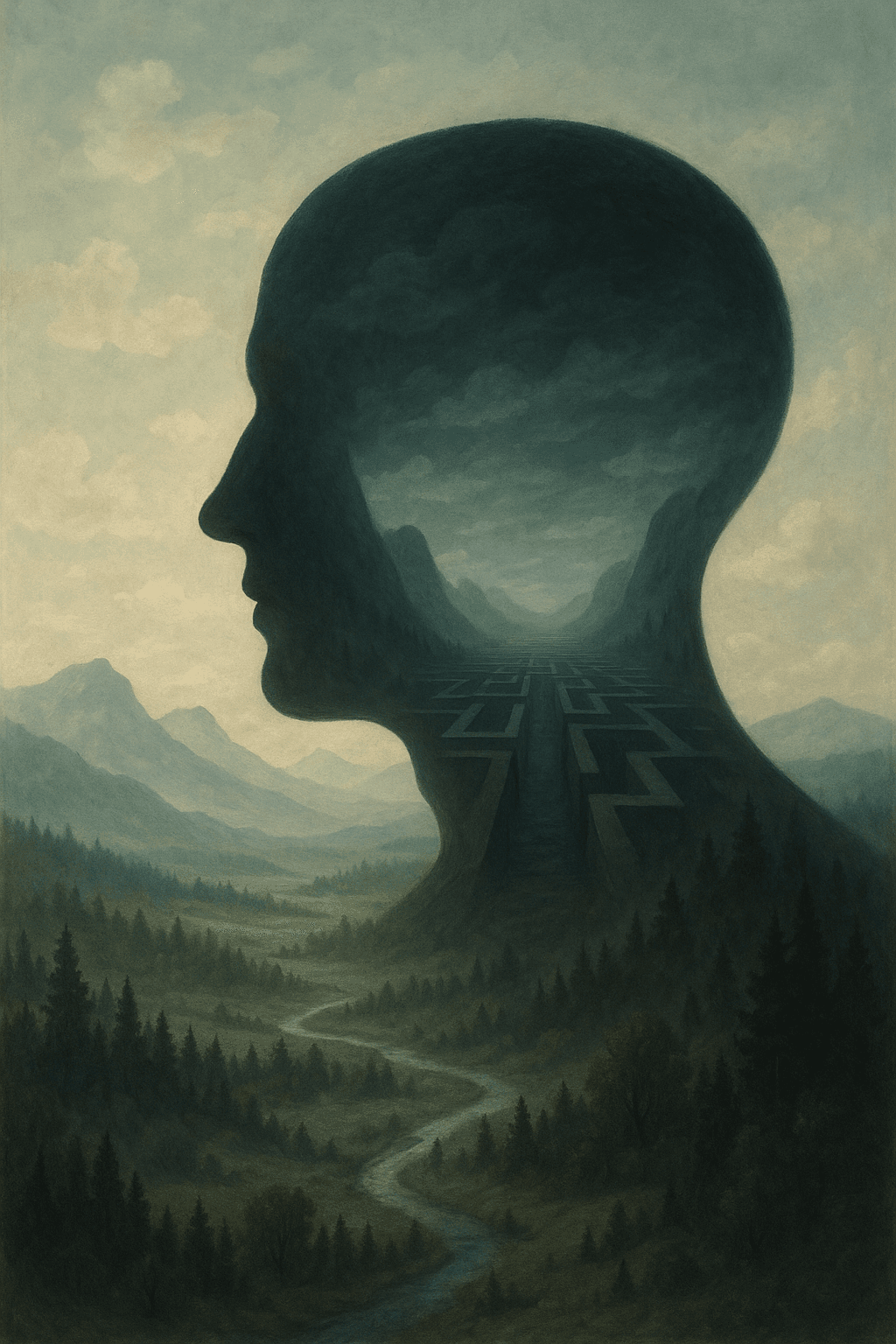
The farthest distance in the world is distance in your mind. — Miyamoto Musashi
—What lingers after this line?
Musashi’s Insight Into Internal Obstacles
Miyamoto Musashi’s assertion that 'the farthest distance in the world is distance in your mind' prompts us to reconsider the concept of separation. Rather than physical miles or geographic boundaries, Musashi draws attention to the invisible yet formidable chasms within ourselves—our doubts, fears, and misconceptions. This notion echoes throughout his treatise, The Book of Five Rings (1645), where mastery over the mind is positioned as the starting point for mastery in all things.
How Mental Barriers Can Eclipse Physical Limits
Delving deeper, it's evident that the mind’s divisions often dwarf any material separation. For example, two people can share the same room yet remain worlds apart due to unspoken grievances or misunderstanding. Similarly, an individual’s aspirations may feel unattainable, not because of circumstance, but due to self-imposed limitations. As Viktor Frankl recounts in 'Man’s Search for Meaning' (1946), the barriers of the psyche can dictate the boundaries of human experience, regardless of external conditions.
Historical Echoes Across Cultures
Across centuries and cultures, sages have observed that the mind’s divides are the most formidable. Buddhists, for instance, describe 'dualistic thinking' as the source of suffering, with enlightenment requiring a collapse of inner divides. Likewise, Plato’s allegory of the cave illustrates how perception can imprison us more tightly than physical shackles, suggesting that liberation begins with challenging mental assumptions.
Modern Psychology and the Internal Gap
Transitioning to contemporary psychology, the idea persists that mental barriers shape our reality. Carol Dweck’s research on mindset demonstrates how fixed beliefs about ability can prevent personal growth, regardless of actual talent or opportunity. Her studies reveal that adopting a 'growth mindset'—the belief that change is possible—can transform the internal distance into a bridge, empowering individuals to overcome what once seemed insurmountable.
Bridging the Distance: The Path to Unity
Ultimately, to bridge this profound distance requires self-awareness and courage. Musashi’s life exemplified this journey: through martial discipline and introspection, he strove to conquer not only external opponents but his own inner divides. By confronting our mental separations, we too can diminish the farthest distance in the world, finding greater connection both within ourselves and with others—an ongoing process of unification that redefines our relationships with both self and world.
One-minute reflection
What feeling does this quote bring up for you?
Related Quotes
6 selectedThere is hope, even when your brain tells you there isn't. — John Green
John Green
John Green’s line begins by acknowledging a familiar conflict: the mind can deliver convincing arguments for despair, yet hope can still exist alongside them. Rather than treating hope as a naïve feeling, he frames it as...
Read full interpretation →Let your hands answer the questions your doubts raise. — Søren Kierkegaard
Søren Kierkegaard
Kierkegaard compresses an existential method into a single imperative: when thought multiplies uncertainties, embodied action brings clarity. He contends that excessive reflection spins into paralysis, while decisions cr...
Read full interpretation →Stand where you are and turn your doubts into the ground for courage to grow. — Seamus Heaney
Seamus Heaney
Heaney’s imperative to “stand where you are” reframes courage as composure before motion. Instead of scrambling for escape or certainty, he invites a pause that gathers scattered attention back into the body—feet planted...
Read full interpretation →The only limit to our realization of tomorrow will be our doubts of today. - Franklin D. Roosevelt
Franklin D. Roosevelt
This quote suggests that doubt is a significant barrier to achieving future goals. It emphasizes how our own uncertainties and lack of confidence can prevent us from realizing our full potential.
Read full interpretation →The only limit to our realization of tomorrow is our doubts of today. - Franklin D. Roosevelt
Franklin D. Roosevelt
This quote suggests that our doubts can significantly hinder our potential and progress. If we let our uncertainties dominate, they become the primary obstacles to achieving our future goals.
Read full interpretation →Doubt kills more dreams than failure ever will. — Suzy Kassem
Suzy Kassem
This quote highlights how doubt can prevent individuals from even attempting to reach their dreams. The fear and uncertainty that come with doubt can paralyze actions and decisions, stopping potential achievements before...
Read full interpretation →More From Author
More from Miyamoto Musashi →There is nothing outside of yourself that can ever enable you to get better, stronger, richer, or smarter. — Miyamoto Musashi
Miyamoto Musashi’s line begins by stripping away a common hope: that some external thing—money, teachers, circumstances, even luck—will finally “enable” a person to improve. Instead, he argues that the decisive source of...
Read full interpretation →Today is victory over yourself of yesterday; tomorrow is your victory over lesser men. — Miyamoto Musashi
Musashi’s line opens by redefining “victory” as an inward contest rather than a public spectacle. Instead of measuring success by applause, rank, or trophies, he points to a quieter benchmark: whether you are stronger, w...
Read full interpretation →You must train day and night in order to make decisions. — Miyamoto Musashi
Miyamoto Musashi’s line compresses a lifetime of martial experience into a single principle: sound decisions are not improvised—they are earned. When he says you must train “day and night,” he points to a kind of prepara...
Read full interpretation →Do nothing which is of no use. — Miyamoto Musashi
Miyamoto Musashi’s line, “Do nothing which is of no use,” reads like a blunt filter for everyday life: if an action doesn’t serve a real aim, drop it. Rather than celebrating busyness, he points to a stricter standard—us...
Read full interpretation →