
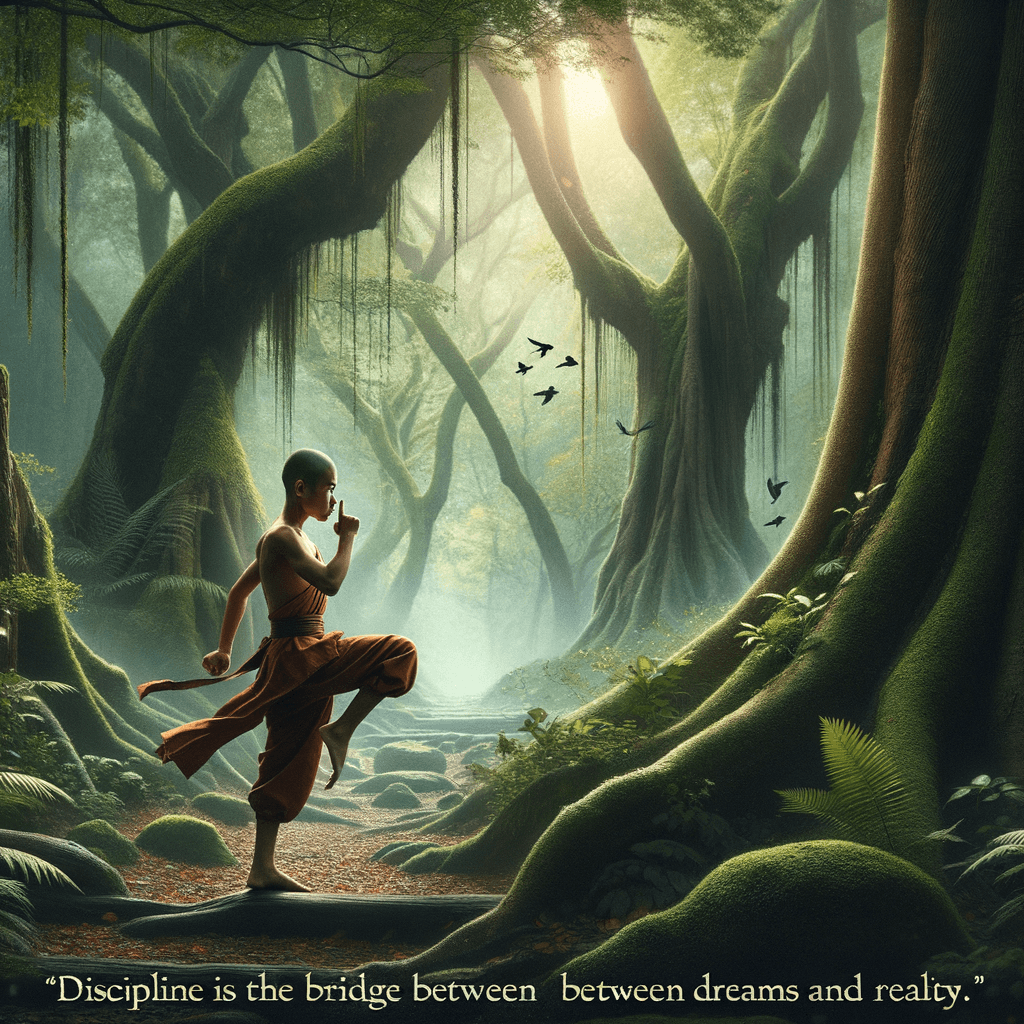
In the heart of the forest, where the trees whisper ancient secrets, a young monk practiced his steps. Each morning, he ran a path known only to him, a journey of solitude and discovery. Discipline, his master had said, is the bridge between dreams and reality. With every step, the forest echoed his silent mantra: Strength in stillness, power in peace. Birds sang his praises, leaves danced in harmony, and the earth felt his determination. In nature's embrace, he found the essence of life, the truth of existence, and the unwavering spirit of perseverance.
—What lingers after this line?
Solitude and Self-Discovery
The young monk's solitary runs through the forest symbolize a personal journey of self-discovery. Away from the distractions of society, he finds clarity and insight within himself.
Nature as a Teacher
The forest, with its whispering trees and harmonious environment, acts as a mentor to the monk. Nature provides lessons in tranquility, patience, and balance, contributing to his spiritual growth.
Discipline and Determination
The monk's disciplined running routine reflects his commitment to transforming dreams into reality. His master's words highlight the importance of perseverance and practice in achieving one's goals.
Strength in Stillness
The mantra 'Strength in stillness, power in peace' emphasizes the idea that true strength comes from inner calm and quiet confidence, rather than outward displays of force.
Harmony with Nature
The imagery of birds singing his praises and leaves dancing in harmony suggests a deep connection with nature. It indicates that his presence and actions are in sync with the natural world, fostering a sense of unity and peace.
Essence of Life and Perseverance
In his interactions with the forest, the monk discovers fundamental truths about life and existence. His unwavering spirit of perseverance is nurtured by his immersive experience in nature, shaping his understanding and approach to life's challenges.
One-minute reflection
What feeling does this quote bring up for you?
Related Quotes
6 selectedEmbrace each challenge as a stepping stone, for it is through the moments of struggle that we uncover our true strength and illuminate the path to our brightest triumphs.
Unknown
This quote encourages individuals to view challenges not as obstacles but as opportunities for personal growth. Each struggle is a chance to develop resilience and discover inner strength.
Read full interpretation →Quiet people are not empty; they are contained. Their power does not seek attention—it waits. — Seneca
Seneca
At first glance, Seneca’s line overturns a common social assumption: that quietness signals absence, weakness, or lack of thought. Instead, he frames silence as containment, suggesting that some people hold their ideas,...
Read full interpretation →A magician is strong because he hurts more than others. He has learned to break the world that has tried to break him. — Haruki Murakami
Haruki Murakami
Murakami’s line begins with a striking reversal: the magician is not powerful because he is untouched, but because he has suffered more deeply than others. In this view, strength does not emerge from comfort; rather, it...
Read full interpretation →True confidence, like deep rivers, flows calmly and silently without the need for continual recognition. — Unknown (Wait: Skipping) -> My limits are not a debate. — Unknown (Wait: Skipping) -> Never bend your head. Always hold it high. Look the world straight in the eye. — Helen Keller
Helen Keller
Helen Keller’s line begins with a physical image, yet it quickly opens into a moral one: to hold one’s head high is to move through the world with unshaken self-respect. In that sense, true confidence does not beg for ap...
Read full interpretation →What you don't react to reveals your strength. — Thibaut
Thibaut
At first glance, Thibaut’s line shifts our attention away from dramatic action and toward restraint. Strength, in this view, is not proven only by what we confront loudly, but by what we decline to let disturb us.
Read full interpretation →True cultivation is a slow, private process that eventually blooms into a public strength. — Anne Lamott
Anne Lamott
At first glance, Anne Lamott’s line emphasizes a truth people often resist: meaningful self-development rarely looks dramatic while it is happening. True cultivation unfolds quietly, in habits, reflection, restraint, and...
Read full interpretation →More From Author
More from Unknown →The language is the substrate. The architecture is the contract.
The line sets up a deliberate pairing: language lies beneath everything, while architecture governs everything above it. In other words, what you can express determines what you can build, and what you commit to structur...
Read full interpretation →A scroll is not a break; it is a trap disguised as rest. — Unknown
The quote begins by challenging a familiar story we tell ourselves: that a brief scroll is a harmless pause between tasks. On the surface, it looks like recovery—no effort, no decision, no commitment.
Read full interpretation →Don't let your ice cream melt while you're counting someone else's sprinkles. — Unknown
The quote uses ice cream as a simple stand-in for life’s fleeting pleasures: what you have is delicious, but it won’t last forever if you ignore it. Meanwhile, “counting someone else’s sprinkles” captures the habit of mo...
Read full interpretation →If your absence doesn't affect them, your presence never mattered. — Unknown
The quote frames absence as a revealing experiment: remove yourself, and the reaction—concern, curiosity, indifference—becomes a kind of data. If nothing changes when you’re gone, it suggests your role was never integrat...
Read full interpretation →