
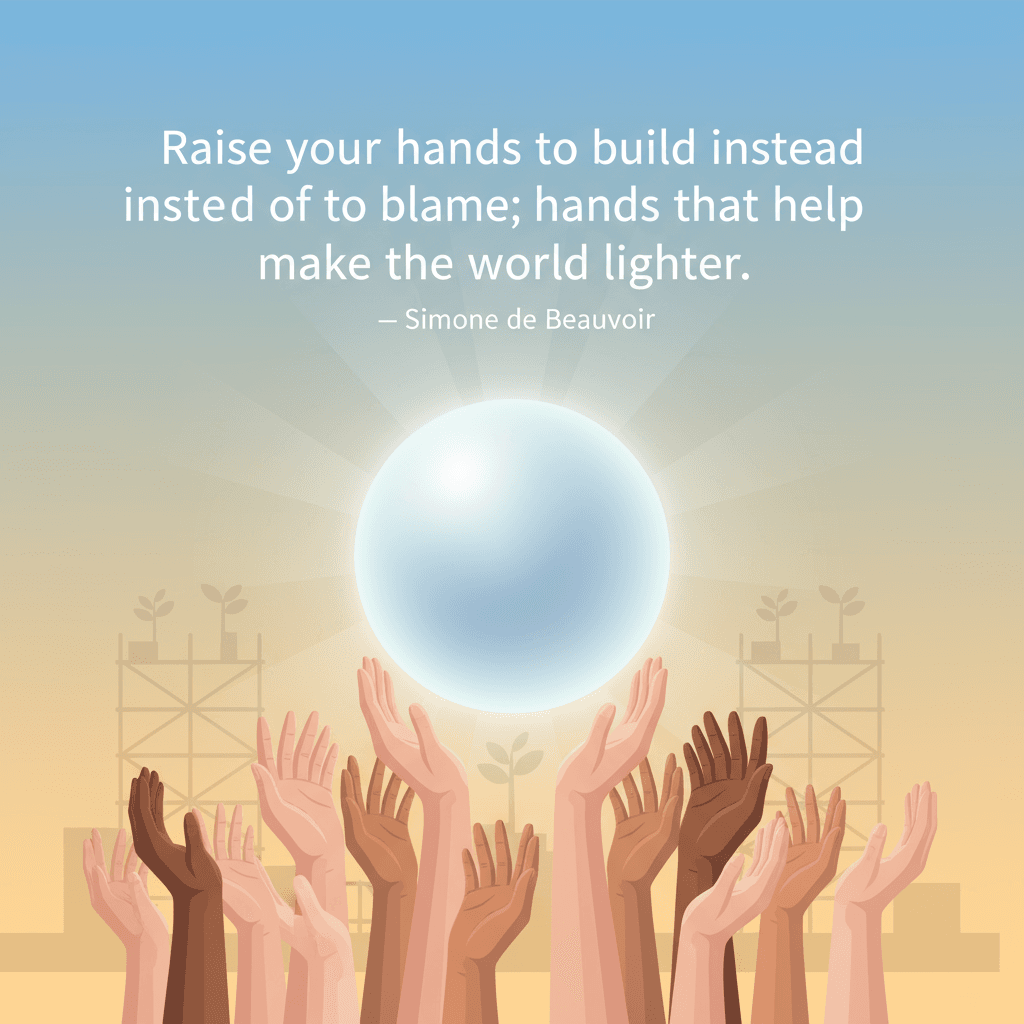
Raise your hands to build instead of to blame; hands that help make the world lighter. — Simone de Beauvoir
—What lingers after this line?
From Accusation to Construction
At the outset, the line contrasts two gestures: the raised hand that points and blames, and the raised hand that lifts, makes, and mends. The former locks us in cycles of recrimination; the latter opens a space where burdens are shared and possibilities multiply. By reframing the instinct to fault into the resolve to build, the statement invites a practical ethics: do what reduces weight for others. In that shift, the world grows lighter not because problems vanish, but because more shoulders are under the load.
Beauvoir’s Ethics of Responsibility
Moving deeper, Simone de Beauvoir’s existentialism roots this call in responsibility and reciprocity. In The Ethics of Ambiguity (1947), she insists that freedom is interwoven: "To will oneself free is also to will others free." Blame isolates and immobilizes, while constructive action acknowledges our entanglement and agency. Thus, building is not naïve optimism; it is an adult response to ambiguity—working amid constraint to enlarge the field of shared freedom.
The Metaphor of Hands and Praxis
Furthermore, hands signify praxis: ideas becoming deeds. Beauvoir consistently links becoming to action—her famous line in The Second Sex (1949), "One is not born, but rather becomes, a woman," underscores how identities and worlds are shaped through projects. When hands craft, clean, code, vote, and care, abstractions take on weight and texture. In this sense, the injunction to help is a summons to concrete projects that translate values into structures people can actually live in.
Solidarity as an Antidote to Blame
Likewise, the passage nudges us from scapegoating to solidarity. Blame seeks culprits; building seeks collaborators. Hannah Arendt’s The Human Condition (1958) shows how action appears in plurality—new beginnings emerge when people act together, not against one another. Historical recoveries, from postwar reconstruction to community-led mutual aid, illustrate this logic: burdens lighten when many hands replace the single wagging finger. Solidarity does not erase conflict; it reorients it toward repair.
Accountability Through Repair
Even so, building does not mean ignoring harm. Instead of punitive spirals, it channels accountability into repair. Restorative justice frameworks—popularized by Howard Zehr’s Changing Lenses (1990)—move from "What law was broken?" to "Who was harmed and how do we make it right?" This shift preserves truth-telling while prioritizing restitution and reintegration. In Beauvoirian terms, it honors the freedom of all parties by reconstructing conditions where better choices become genuinely possible.
Everyday Ways to Lighten the Load
Ultimately, lightening the world begins locally and scales outward. Mentoring a newcomer at work, sharing credit, fixing a buggy line of code, delivering a meal, or organizing a neighborhood tool library—such acts change atmospheres, not just outcomes. As small projects cohere into institutions, they model a politics of making rather than blaming. Thus the hands we raise—whether to vote, to volunteer, or to steady someone climbing—become the quiet architecture of a more livable common world.
One-minute reflection
What feeling does this quote bring up for you?
Related Quotes
6 selectedThe things that you do for yourself are gone when you are gone, but the things that you do for others remain as your legacy. — Kalu K. Ndukwe Kalu
Kalu K. Ndukwe Kalu
At its heart, Kalu K. Ndukwe Kalu’s quote redirects attention from personal gain to shared impact.
Read full interpretation →The most important aspect of gratitude is that it spurs action—that it compels us to go outside ourselves to express our gratitude in a way that makes a difference in someone else's life. — Rebecca Solnit
Rebecca Solnit
Rebecca Solnit shifts gratitude away from being a private sentiment and turns it into a moral impulse. In her view, thankfulness matters most not when it remains an inward glow, but when it pushes us outward toward other...
Read full interpretation →One of the deep secrets of life is that all that is really worth the doing is what we do for others. — Lewis Carroll
Lewis Carroll
Lewis Carroll’s line turns attention away from achievement for its own sake and toward a quieter measure of value: whether our actions help someone beyond ourselves. At first glance, this may sound like simple moral advi...
Read full interpretation →The only thing to do with good advice is to pass it on. It is never of any use to oneself. — Oscar Wilde
Oscar Wilde
Oscar Wilde’s line turns a familiar moral expectation on its head: instead of treating advice as a tool for self-improvement, he treats it as a social commodity best circulated outward. The joke lands because it exposes...
Read full interpretation →Measure success by the lives you lift, not the titles you earn — Kahlil Gibran
Kahlil Gibran
Gibran’s line shifts the measure of achievement away from what can be printed on a business card and toward what can be felt in other people’s lives. Titles are visible, quickly understood, and easy to compare, which is...
Read full interpretation →Measure progress by the lives you move, not by the applause you collect. — Amartya Sen
Amartya Sen
Amartya Sen’s line asks us to swap a noisy yardstick for a humane one: instead of treating public approval as proof of achievement, we should look for tangible improvements in other people’s lives. In this view, standing...
Read full interpretation →More From Author
More from Simone de Beauvoir →I am too intelligent, too demanding, and too resourceful for anyone to be able to take charge of me entirely. — Simone de Beauvoir
Simone de Beauvoir’s line reads first as a firm personal boundary: she refuses the premise that another person could—or should—“take charge” of her entirely. The triad “too intelligent, too demanding, and too resourceful...
Read full interpretation →Hold fast to what you can change and gently release what you cannot. — Simone de Beauvoir
Simone de Beauvoir’s line works like a practical compass: first, grasp firmly the parts of life that respond to effort; then, loosen your grip on what will not yield. The pairing matters because willpower alone can becom...
Read full interpretation →One can never consent to creep when one feels an impulse to soar. — Simone de Beauvoir
Simone de Beauvoir’s line begins with a quiet rebellion: once you feel the tug of possibility, “consenting to creep” becomes intolerable. The word consent matters, because it frames smallness as a choice we are pressured...
Read full interpretation →Turn hesitation into rehearsal, and action will follow. — Simone de Beauvoir
Simone de Beauvoir’s line reframes hesitation not as failure, but as raw material. Instead of treating uncertainty like a wall, she implies it can be treated like a doorway—an early stage of becoming capable.
Read full interpretation →