
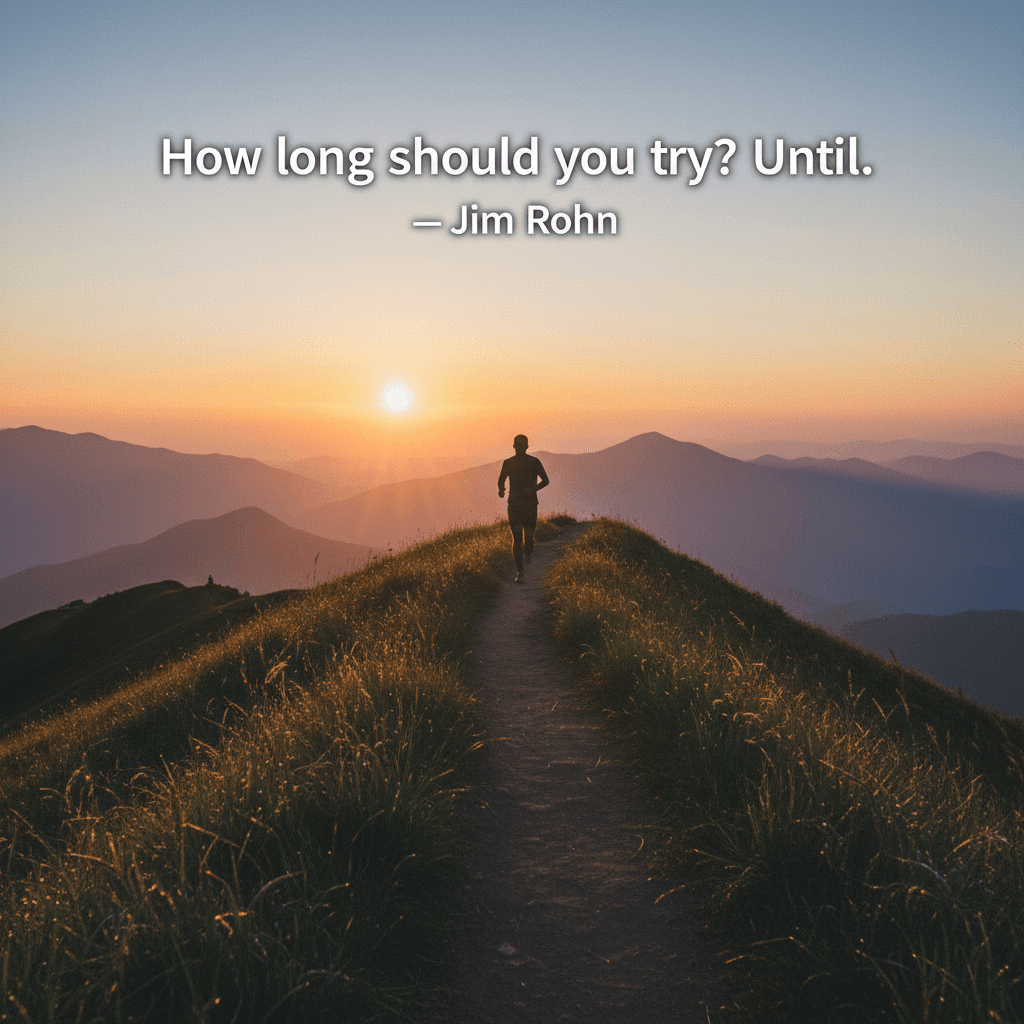
How long should you try? Until. — Jim Rohn
—What lingers after this line?
The Meaning Packed in One Word
Jim Rohn’s terse answer—until—compresses an entire philosophy into a single horizonless adverb. It rejects arbitrary timelines and locates success in sustained engagement rather than instant outcomes. Crucially, until does not endorse stubbornness for its own sake; it implies an unwavering commitment to a worthy aim, coupled with learning along the way. In this reading, persistence becomes a practice of revising methods while preserving the mission, so effort remains purposeful rather than performative.
Stories That Make 'Until' Concrete
To ground this, consider Thomas Edison, whose laboratory ran thousands of filament trials before a commercially viable light bulb emerged; the point was not repetition, but iteration under pressure. Likewise, J. K. Rowling faced a string of rejections before Bloomsbury accepted Harry Potter; her revising persisted until the manuscript met the right champion. Even Winston Churchill’s wartime admonition at Harrow School (1941)—never give in—echoes this ethic: obstacles are signals to adjust the approach, not abandon the cause.
What Science Says About Sticking With It
Moreover, research backs the power of sustained effort. Angela Duckworth’s Grit (2016) shows that passion combined with perseverance predicts achievement beyond raw talent. Carol Dweck’s work on growth mindset (2006) explains why reframing setbacks as information preserves motivation. Complementing this, Anders Ericsson’s studies of deliberate practice (1993; with Pool, *Peak*, 2016) reveal that targeted, feedback-rich effort—not mere repetition—builds expertise. Together, these findings translate until into a learnable skill: keep going, keep improving, and keep correcting course.
Turning Persistence into Daily Systems
In practice, until thrives on systems that automate progress. James Clear’s *Atomic Habits* (2018) popularizes identity-based habits—show up as the kind of person who does the work, then let small actions compound. BJ Fogg’s tiny habits (2019) and Peter Gollwitzer’s implementation intentions (1999) add the how: shrink the first step and predecide the when-then. Thus persistence becomes less about heroic willpower and more about environment, cues, and routines that quietly remove friction.
Iteration: Persist, But Also Adapt
At the same time, until requires intelligent flexibility. Eric Ries’s *The Lean Startup* (2011) frames the pivot-or-persevere decision as a learning milestone: measure what matters, then change what doesn’t. Similarly, John Boyd’s OODA loop (observe–orient–decide–act) urges rapid cycling between action and insight. The throughline is clear: endurance without feedback drifts into futility, while feedback without endurance evaporates before results appear. The winning posture blends both.
Guardrails: Endurance Without Burnout
Sustainable until respects human limits. The World Health Organization’s ICD‑11 (2019) recognizes burnout as an occupational syndrome, reminding us that recovery is not indulgence but infrastructure. Athletes periodize training; knowledge workers can periodize intensity, too—protecting sleep, scheduling deep work, and engineering no-meeting blocks. By designing rest as part of the system, you preserve the capacity to persist, ensuring that long horizons do not become short fuses.
A Simple Plan to Try Until
Finally, translate the philosophy into a rhythm: define a clear outcome and the smallest daily behavior that proves identity—twenty focused minutes, one sales call, a page of code. Track leading indicators, review weekly, and adjust based on evidence rather than mood. To avoid the sunk‑cost trap (Arkes and Blumer, 1985), set prewritten kill or pivot criteria before you start. In this way, until stops being a slogan and becomes a cadence that steadily carries you to the finish.
Recommended Reading
As an Amazon Associate, we earn from qualifying purchases.
One-minute reflection
Where does this idea show up in your life right now?
Related Quotes
6 selectedIt is the set of the sails, not the direction of the wind that determines which way we will go. — Jim Rohn
Jim Rohn
Jim Rohn’s image of sails and wind turns a familiar scene into a philosophy of agency. At first glance, wind seems to control everything: it is invisible, powerful, and beyond human command.
Read full interpretation →If you are not willing to learn, no one can help you. If you are determined to learn, no one can stop you. — Zig Ziglar
Zig Ziglar
Zig Ziglar’s quote begins with a blunt truth: learning cannot be forced from the outside. Teachers, mentors, and books may offer guidance, yet none of them can move a closed mind.
Read full interpretation →Consistency is not a grand, dramatic act; it is the small, boring choice to show up again even when your internal weather is stormy. — Atomic Habits (James Clear)
Atomic Habits (James Clear
James Clear’s line from Atomic Habits reframes consistency as something far less glamorous than popular culture often suggests. Rather than a heroic burst of motivation, it is the ordinary decision to return to the task,...
Read full interpretation →Anything worth having is worth waiting for, and everything worth doing is worth doing with patience. — Confucius
Confucius
At its core, this saying ties value to delay. Confucius suggests that truly meaningful things do not arrive instantly; instead, they ask us to endure uncertainty, effort, and time.
Read full interpretation →Dreams become reality when we put our minds to it. — Queen Rania of Jordan
Queen Rania of Jordan
Queen Rania of Jordan’s statement condenses a hopeful but demanding truth: dreams do not become real through wishing alone, but through focused intention. By saying “when we put our minds to it,” she shifts attention fro...
Read full interpretation →Inspiration on its own was shallow; you had to back it up with hard work. — Michelle Obama
Michelle Obama
Michelle Obama’s remark begins with a necessary correction to a popular myth: feeling inspired is not the same as accomplishing something meaningful. Inspiration can ignite ambition, but on its own it is fleeting, emotio...
Read full interpretation →More From Author
More from Jim Rohn →Your level of success is determined by your level of discipline and your ability to protect your own energy, not just your capacity to endure. — Jim Rohn
At first glance, Jim Rohn’s quote challenges a common cultural myth: that success belongs mainly to those who can suffer the longest. Instead, he shifts attention toward discipline and energy management, suggesting that...
Read full interpretation →It is the set of the sails, not the direction of the wind that determines which way we will go. — Jim Rohn
Jim Rohn’s image of sails and wind turns a familiar scene into a philosophy of agency. At first glance, wind seems to control everything: it is invisible, powerful, and beyond human command.
Read full interpretation →Mastery is built in silence. Let your results be your only noise. — Jim Rohn
Jim Rohn’s line begins with a striking contrast: mastery grows in silence, while results make the sound. In other words, real skill is usually forged away from applause, through repetition, correction, and patience.
Read full interpretation →We must all suffer one of two things: the pain of discipline or the pain of regret and disappointment. — Jim Rohn
Jim Rohn’s statement begins with a hard truth: suffering is not optional, but its form often is. In other words, people cannot avoid discomfort altogether; they can only choose between the short-term strain of discipline...
Read full interpretation →