
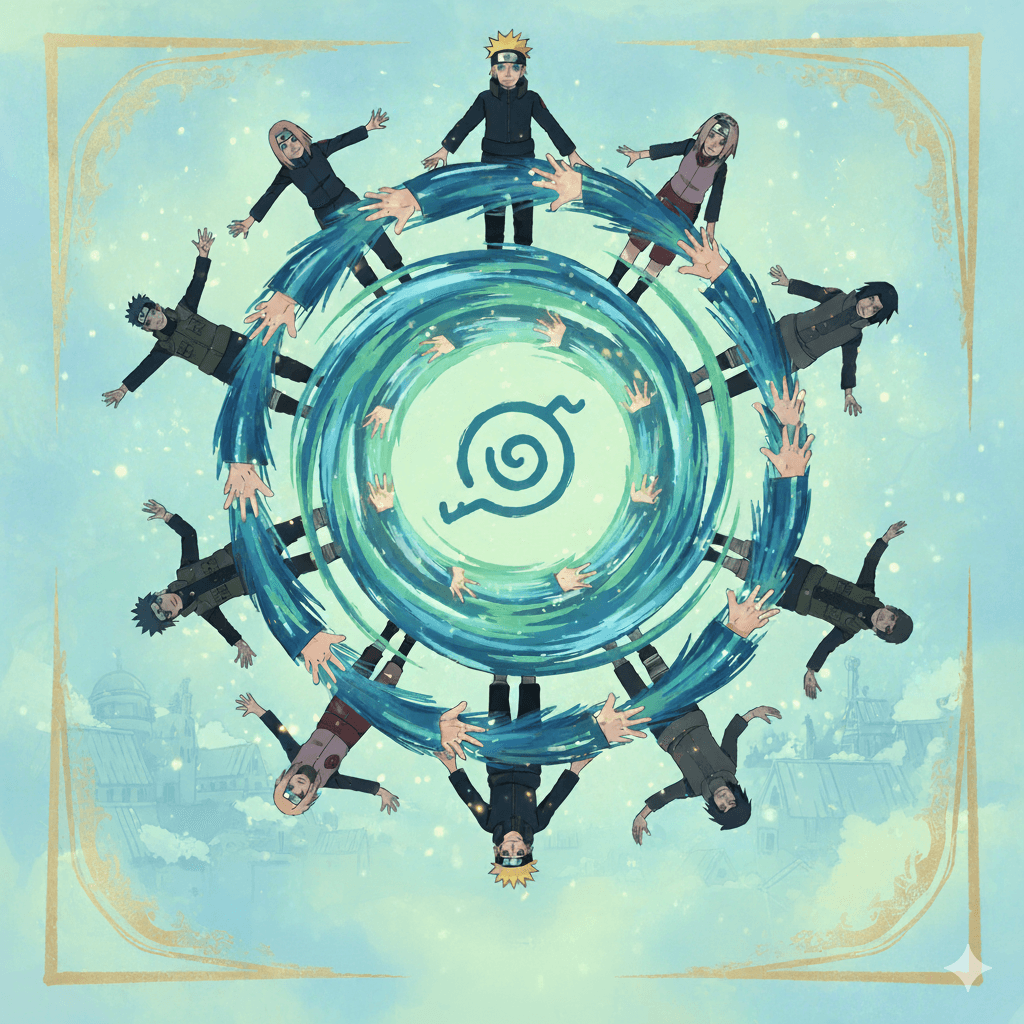
Originally, chakra was a power that was meant to connect people to each other. - Naruto Uzumaki
—What lingers after this line?
The Sage’s First Intention
Naruto’s line recalls the earliest teaching of Hagoromo Ōtsutsuki, the Sage of Six Paths, who spread chakra among people to help them understand one another. He called this practice Ninshū—a way to link hearts, not to overpower foes. As the Sage explains, chakra was a common language, a medium for shared feeling and mutual recognition rather than domination (Naruto, ch. 671). In echoing this origin, Naruto reframes strength as communion, suggesting that real power is measured by how well it binds lives together.
How War Bent Connection Into Weapon
Yet history in the shinobi world shows how ideals warp under pressure. Over generations, Ninshū decayed into ninjutsu, a system of techniques optimized for conflict. The Warring States era, marked by clan violence and cycles of revenge, pulled chakra away from empathy and toward efficiency in battle. Hashirama and Madara’s backstory illustrates this tragic drift: two boys dreaming of peace are driven by clan loyalties into rivalry, turning shared potential into armed contest (Naruto, chs. 622–627). Thus, a language for hearts became a vocabulary for war.
Naruto’s Practice of Reconnection
Against that momentum, Naruto operationalizes the Sage’s intention. He persuades enemies by linking experiences, from confronting Pain’s despair to reaching the buried hope inside Obito (Naruto, ch. 449; ch. 654). More concretely, during the Fourth Shinobi World War he transmits Kurama’s chakra to allies, synchronizing their movements and morale across the battlefield—an embodied network of trust. In these moments, chakra ceases to be mere fuel for techniques and becomes a social fabric, stitching isolated fighters into a resilient whole.
Bonds Beyond Bloodlines and Beasts
Moreover, Naruto extends connection beyond clan and species. By learning the tailed beasts’ true names and listening to their stories, he transforms coercive sealing into cooperative partnership (Naruto, chs. 572–573; Shippuden ep. 329). Kurama’s shift from captive to comrade embodies the thesis: recognition reconfigures power. Where bloodline limits often gatekeep prestige, Naruto’s strength scales with the breadth of his bonds. In turning fearsome chakra into shared purpose, he models a politics of inclusion rather than inheritance.
The Ethics of Power-as-Communication
This reframing aligns with a broader ethical insight: power that communicates can heal, while power that coerces corrodes. Philosophically, it echoes Martin Buber’s I and Thou (1923), which privileges relationships that treat others as ends, not means. Technologically, it mirrors tools like the internet—designed to connect yet prone to polarization. Naruto’s approach suggests a test: ask whether a technique widens understanding or narrows it. If chakra is a channel, then its most moral use is to carry empathy, not merely energy.
Returning to Ninshū’s Promise
Consequently, Naruto’s leadership gestures back to the Sage’s vow. Peace in his era does not erase conflict; rather, it reorients practice—schools, alliances, and rituals—around shared learning instead of zero-sum prestige (Boruto’s early depictions of inter-village cooperation continue this arc). The quote becomes a compass: use chakra to make others more legible to one another. In that return, connection is not sentimentality but strategy, the very architecture of resilience. The original promise of chakra endures when it is passed, not hoarded.
One-minute reflection
Why might this line matter today, not tomorrow?
Related Quotes
6 selectedIt’s all right to cry when you’re happy. - Naruto Uzumaki
Naruto Uzumaki
At first glance, “It’s all right to cry when you’re happy” feels contradictory, yet Naruto’s line names a common human truth: powerful emotions rarely arrive in neat boxes. Joy often carries traces of relief, awe, and re...
Read full interpretation →I’m not gonna run away, I never go back on my word! That’s my nindō: my ninja way. - Naruto Uzumaki
Naruto Uzumaki
At the outset, Naruto’s declaration—never running away and never breaking his word—emerges from isolation. As an orphan shunned for the Nine-Tails within him, he crafts a promise sturdy enough to anchor a drifting identi...
Read full interpretation →A true leader builds a world where children can laugh freely. — Hashirama Senju, Naruto Series
Hashirama Senju, Naruto Series
Hashirama Senju’s words shift leadership away from power and glory toward a gentler benchmark: the sound of children laughing without fear. Rather than celebrating conquest or authority, this view treats safety, joy, and...
Read full interpretation →When your heart grows, your power follows. — Choji Akimichi, Naruto Series
Choji Akimichi, Naruto Series
In the Naruto series, Choji Akimichi begins as an often-overlooked character, more associated with snacks than strength. Yet his line, “When your heart grows, your power follows,” quietly summarizes his entire journey.
Read full interpretation →Kindness is a strength many underestimate. — Choji Akimichi, Naruto Series
Choji Akimichi, Naruto Series
Choji Akimichi’s line from the Naruto series challenges a common misconception: that kindness is a soft trait, secondary to more visibly dramatic strengths like physical power or tactical genius. By stating that kindness...
Read full interpretation →The will of fire burns brightest when shared. — Hashirama Senju, Naruto Series
Hashirama Senju, Naruto Series
Hashirama Senju’s line, “The will of fire burns brightest when shared,” captures a paradox at the heart of human motivation: some inner flames strengthen not by being guarded, but by being given. In the world of Naruto,...
Read full interpretation →More From Author
More from Naruto Uzumaki →It’s all right to cry when you’re happy. - Naruto Uzumaki
At first glance, “It’s all right to cry when you’re happy” feels contradictory, yet Naruto’s line names a common human truth: powerful emotions rarely arrive in neat boxes. Joy often carries traces of relief, awe, and re...
Read full interpretation →I’m not gonna run away, I never go back on my word! That’s my nindō: my ninja way. - Naruto Uzumaki
At the outset, Naruto’s declaration—never running away and never breaking his word—emerges from isolation. As an orphan shunned for the Nine-Tails within him, he crafts a promise sturdy enough to anchor a drifting identi...
Read full interpretation →