
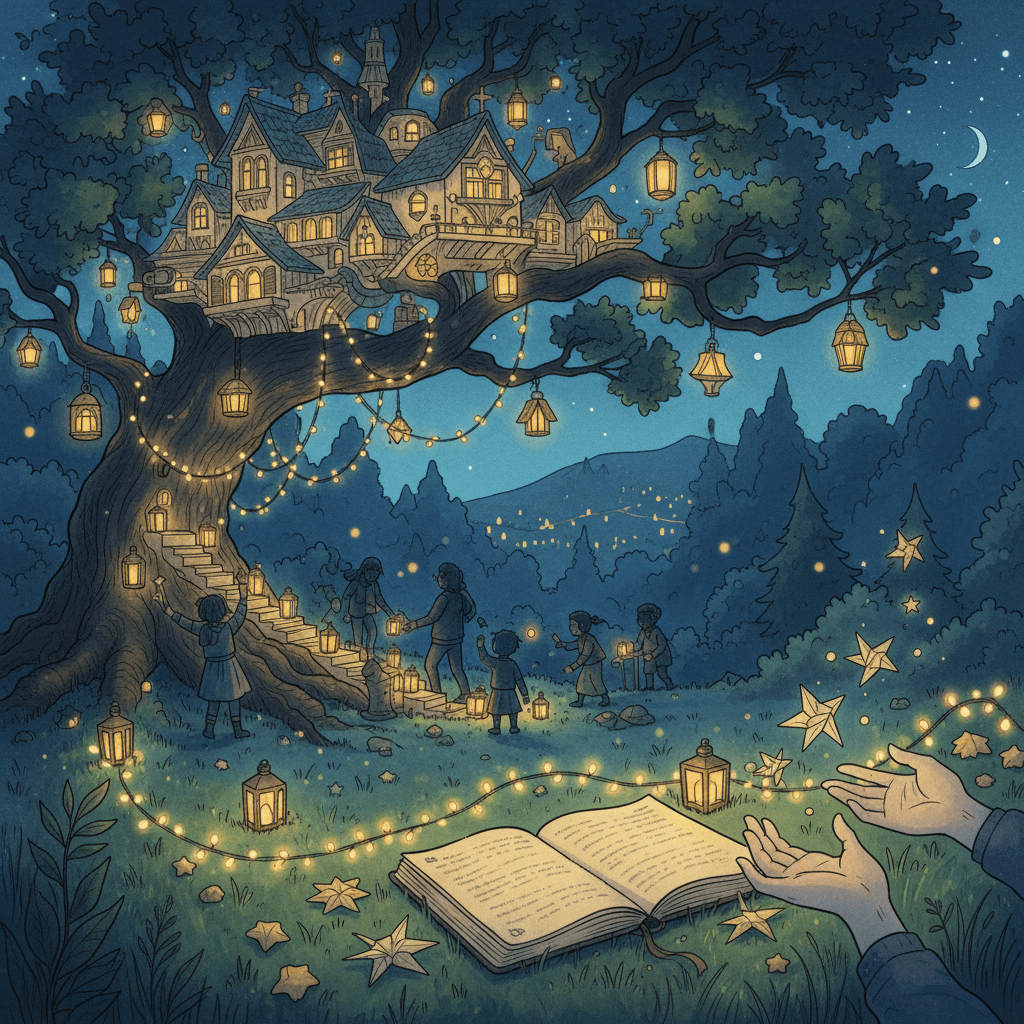
Shape wonder into shelter; imagination becomes home when it is shared. — J.R.R. Tolkien
—What lingers after this line?
Sub-creation as a Craft of Shelter
Tolkien’s image of shaping wonder into shelter echoes his idea of “sub-creation,” the human craft of making secondary worlds within the primary one. In On Fairy-Stories (1939), he argues that stories offer recovery, escape, and consolation—functions that feel architectural, as if narrative were timber and beam. Wonder, then, is the raw material; the shaping is the careful craft that turns awe into a place to dwell.
The Hearth of Story: Sharing Makes It Home
Yet a house is not a home until voices gather. Tolkien read drafts to the Inklings at Oxford’s Eagle and Child, where critique and laughter acted like firelight binding companions. Earlier, The Hobbit began as a tale spun aloud to his children. In both settings, imagination only settled into “home” when others joined—proof that hospitality, not just brilliance, completes the architecture of wonder.
Leaf by Niggle: Art Becomes a Shared Garden
This insight crystallizes in Leaf by Niggle (1945), where a solitary painter’s imagined tree becomes a real landscape only when tended with his neighbor, Parish. The private vision turns livable once it is worked on together; solitude starts the canvas, but communion furnishes the rooms. Thus, Tolkien dramatizes how art, once shared and cared for, becomes habitable—shelter fashioned from wonder.
Language as Rooms We Build Together
Moving inward, Tolkien’s invented tongues show how language itself is a dwelling. In A Secret Vice (1931), he treats language-making as a craft that births worlds; words become walls, grammar the blueprint. Heidegger’s dictum that “language is the house of Being” (1947) resonates here: when we speak a world in common, we do more than describe it—we live in it, room by resonant room.
From Inklings to Fandoms: Communal Worldbuilding
Consequently, modern readers extend his principle by co-creating. Fan fiction, role-playing, and collaborative builds—such as communities that reconstruct Middle-earth in digital sandboxes—transform solitary wonder into shared addresses. Henry Jenkins’s Textual Poachers (1992) shows how audiences become makers; the threshold between creator and guest blurs, and the story-house acquires many keys, each opening new, connected rooms.
Hospitality and the Ethics of Home
Finally, shelter implies responsibility. Tolkien distinguished “escape” from “desertion”: to flee a prison is not to abandon duty (On Fairy-Stories, 1939). By that measure, imaginative homes must welcome the weary and widen belonging, not gatekeep. When wonder is shaped with hospitality—inviting dissent, diversity, and care—the house of story resists collapse into mere refuge and becomes a neighborhood of hope.
Practices for Shaping Wonder into Shelter
Putting this into practice, communities can: read aloud to stitch a common hearth; host worldbuilding circles where maps, names, and songs are co-crafted; run participatory design workshops so imagined spaces guide real ones; and seed “little libraries” or story walks that let narratives inhabit streets. Thus the cycle closes: we share, the space holds us, and imagination—at last—becomes home.
One-minute reflection
What feeling does this quote bring up for you?
Related Quotes
6 selectedOne single dream is more powerful than a thousand realities. — J.R.R. Tolkien
J.R.R. Tolkien
This quote emphasizes the significance of dreams and imagination. A single dream can inspire and drive individuals to achieve great things, transcending the limitations of their current realities.
Read full interpretation →Imagination is more important than knowledge. For knowledge is limited, whereas imagination embraces the entire world, stimulating progress, giving birth to evolution. - Albert Einstein
Albert Einstein
This quote emphasizes that knowledge, although valuable, has its boundaries. It is confined to the information and understanding we currently possess, which can always change or expand.
Read full interpretation →Imagination is more important than knowledge. For knowledge is limited, whereas imagination embraces the entire world, stimulating progress, giving birth to evolution. - Albert Einstein
Albert Einstein
Einstein emphasizes that imagination holds greater value because it is boundless. While knowledge is finite, imagination has no limits and can conceive new ideas and possibilities.
Read full interpretation →Draw a map with your hands, then step into the landscape you imagine. — J.R.R. Tolkien
J.R.R. Tolkien
The line urges a sequence: make something tangible, then inhabit it. By telling us to draw a map “with your hands,” it foregrounds craft and embodiment before vision.
Read full interpretation →True belonging is not passive. — Brené Brown
Brené Brown
Brené Brown’s statement challenges the comforting idea that belonging is something we simply find or receive. Instead, she frames it as something we help create through honesty, presence, and courage.
Read full interpretation →The most significant shift underway is not technological. It is relational. People are tired of being audiences. They want to belong. — Mariana F. Silva
Mariana F. Silva
At the heart of Mariana F. Silva’s observation is a subtle but powerful correction to the way modern change is usually described.
Read full interpretation →More From Author
More from J.R.R. Tolkien →Courage is found in unlikely places. — J. R. R. Tolkien
Tolkien’s line gently overturns the usual image of courage as something reserved for warriors, rulers, or legendary heroes. Instead, it suggests that bravery often appears in ordinary people and modest settings, where no...
Read full interpretation →It is not our part here to take thought only for a season, or for a few lives of men, or for a passing age of the world. — J.R.R. Tolkien
At its core, Tolkien’s line rejects narrow, short-term thinking. He urges us to look beyond a single season, a generation, or even an era, and to measure our actions against a far larger horizon.
Read full interpretation →Faithless is he that says farewell when the road darkens. — J.R.R. Tolkien
Tolkien’s line draws a sharp boundary between affection that is convenient and fidelity that is real. Saying farewell “when the road darkens” suggests abandoning a person, cause, or duty precisely at the moment it demand...
Read full interpretation →Forge ahead where maps end; the brave craft new paths as they go. — J.R.R. Tolkien
Tolkien’s line evokes the moment when the comfort of the known world runs out—when the map quite literally ends. At such boundaries, most people turn back, trusting only what has been charted before.
Read full interpretation →