
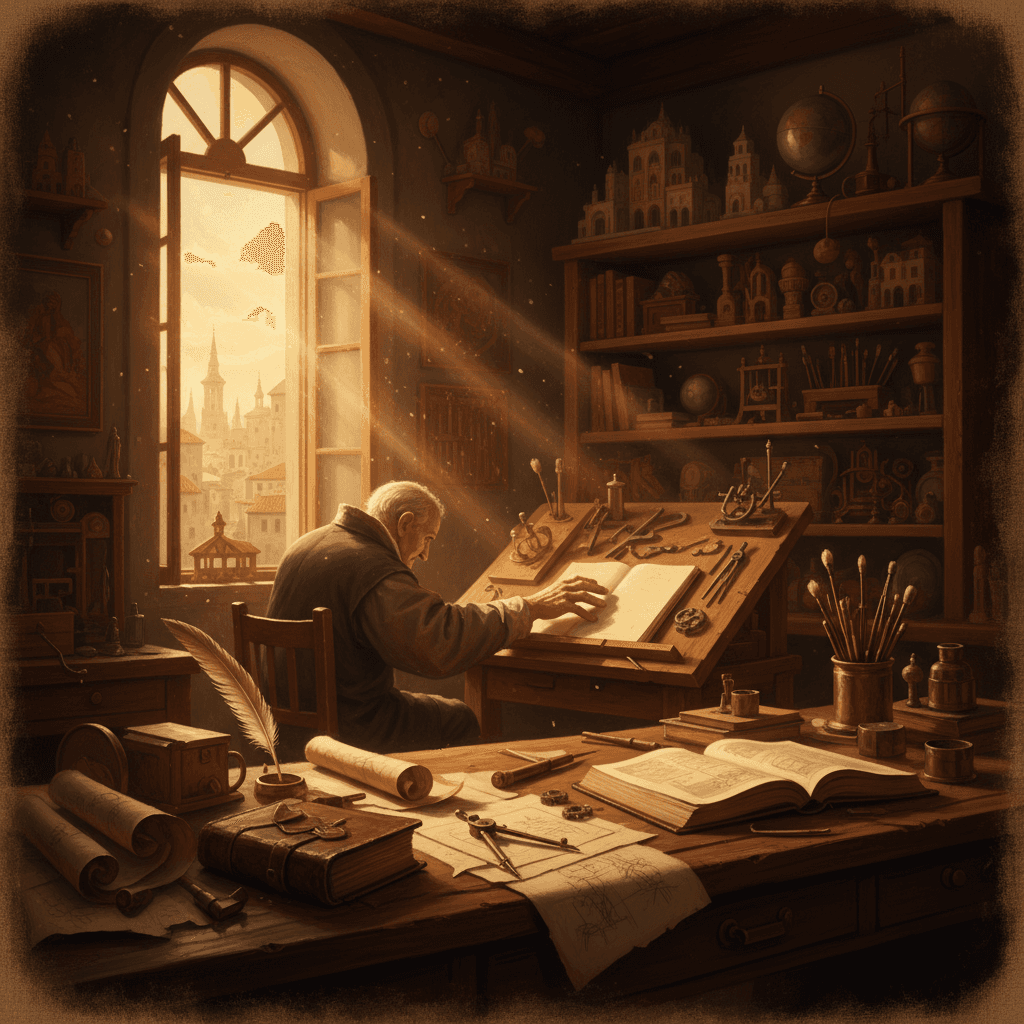
Let your curiosity lead and your craft will follow. — Leonardo da Vinci
—What lingers after this line?
Curiosity Before Competence
Begin with a question, and skill arrives as its consequence. Whether or not the phrasing is verbatim, the sentiment attributed to Leonardo da Vinci captures a reliable sequence: curiosity sets direction; craft supplies momentum. When we lead with wonder, we choose problems that keep us engaged long enough to get good. Conversely, when we fixate on technique first, we often practice without purpose and quit early. This reversal of cause and effect reframes mastery. You need not wait to be skilled before you explore; you explore to become skilled. In that light, the mandate is simple: cultivate questions large enough to pull your effort forward.
Da Vinci’s Working Method
History offers a working model. Da Vinci’s notebooks—especially the Codex Atlanticus (c. 1480–1518) and the Codex Leicester (c. 1508)—fizz with points of curiosity: Why do eddies spiral? How do birds bank? He dissected more than thirty human cadavers to resolve anatomical puzzles, then carried the answers back into painting. Vitruvian Man (c. 1490) shows the bridge: geometric inquiry clarifying human proportion, art strengthened by measurement. Because his questions ranged widely, his craft developed breadth: hydraulics informed stage machinery; anatomy sharpened sfumato; optics improved perspective. The throughline is visible on the page—the drawing follows the question. In other words, technique was not an idol but a tool refined in service of inquiry.
The Psychology of Intrinsic Drive
Psychology explains why this sequence works. Self-Determination Theory (Deci & Ryan, 1985; 2000) shows that intrinsic motivation—sparked by curiosity—sustains effort by satisfying autonomy and competence. Interest tends to deepen in stages, as Hidi and Renninger (2006) describe: fleeting sparks, triggered interest, then well-developed interest, each step amplifying attention and practice. When attention is high and challenge matches skill, people enter flow (Csikszentmihalyi, 1990), a state paradoxically both effortful and enjoyable. Thus curiosity does more than entertain; it regulates energy over long arcs of learning. The question acts like a battery, powering repetitions that would otherwise feel like drudgery.
From Questions to Prototypes
Translating curiosity into outcomes requires iteration. Design thinking popularized this path—empathize, define, ideate, prototype, test—with a bias toward action at IDEO (Kelley & Kelley, 2013). Edison’s Menlo Park notebooks (1878–1880) document thousands of filament trials before a reliable bulb emerged; the experiments were questions made tangible. In filmmaking, Catmull and Wallace’s Creativity, Inc. (2014) describes Pixar’s ‘plussing’: experiments that retain a kernel and ask, ‘What if we try…?’ Across these cases, a simple rhythm appears: pose a question, build a sketch, learn from the gap, repeat. As the loops accumulate, craft improves almost as a side effect.
Practice That Follows the Question
Still, practice matters; curiosity merely chooses what to practice. Deliberate practice research (Ericsson, Krampe, and Tesch-Römer, 1993) shows that targeted, feedback-rich drills accelerate expertise. The twist is to aim those drills at your question. A jazz musician, intrigued by a reharmonization, woodsheds chord families; an engineer, puzzled by latency, constructs micro-benchmarks. The drills follow the itch. Because feedback closes faster when you care, you notice finer distinctions and adjust more quickly. In this way, curiosity personalizes the generic advice to ‘practice more’ into ‘practice what your question demands.’
Daily Habits That Let Curiosity Lead
To let curiosity lead in daily work, cultivate small rituals. Begin projects with a written inquiry—‘What am I actually trying to learn?’—then keep a learning log that tracks surprises and dead ends (a habit physicists like Richard Feynman championed in his notebooks, c. 1940s–1988). Share work-in-progress to create accountability and serendipitous input; Austin Kleon’s Show Your Work (2014) argues that public transparency compounds learning. Moreover, use constraints to focus wonder: timebox explorations, set evidence thresholds, and end sessions by drafting the next question. These micro-practices keep curiosity warm and craft moving.
Guardrails: Focus, Ethics, and Finish
Finally, curiosity benefits from guardrails so it does not dissolve into distraction. Organizational theory distinguishes exploration from exploitation (March, 1991); individuals need both. Alternate open-ended searching with committed finishing through simple rules: decide in advance how many iterations you will run, run them, then ship. A pre-mortem (Klein, 2007) can surface ethical and practical risks before you dive. With cadence and conscience in place, curiosity becomes a compass rather than a whirlpool—pointing the way while craft, mile by mile, catches up.
Recommended Reading
As an Amazon Associate, we earn from qualifying purchases.
One-minute reflection
What does this quote ask you to notice today?
Related Quotes
6 selectedTurn curiosity into craft; practice is where dreams learn to behave. — John Steinbeck
John Steinbeck
Steinbeck begins with a familiar engine of creativity: curiosity. It’s the restless question—“What if?”—that nudges a person toward a story, a song, a business, or a skill.
Read full interpretation →Curiosity is the wick in the candle of learning. — William Arthur Ward
William Arthur Ward
This quote emphasizes that curiosity is an essential driving force for acquiring knowledge. Just as a wick fuels the candle’s flame, curiosity ignites and sustains the quest for learning.
Read full interpretation →I am against the picture of the artist as a starry-eyed visionary. I'd almost prefer the word 'craftsman.' — William Golding
William Golding
William Golding pushes back against a familiar cultural fantasy: the artist as a mystical figure swept along by inspiration alone. At once blunt and corrective, his preference for the word “craftsman” suggests that art i...
Read full interpretation →The craftsman who wants to do good work must first sharpen his tools. — Confucius
Confucius
Confucius frames good work as something that begins long before the visible task itself. By saying a craftsman must first sharpen his tools, he emphasizes that excellence depends on preparation, not merely effort in the...
Read full interpretation →The artist must be a craftsman; he must know his materials, his tools, and his methods. — Henri Matisse
Henri Matisse
Henri Matisse’s statement immediately shifts attention from inspiration to discipline. Rather than treating art as a purely mysterious gift, he insists that the artist is first a craftsman—someone who understands how thi...
Read full interpretation →There are two men inside the artist, the poet and the craftsman. One is born a poet. One becomes a craftsman. — Emile Zola
Émile Zola
At first glance, Zola’s remark divides the artist into two figures: the poet and the craftsman. Yet the contrast is not meant to split art into separate worlds, but to show that creation depends on both impulse and disci...
Read full interpretation →More From Author
More from Leonardo da Vinci →It is easier to resist at the beginning than at the end. — Leonardo da Vinci
Leonardo da Vinci’s remark turns attention to a simple but powerful truth: the first moment of temptation, error, or excess is usually the easiest point at which to intervene. At the beginning, a habit is still weak, a d...
Read full interpretation →Observe, imagine, then act — invention begins when thought meets motion — Leonardo da Vinci
Leonardo’s sequence—observe, imagine, then act—reads like a practical recipe for invention rather than a lofty slogan. It starts with disciplined attention to the world, moves into the mind’s power to reshape what it has...
Read full interpretation →Create small acts of courage as if you were painting—layers make the picture whole. — Leonardo da Vinci
Da Vinci’s image begins by shrinking courage to a workable size: not a single dramatic leap, but a sequence of small acts. That framing matters because it removes the myth that bravery belongs only to heroes or crises; i...
Read full interpretation →Seek progress over applause; mastery outlasts praise. — Leonardo da Vinci
Leonardo da Vinci’s dictum, “Seek progress over applause; mastery outlasts praise,” redirects attention from the crowd to the craft. Instead of chasing fleeting approval, he urges a quieter, steadier pursuit: becoming tr...
Read full interpretation →