
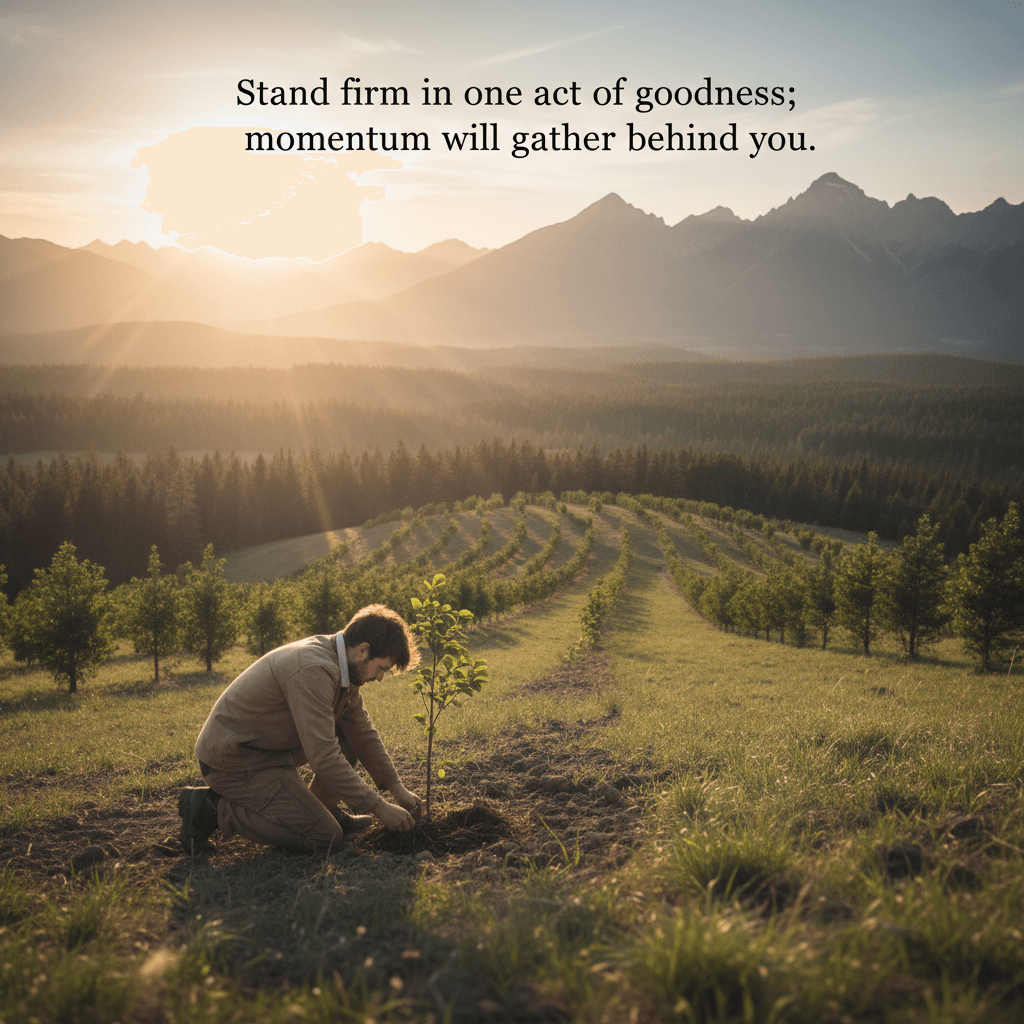
Stand firm in one act of goodness; momentum will gather behind you. — Booker T. Washington
—What lingers after this line?
From Single Deed to Gathering Force
Booker T. Washington’s line invites us to see moral life through the lens of physics: a single, well-aimed push sets a body in motion, and with each successive nudge, momentum grows. In character and community, that first act of goodness functions as the initial impulse—clarifying priorities, signaling intent, and aligning attention. Once direction is established, subsequent choices face less resistance; the path is marked, and others can recognize and support it. In this way, standing firm is not stubbornness but strategic anchoring. It turns goodwill from a fleeting feeling into a trajectory—one that accumulates reputational capital, strengthens self-trust, and makes the next right action easier. Consequently, momentum is not merely what follows; it is what becomes possible when the first step is both clear and unwavering.
Washington at Tuskegee: Work that Snowballed
This principle was no abstraction for Washington. In Up From Slavery (1901), he recounts founding the Tuskegee Institute in 1881 with a philosophy that students would learn by building—literally. They cleared land, constructed classrooms, and learned trades; when they lacked materials, they experimented with making bricks despite early kiln failures. By staying the course after those setbacks, they signaled a credible, value-driven commitment to self-reliance and practical education. As the work took visible shape, local respect and national support followed. Community members bought the bricks; later, philanthropists amplified the mission with resources and attention. Thus, a single educational stance—work as learning—created a flywheel. Each small, tangible success reduced doubt, attracted allies, and made the next investment—of sweat, trust, or funds—feel safer and more natural.
Virtue as Habit, Not Isolated Acts
Building on this, Aristotle’s Nicomachean Ethics (Book II) argues that we become just by doing just acts; virtue is a habit formed by repetition, not an innate trait waiting to be revealed. The first instance matters because it inaugurates a pattern—one that gradually reshapes what feels normal. When we stand firm in a good act, we reduce the friction of future choices: the mind learns what to expect, and the will wastes less energy debating. Over time, habit and identity converge; we do the right thing not as a heroic exception but as a practiced reflex. Washington’s maxim, read through Aristotle, suggests that momentum is character accumulating in motion—each deed reinforcing the next until goodness becomes the path of least resistance.
Commitment, Consistency, and the Foot-in-the-Door
Psychology explains why the first steadfast act often multiplies. In a classic study, Freedman and Fraser (1966) found that homeowners who agreed to a small, harmless request—like placing a modest safety sign—were far more likely later to accept a large, intrusive sign on their lawn. Robert Cialdini’s Influence (1984) frames this as commitment and consistency: once we publicly align with a principle, we tend to act in ways that preserve that self-image. Standing firm, then, is a reputational and identity cue—to ourselves and to others. It says, “This is who I am; this is what we do.” As that signal is repeated, people feel both internally coherent and socially supported in continuing. What begins as a single good deed becomes a stable reference point that naturally elicits further aligned actions.
Small Wins that Mobilize Teams
Extending the logic to groups, Karl Weick’s “small wins” approach (1984) shows how modest, visible successes reduce complexity and invite participation. When a team sees one sturdy step completed—one process fixed, one client helped—the next step appears more achievable, and discretionary effort rises. Teresa Amabile and Steven Kramer’s The Progress Principle (2011) adds that daily progress, however small, is the most potent motivator of creative work. In organizational change, John Kotter emphasizes short-term wins to sustain credibility and accelerate adoption (Leading Change, 1996). Thus, firmness in one concrete good—shipped code, repaired workflow, fair policy—creates a focal point for alignment. Momentum “gathers behind you” because people rally to what works; success clarifies the map and lowers the social cost of joining the march.
Catalyzing Collective Change in Communities
At a civic scale, a firm act can crystallize diffuse sympathies into coordinated movement. Rosa Parks’s refusal to surrender her seat on December 1, 1955—supported by organizers like Jo Ann Robinson and the Women’s Political Council—helped catalyze the Montgomery Bus Boycott (381 days). Parks’s action did not conjure a movement from thin air; it focused existing networks and moral energy around a clear, actionable stand (see Taylor Branch, Parting the Waters, 1988). The principle mirrors Washington’s insight: when one person or group acts decisively for the good, the community’s latent will finds a channel. What was once scattered becomes directional; momentum builds not because everyone acts at once, but because one resolute act gives others a place to stand.
Turning Principle into Daily Practice
To translate the maxim into life, begin with one keystone act that is specific, repeatable, and visible—return every call within a day, give 10% of consulting hours pro bono, or start each meeting with a safety check. Make it steady rather than grand; regularity is the engine of momentum. Then, reduce friction: schedule the act, create cues, and track completion so progress is felt. Finally, widen the circle. Share the commitment, invite a partner, and celebrate small wins so others see proof-of-concept. As the habit takes root, escalate scope or frequency deliberately. In time, what started as a single firm stance becomes a reliable current that carries you—and those watching—farther than resolve alone ever could.
One-minute reflection
What's one small action this suggests?
Related Quotes
6 selectedYour hands shape the world; with every act of kindness, you create a ripple of change. — Unknown
Unknown
This quote highlights the influence that individual actions can have in creating positive change. Each act of kindness, no matter how small, contributes to the larger fabric of society.
Read full interpretation →Awaken the hero within you; every act of courage, no matter how small, creates ripples of change that can transform the world. — Unknown, Global.
Unknown, Global.
This quote emphasizes the idea that everyone has a hero within them. It encourages individuals to tap into their inner strength and courage to effect positive change in their lives and communities.
Read full interpretation →Every step you take creates a ripple in the fabric of the universe; move with purpose and watch your actions inspire waves of change. — Unknown, Global.
Unknown, Global.
This quote highlights the significance of individual actions, suggesting that every choice and movement has the potential to influence the world around us, no matter how small.
Read full interpretation →Unfortunately, we've rewarded a sort of cowardice by calling it 'kindness', and this has made us utterly spineless when truth finally hits. — Criss Jami
Criss Jami
At its core, Criss Jami’s statement argues that not every gentle gesture is morally brave. Sometimes what society praises as kindness is really avoidance: a refusal to speak hard truths, set boundaries, or confront harmf...
Read full interpretation →The life I touch for good or ill will touch another life, and that in turn another, until who knows where the trembling stops or in what far place my touch will be felt. — Frederick Buechner
Frederick Buechner
At its heart, Frederick Buechner’s line imagines human life as a chain of contact, where no gesture ends with the person directly before us. A kindness, a cruelty, a moment of attention, or a careless word passes onward...
Read full interpretation →It is a rare and ethical thing to be a person who is willing to be changed. — Ocean Vuong
Ocean Vuong
Ocean Vuong frames openness to transformation as both uncommon and ethically charged, suggesting that character is not merely what we defend but what we are willing to revise. In this view, the “rare” person is not the o...
Read full interpretation →More From Author
More from Booker T. Washington →Nothing is built in a day, but every small, deliberate action is a stone laid in the foundation of your character. — Booker T. Washington
Booker T. Washington’s statement begins with a simple truth: anything lasting takes time.
Read full interpretation →Discipline is not about control; it is about teaching yourself how to govern your own life. — Booker T. Washington
At first glance, discipline is often mistaken for external restraint: rules, punishments, and rigid self-denial. Yet Booker T.
Read full interpretation →If you love someone, you will not spare them the discipline they need to become their best self. — Booker T. Washington
At first glance, Booker T. Washington’s statement challenges the comforting idea that love always feels gentle or permissive.
Read full interpretation →You can't hold a man down without staying down with him. — Booker T. Washington
Booker T. Washington’s line turns a physical act—holding someone down—into a moral diagram.
Read full interpretation →