
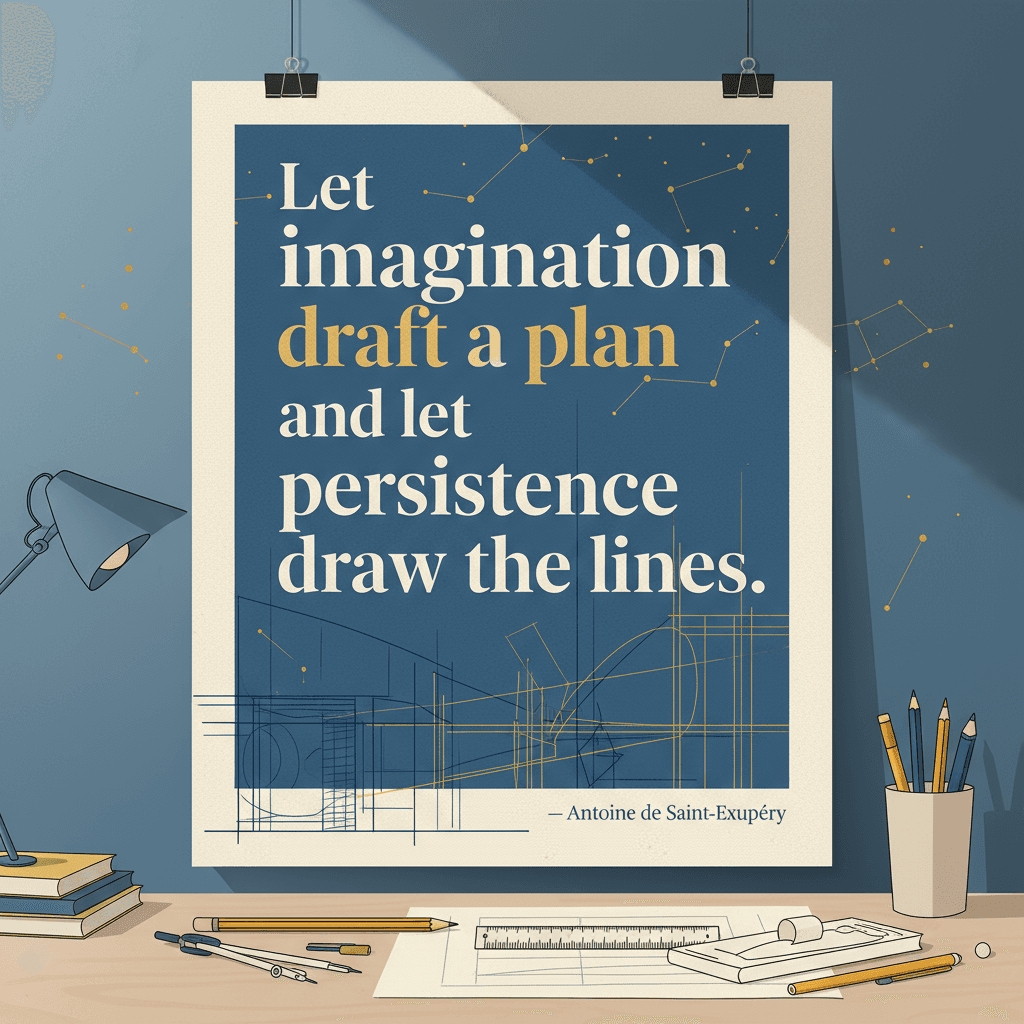
Let imagination draft a plan and let persistence draw the lines — Antoine de Saint-Exupéry
—What lingers after this line?
The Two-Part Engine of Achievement
Saint-Exupéry’s line pairs two indispensable forces: imagination to sketch possibilities and persistence to convert them into structure. Drafts are generous with curves and freedom; lines are strict, measured, and repeatable. Together they form a blueprint, turning what could be into what is. Without the first, we merely trace what already exists; without the second, we drift among promising ideas that never harden into outcomes. Seen this way, the quote is less a slogan than a process. It invites us to separate moments of generative thinking from moments of disciplined execution, then to link them deliberately. By doing so, we avoid confusing inspiration with completion and keep energy moving from vision to verification.
Lessons from a Pilot-Writer
This balance becomes vivid in Saint-Exupéry’s own life. As an airmail pilot, he plotted exact courses across hostile skies, drawing straight lines on maps to cut through uncertainty. Yet in Wind, Sand and Stars (1939), he also narrates the awe, fear, and wonder that such flights stirred—an imaginative lens that gave meaning to those lines. His desert crash during the 1935 Paris–Saigon attempt, later recounted there, demanded endurance as method, while reflective storytelling transformed ordeal into insight. The Little Prince (1943) extends this synthesis: a fable of pure imagination conveyed with spare, disciplined prose. Thus, the author who drew literal flight paths also drafted moral and poetic ones—revealing how imagination frames the horizon, while persistence keeps the bearing.
Innovation’s Pattern: Dream, Test, Refine
Carrying this insight beyond the cockpit, many breakthroughs follow the same cadence. The Wright brothers imagined controlled flight, then spent years testing airfoils, building a wind tunnel, and logging results at Kitty Hawk (1900–1903). Their notebooks—preserved in the National Air and Space Museum archives—show hundreds of incremental adjustments, a patient lattice of lines beneath an audacious sketch. Likewise, Octave Chanute’s Progress in Flying Machines (1894) compiled prior attempts, helping transform scattered dreams into workable designs. The arc is consistent: vision drafts a plan bold enough to orient effort, while persistence generates data, revises assumptions, and sharpens tolerances. What looks like a leap, seen up close, is a series of well-placed steps that make the leap inevitable.
The Psychology of Grit and Plans
Psychology echoes this pattern. Angela Duckworth’s Grit (2016) links long-term goal attainment to sustained effort over years, not bursts of inspiration. Imagination sets the direction; grit keeps the hand steady when progress is slow. Moreover, Gabriele Oettingen’s mental contrasting (Rethinking Positive Thinking, 2014) shows that pairing vivid goals with realistic obstacles produces stronger commitment than optimism alone. Finally, Peter Gollwitzer’s implementation intentions—if-then plans like “If it’s 6 a.m., then I write 300 words” (1999)—turn intentions into reliable lines. These techniques don’t shrink ambition; they scaffold it, ensuring that a bold sketch becomes a daily practice rather than a deferred dream.
A Practical Workflow to Apply the Maxim
Translating research into action, start by time-boxing an imaginative draft: explore three futures, define success, and list constraints. Next, converge: pick one thesis and outline milestones with clear, measurable checkpoints. Then calendarize persistence—protect fixed blocks for the least glamorous, most critical tasks, and use if-then cues to trigger them. Build a minimum viable step within a week, however small, to convert idea into evidence. Establish a weekly review: compare outcomes to assumptions, decide what to keep, cut, or change, and rewrite the next set of lines. Over time, a rhythm emerges—sketch on Monday, draw from Tuesday to Friday—that turns creativity into momentum.
Avoiding Extremes: When to Redraw
Even so, equilibrium matters. Overreliance on imagination breeds elegant plans that never meet resistance; overreliance on persistence produces tireless motion toward the wrong target. A simple safeguard is the Plan–Do–Check–Act cycle: commit, execute, examine results, and adjust. This rhythm legitimizes course correction without abandoning the journey. Watch for the sunk cost fallacy (Kahneman, Thinking, Fast and Slow, 2011): effort already spent is not evidence of future payoff. If the data contradict the draft, redraw the lines. Paradoxically, the most persistent builders are those willing to revise their own blueprints when reality instructs them to do so.
One-minute reflection
What feeling does this quote bring up for you?
Related Quotes
6 selectedA rock pile ceases to be a rock pile the moment a single man contemplates it, bearing within him the image of a cathedral. — Antoine de Saint-Exupéry
Exupéry
At first glance, Saint-Exupéry’s line seems to describe an ordinary heap of stones. Yet the moment someone looks at it while carrying the image of a cathedral within, the pile is transformed in meaning.
Read full interpretation →To those who can dream there is no such place as far away. — Antoine de Saint-Exupéry
Exupéry
This quote underscores the transformative power of imagination. It suggests that dreams and aspirations create opportunities and a sense of closeness to what may seem out of reach.
Read full interpretation →Turn imagination into steady work; practice brings it into being. — W. H. Auden
W. H. Auden
Auden’s line begins by reframing imagination as a raw material rather than a finished product. Instead of treating inspiration as a lightning strike that completes the work for you, he suggests it needs conversion—an int...
Read full interpretation →Let your imagination be the architect of your actions. — Sappho
Sappho
Sappho’s line begins with a simple but demanding premise: actions do not arise from nowhere—they are built from the images, stories, and possibilities we allow ourselves to envision. By naming imagination as an “architec...
Read full interpretation →Your imagination is the blueprint of your success; dare to design a life that reflects your wildest aspirations and dreams. — Unknown, Global.
Unknown, Global.
This quote emphasizes that imagination is a powerful force that shapes our future. It suggests that our thoughts and creative visions are the foundational elements that can lead to success.
Read full interpretation →The way to do a great deal is to keep on doing a little. The way to do nothing at all is to be continually resolving that you will do everything. — C.H. Spurgeon
C.H. Spurgeon
Spurgeon’s statement begins with a practical paradox: great accomplishments are rarely born from dramatic bursts of effort, but from the steady repetition of small acts. By saying that “a great deal” is done by “doing a...
Read full interpretation →More From Author
More from Exupéry →A rock pile ceases to be a rock pile the moment a single man contemplates it, bearing within him the image of a cathedral. — Antoine de Saint-Exupéry
At first glance, Saint-Exupéry’s line seems to describe an ordinary heap of stones. Yet the moment someone looks at it while carrying the image of a cathedral within, the pile is transformed in meaning.
Read full interpretation →Perfection is achieved, not when there is nothing more to add, but when there is nothing left to take away. — Antoine de Saint-Exupéry
Saint-Exupéry reframes perfection as an endpoint reached by removal rather than accumulation. Instead of chasing the next enhancement, he invites us to question what is truly necessary and what is merely decorative.
Read full interpretation →Let curiosity guide your flight and persistence steady the wings. — Antoine de Saint-Exupéry
Saint-Exupéry frames personal growth as a kind of aviation: curiosity is the impulse to take off, while persistence is the disciplined skill that keeps you in the air. The line feels especially fitting from someone who l...
Read full interpretation →Curiosity paired with courage writes the maps others fear to follow. — Antoine de Saint-Exupéry
Curiosity is the quiet spark behind every new path. In Antoine de Saint-Exupéry’s line, it functions as the inner question that refuses to be silenced: What lies beyond what I already know?
Read full interpretation →