
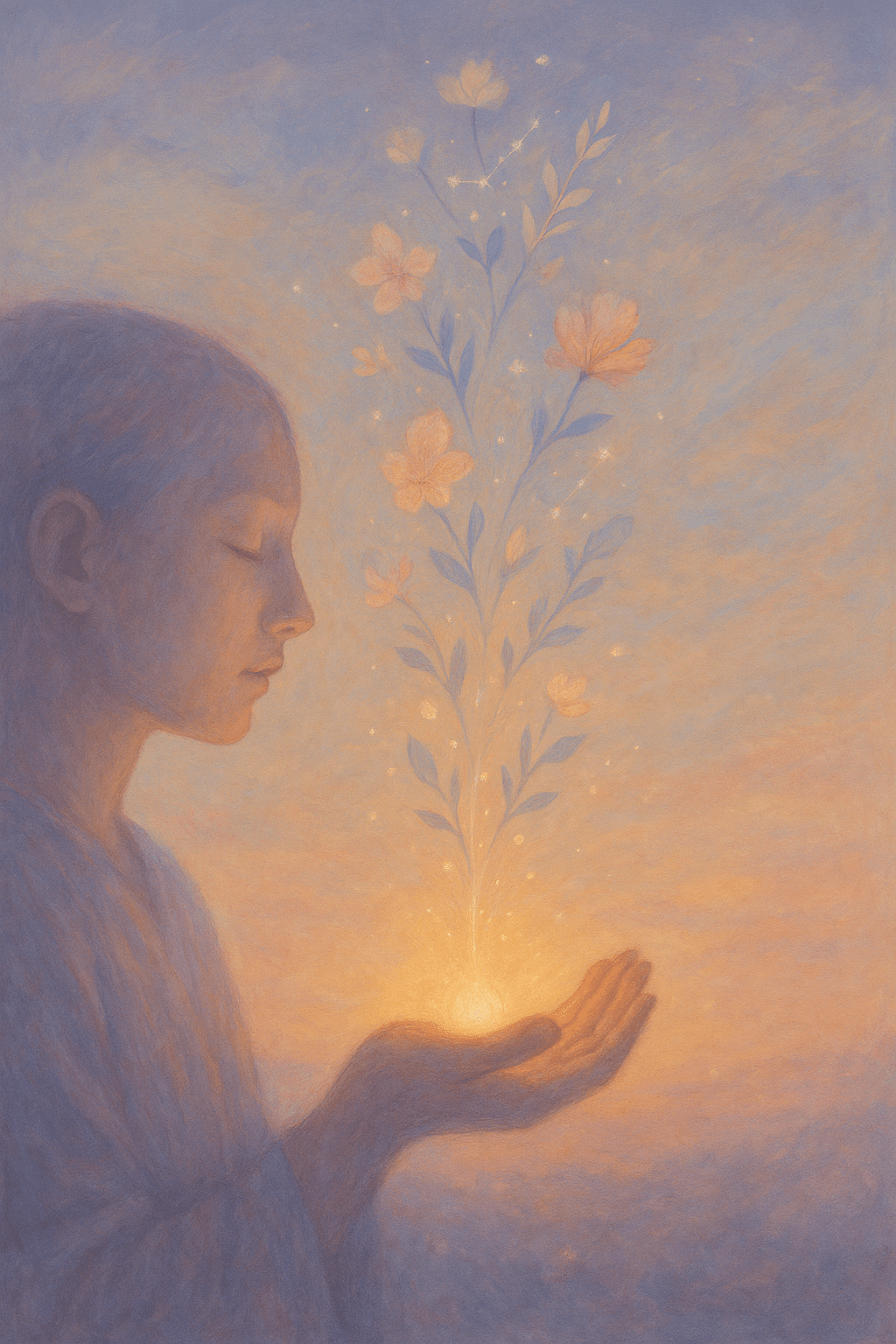
Tender care for your vision makes it blossom into reality. — Kahlil Gibran
—What lingers after this line?
Seeing Vision as a Living Seed
Kahlil Gibran’s line suggests that a vision is not a cold plan but a living seed waiting to grow. Rather than arriving fully formed, our deepest aspirations begin as fragile images in the mind, easily dismissed or forgotten. By calling for “tender care,” Gibran implies that visions require the same gentle attention we would give to a young plant. They respond to warmth, patience, and constancy, not to harsh demands or hurried timelines. In this way, the quote frames imagination as potential life: something that can flourish, wither, or remain dormant depending on how we treat it.
The Power of Gentle Attention
Moving from metaphor to practice, “tender care” emphasizes quality of attention over brute effort. Instead of forcing outcomes, we are invited to cultivate our ideas through small, consistent acts—journaling, sketching, revisiting, and refining them. Like a careful gardener checking soil and light, we learn to ask what our vision needs at each stage. This gentleness also guards us against self-criticism that can uproot a dream too early. By approaching our vision with curiosity rather than judgment, we create conditions in which possibility feels safe enough to grow.
Patience as the Bridge to Reality
Gibran’s choice of the word “blossom” signals that the path from idea to reality is organic, gradual, and season-bound. A blossom appears only after roots and stems have quietly developed; likewise, visible success usually rests on unseen periods of preparation. This perspective counters the modern obsession with instant results. It reminds us that timing matters and that rushing can damage what might otherwise flourish. Thus, patience becomes the bridge between envisioning and embodying, allowing each phase—conception, experimentation, and refinement—to unfold without premature abandonment.
From Inner Image to Outer Form
As we continue, the quote also points to a subtle transformation: careful inner work eventually manifests as outer form. When we repeatedly return to a vision, our choices, habits, and relationships begin to align around it, much like a plant orienting toward light. Artists often describe this process—an idea quietly shaping their days until a painting, poem, or design emerges. Similarly, social reformers from Martin Luther King Jr. to Wangari Maathai turned inner convictions into visible movements by tending their ideals through study, dialogue, and persistent action. In this sense, reality becomes the matured expression of an inner image long cared for.
Protecting Vision from Neglect and Harshness
However, Gibran’s emphasis on tenderness also implies what can harm a vision: neglect, ridicule, and relentless self-doubt. When we expose our fragile beginnings too quickly to cynical voices—our own or others’—we risk stunting their growth. Just as seedlings need shelter from storms, early-stage dreams benefit from boundaries and selective sharing. This does not mean avoiding criticism forever, but rather introducing challenge at the right time, when roots are strong. By respecting this vulnerability, we give our vision a genuine chance to mature instead of forcing it to withstand pressures it is not yet ready to bear.
Living as a Caretaker of Possibility
Ultimately, Gibran invites us to view ourselves as caretakers of possibility. Our role is less that of a commander issuing orders and more of a steward who notices, nourishes, and protects what is emerging. This shift in posture softens the anxiety around achievement and replaces it with a relationship to one’s own aspirations. Vision becomes something we accompany rather than conquer. As we practice this tenderness—through attention, patience, and wise protection—we increase the likelihood that what once existed only in the quiet of our hearts will, in time, stand before us as lived reality.
One-minute reflection
What's one small action this suggests?
Related Quotes
6 selectedVision without action is a daydream. Action without vision is a nightmare. — Japanese Proverb
Japanese Proverb
The proverb highlights the necessity of balancing vision and action. Neither should exist without the other if one wishes to achieve meaningful results.
Read full interpretation →Act as if what you intend to create is already true; let your vision manifest in the reality you build. — Unknown.
Unknown
This quote emphasizes the significance of visualization in achieving goals. By acting as though your desired outcome is already a reality, you align your actions and mindset with that vision.
Read full interpretation →Your thoughts shape your reality; cultivate positivity and watch the world transform around you. — Unknown.
Unknown
This quote highlights the significant role that our thoughts play in influencing our perception of reality. A positive mindset can lead to better experiences and outcomes.
Read full interpretation →Drawing is vision on paper. — Andrew Loomis
Andrew Loomis
At first glance, Andrew Loomis’s remark condenses the whole art of drawing into a single elegant idea: drawing is not merely the movement of a hand, but the translation of perception into form. In this sense, the page be...
Read full interpretation →A rock pile ceases to be a rock pile the moment a single man contemplates it, bearing within him the image of a cathedral. — Antoine de Saint-Exupéry
Exupéry
At first glance, Saint-Exupéry’s line seems to describe an ordinary heap of stones. Yet the moment someone looks at it while carrying the image of a cathedral within, the pile is transformed in meaning.
Read full interpretation →Sow clarity where confusion grows and watch your vision bloom. — Ada Lovelace
Ada Lovelace
Ada Lovelace frames understanding as an act of cultivation: clarity is something you “sow,” not something that merely appears. In this metaphor, confusion is not a personal failure but a kind of soil—messy, dense, and fu...
Read full interpretation →More From Author
More from Kahlil Gibran →Your home is your larger body. It grows in the sun and sleeps in the stillness of the night. — Kahlil Gibran
At first glance, Gibran transforms the idea of home from a mere structure into something intimate and organic: “your larger body.” In this image, a dwelling is not separate from the person who inhabits it, but an outward...
Read full interpretation →March on. Do not tarry. To go forward is to move toward perfection. — Kahlil Gibran
Gibran’s opening imperative—“March on. Do not tarry.”—sets a tone of disciplined urgency.
Read full interpretation →There must be spaces in your togetherness, and let the winds of the heavens dance between you. — Kahlil Gibran
Gibran’s line opens with a gentle paradox: he speaks to people who are already “together,” yet insists that togetherness is healthiest when it includes room. Rather than portraying love as fusion, he frames it as a relat...
Read full interpretation →Our anxiety does not come from thinking about the future, but from wanting to control it. — Kahlil Gibran
Kahlil Gibran reframes anxiety as something more specific than mere anticipation. The future itself—uncertain, unfolding, and not yet real—doesn’t automatically distress us; rather, distress appears when we demand certai...
Read full interpretation →