
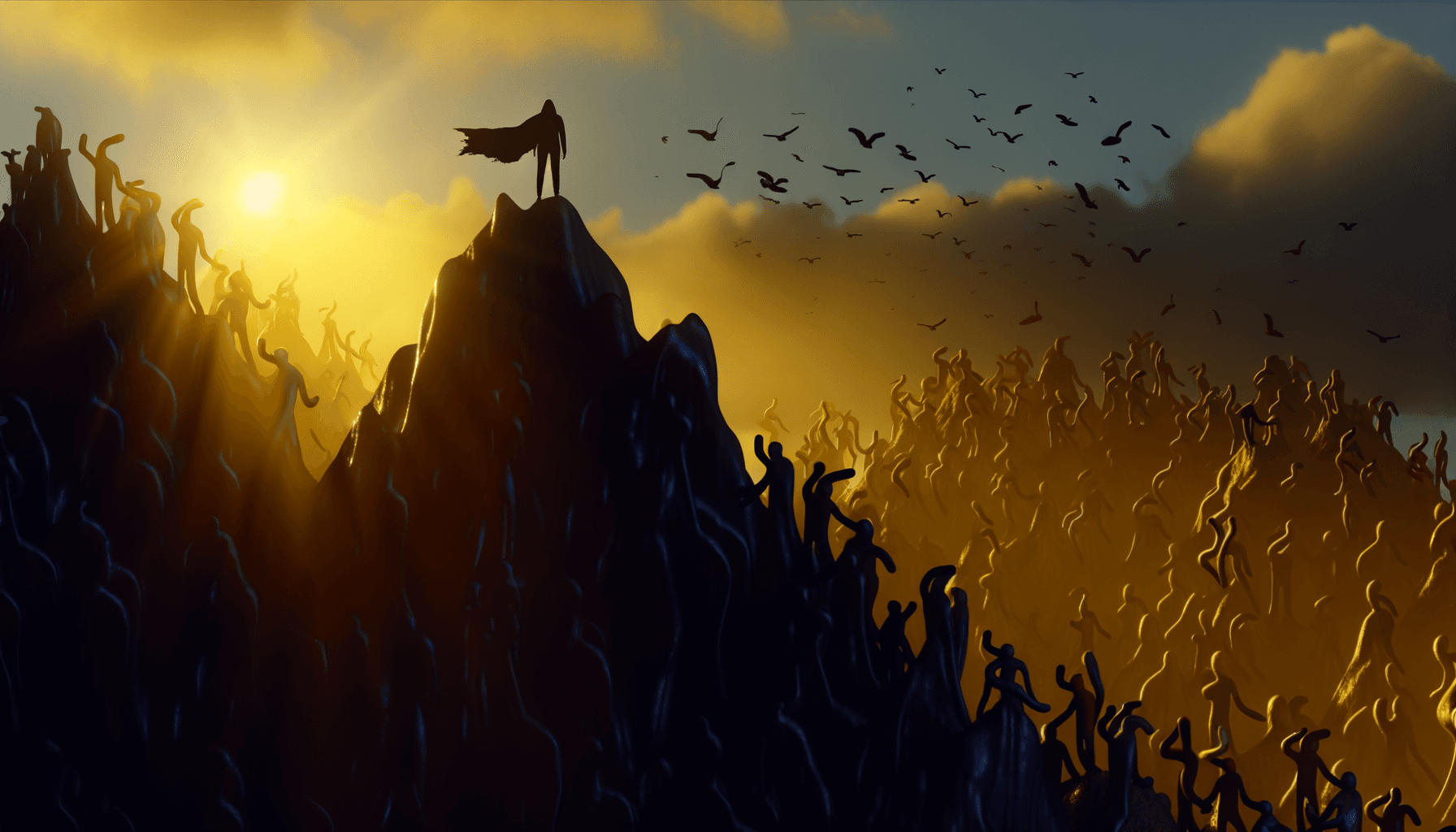
To achieve greatness, you must be willing to be mocked, hated, and misunderstood. — Auliq Ice
—What lingers after this line?
Resilience in the Face of Criticism
The quote highlights that those who strive for greatness often face opposition and criticism. It encourages individuals to develop resilience and not be discouraged by negativity.
Breaking Away from Conventional Thinking
Greatness often requires innovation and unconventional thinking. Being misunderstood is a natural consequence of challenging existing norms and introducing new ideas.
Courage and Determination
Achieving greatness requires the courage to keep moving forward despite mockery and hate. It emphasizes the importance of staying committed to one's vision and goals.
Historical Examples of Greatness
Many of history’s greatest figures, such as Galileo, Mahatma Gandhi, and Martin Luther King Jr., faced criticism and opposition before their contributions were truly recognized.
Personal Growth Through Adversity
Facing opposition helps in personal growth and refinement of ideas. The struggles and hardships encountered along the way often shape individuals into stronger versions of themselves.
One-minute reflection
Why might this line matter today, not tomorrow?
Related Quotes
6 selectedA mind grows by staying with difficulty long enough for the experience to change it. — Mary Catherine Bateson
Mary Catherine Bateson
Mary Catherine Bateson’s observation begins with a quiet but demanding truth: the mind does not grow merely by encountering difficulty, but by remaining with it. Challenge becomes transformative only when we resist the u...
Read full interpretation →When you are friends with your storm, you dance, instead of getting blown away. — Michael Bassey Johnson
Michael Bassey Johnson
Michael Bassey Johnson’s line begins with a striking reversal: the storm is not merely an enemy to survive, but a force one can learn to understand. In this sense, the storm may represent grief, fear, conflict, uncertain...
Read full interpretation →Just because your light flickers does not mean it is about to go out. — Yohancé Salimu
Yohancé Salimu
At first glance, Yohancé Salimu’s line separates appearance from reality. A flicker suggests instability, fatigue, or interruption, yet it does not automatically signal extinction.
Read full interpretation →When something in your life dies—whether it be a job, a hobby, or a dream—I encourage you not to focus on what could have been but instead to look for the new life and the new opportunities that result. — Ryan Hall
Ryan Hall
Ryan Hall frames loss as a kind of death, and that metaphor immediately broadens the quote beyond grief in the literal sense. A job can end, a cherished hobby can fade, and a long-held dream can collapse; yet in each cas...
Read full interpretation →If you are not failing from time to time, you are not aiming high enough. — Soichiro Honda
Soichiro Honda
At its core, Soichiro Honda’s remark reframes failure from a mark of inadequacy into proof of aspiration. If every attempt succeeds smoothly, the goal may be too safe, too familiar, or too small to stretch one’s abilitie...
Read full interpretation →Dreams are made of sturdy stuff. — William Carlos Williams
William Carlos Williams
At first glance, William Carlos Williams’s line reverses a familiar assumption: dreams are often treated as airy, fleeting, and insubstantial, yet he insists they are made of “sturdy stuff.” In that compact phrase, he gi...
Read full interpretation →More From Author
More from Auliq Ice →Act with integrity and you will be irresistible. — Auliq Ice
This quote highlights the essential nature of integrity, suggesting that being honest and ethical in one's actions naturally attracts others. Integrity is seen as a magnet for genuine relationships.
Read full interpretation →Take action, every day, and you will find that the smallest step can lead to the greatest journey. — Auliq Ice
This quote emphasizes that taking consistent action, no matter how small, is essential for achieving goals and initiating change in one’s life.
Read full interpretation →Dream beyond what you see. — Auliq Ice
This quote encourages individuals to think beyond their immediate reality and embrace the power of imagination. It highlights the importance of seeing possibilities that lie beyond the surface.
Read full interpretation →Believe in yourself, and the world will believe in you too. — Auliq Ice
This quote emphasizes the significance of self-belief. When you trust in your own abilities and worth, it creates a positive aura that others can see and respect.
Read full interpretation →