
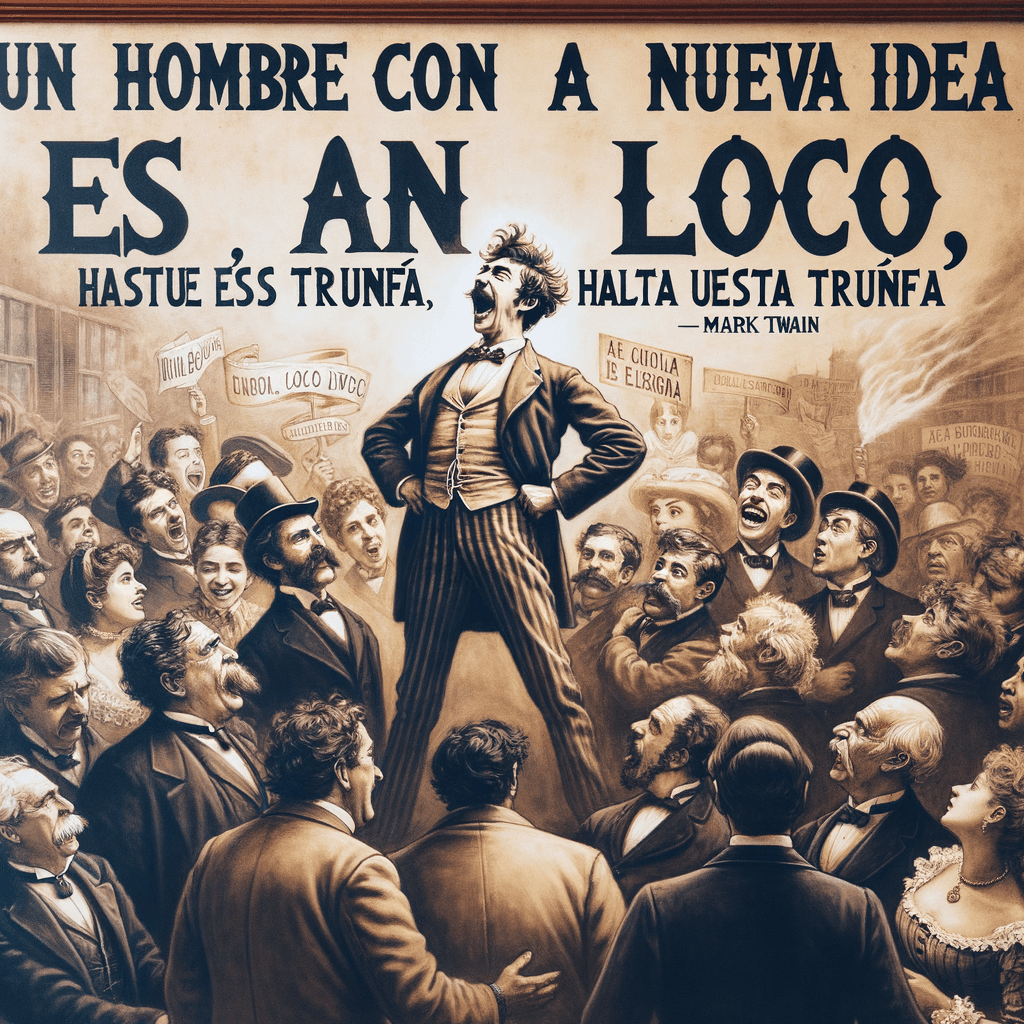
A man with a new idea is a madman until it succeeds. - Mark Twain
—What lingers after this line?
Innovation and Perception
This quote highlights how innovators are often met with skepticism and labeled as 'madmen' because their ideas challenge the status quo. Only when their ideas prove successful do they gain acceptance and recognition.
Resistance to Change
It accentuates society's natural resistance to change and how groundbreaking ideas often face opposition until they demonstrate tangible benefits or success.
Vision and Determination
The quote underscores the importance of vision and determination. Pioneers must persevere despite initial ridicule or doubt, as success will ultimately validate their innovation.
Historical Examples
Throughout history, many renowned inventors and thinkers, like Galileo or Einstein, were initially disregarded or even persecuted for their revolutionary ideas. Once these ideas proved successful, the perceptions of these individuals shifted from 'madmen' to geniuses.
Mark Twain's Perspective
As a prolific writer and social commentator, Mark Twain often examined human nature and society. This quote reflects his understanding of how unconventional ideas can catalyze progress despite initial resistance.
One-minute reflection
What's one small action this suggests?
Related Quotes
6 selectedYou cannot force ideas. Successful ideas are the result of slow growth. — Alexander Graham Bell
Alexander Graham Bell
Alexander Graham Bell’s statement begins with a quiet warning against impatience: ideas cannot be commanded into maturity simply because we desire results. Like plants, they require conditions, time, and repeated attenti...
Read full interpretation →We will either find a way, or make one. — Hannibal Barca
Hannibal Barca
At its core, Hannibal Barca’s line is a declaration that obstacles do not end the story; they merely change the method. Rather than waiting for ideal conditions, he frames action itself as the answer: if a route exists,...
Read full interpretation →Each time we shift the lens of our perceptions, we gain new perspectives—and new opportunities for innovation. — Linda Naiman
Linda Naiman
Linda Naiman’s quote begins with a simple but powerful premise: perception is not fixed, and neither are the possibilities we can imagine. When we deliberately shift how we look at a problem, a person, or a situation, wh...
Read full interpretation →Where all think alike there is little danger of innovation. — Edward Abbey
Edward Abbey
Edward Abbey’s line turns a common assumption on its head. At first glance, a group that thinks alike may seem stable, efficient, and harmonious.
Read full interpretation →Observe, imagine, then act — invention begins when thought meets motion — Leonardo da Vinci
Leonardo da Vinci
Leonardo’s sequence—observe, imagine, then act—reads like a practical recipe for invention rather than a lofty slogan. It starts with disciplined attention to the world, moves into the mind’s power to reshape what it has...
Read full interpretation →If you're not failing now and again, it's a sign you're not doing anything innovative. — Guy Kawasaki
Guy Kawasaki
Guy Kawasaki’s line reframes failure from a personal deficit into a useful indicator: if nothing is going wrong, you may not be attempting anything meaningfully new. Innovation, by definition, pushes beyond proven method...
Read full interpretation →More From Author
More from Mark Twain →We can secure other people's approval if we do right and try hard; but our own is worth a hundred of it. — Mark Twain
At its heart, Mark Twain argues that external approval is attainable through good conduct and honest effort, yet it remains secondary to a deeper judgment: our own. Praise from others can reassure us, but it is often cha...
Read full interpretation →Grief can take care of itself, but to get the full value of a joy you must have somebody to divide it with. — Mark Twain
Mark Twain’s remark begins with a striking contrast: grief, he says, can sustain its own weight, while joy needs companionship to reach its fullest meaning. In other words, sorrow often folds inward, making us solitary,...
Read full interpretation →Work consists of whatever a body is obliged to do, and that Play consists of whatever a body is not obliged to do. — Mark Twain
At first glance, Mark Twain’s line seems almost playful in its simplicity, yet it cuts directly to the heart of human motivation. Work, in his framing, is not defined by effort alone but by obligation: it is what a perso...
Read full interpretation →Eat a live frog first thing in the morning and nothing worse will happen to you the rest of the day. — Mark Twain
Mark Twain’s line is meant to jolt: the grotesque image of eating a live frog isn’t culinary advice but a metaphor for confronting the most unpleasant task first. By exaggerating the discomfort, Twain makes the underlyin...
Read full interpretation →