
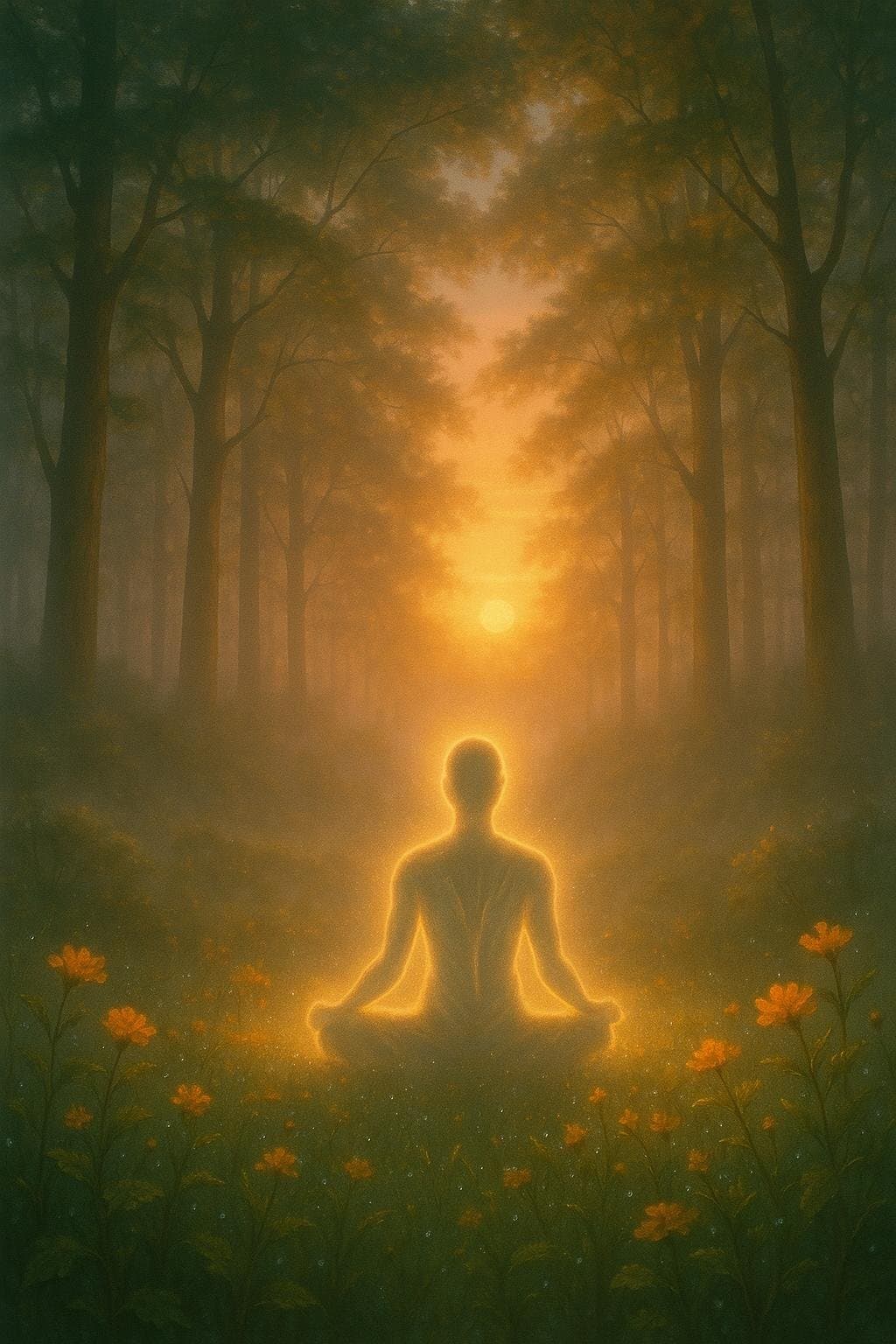
By awakening nature in ourselves, we awaken ourselves in nature. — Eckhart Tolle
—What lingers after this line?
Rediscovering Our Place in the Natural World
Eckhart Tolle’s reflection begins by turning our attention inward: he suggests that the process of awakening nature within ourselves is inseparable from rediscovering our own identity. Modern life often separates us from the earth that sustains us, but Tolle encourages a homecoming—reminding us that our innermost being and the outer world are deeply intertwined. This approach resonates with Indigenous cultures, for whom identity and land are inseparable elements of existence.
Seeing Ourselves Reflected in Nature’s Rhythms
As we awaken nature within, we start discerning the rhythms of renewal, growth, and transformation mirrored both in ourselves and in the environment. Consider the Japanese tradition of 'shinrin-yoku' or forest bathing, where mindful immersion in nature is believed to reduce stress and enhance clarity. In this way, our own states of mind often reflect the cyclical changes we observe in the natural world—highlighting the profound feedback loop between our consciousness and our surroundings.
Ecological Awareness and the Extended Self
Moving deeper, the awakening referenced by Tolle points toward a broader ecological awakening. Environmental philosophers like Arne Naess have spoken of the 'ecological self,' an expanded sense of identity rooted not only in individual experience but also in interconnectedness with all living things. When we perceive the unity between our inner being and nature, stewardship and empathy for the planet emerge naturally—making environmental care not just a value, but a lived extension of self-compassion.
Mindfulness as a Bridge Between Self and Nature
Tolle’s teachings often emphasize mindfulness—the act of being fully present in the moment. By practicing mindfulness in natural settings, such as sitting quietly by a stream or observing the unfolding of leaves, we dissolve the boundaries between the observer and the observed. As Henry David Thoreau noted during his time at Walden Pond (1854), immersion in nature sharpens awareness and dissolves the myth of separateness, accelerating both personal and ecological awakenings.
Cultivating Mutual Flourishing
Finally, awakening nature within ourselves creates space for reciprocal flourishing: as we nurture and respect the environment, we inevitably nourish our own well-being. This cyclical relationship calls us to actively tend both our inner landscape and the outer world—recognizing, as Tolle implies, that healing and growth are shared journeys. In protecting nature, we not only secure the planet’s vitality but also awaken hidden dimensions of our humanity.
One-minute reflection
Where does this idea show up in your life right now?
Related Quotes
6 selectedEverything in the world is full of signs. All events are coordinated. All things depend on each other. Everything breathes together. — Plotinus
Plotinus
At first glance, Plotinus presents the world not as a collection of isolated objects, but as a living whole in which every part participates in a larger order. His claim that everything is full of signs suggests that rea...
Read full interpretation →We are all so deeply interconnected; we have no option but to love all. — Amit Ray
Amit Ray
Amit Ray’s statement begins with a simple but far-reaching premise: human beings are not isolated units, but participants in a shared web of life. If our lives constantly shape one another through family, community, econ...
Read full interpretation →We are in it together and the company of spiritual friends helps us realize our interconnectedness. — Tara Brach
Tara Brach
Tara Brach’s statement begins with a simple but profound correction to the modern illusion of separateness: we are not moving through life alone. By saying “we are in it together,” she frames human experience as fundamen...
Read full interpretation →We are like islands in the sea, separate on the surface but connected in the deep. — William James
William James
William James’s metaphor begins with a simple visual truth: islands appear isolated when viewed from above. In the same way, human beings often seem self-contained, bounded by private thoughts, personal histories, and in...
Read full interpretation →In nature we never see anything isolated, but everything in connection with something else which is before it, beside it, under it and over it. — Johann Wolfgang von Goethe
Johann Wolfgang von Goethe
Goethe’s remark begins with a simple observation and expands into a profound worldview: nothing in nature exists alone. Every plant, stone, current, and creature belongs to a web of relations shaped by time, place, and s...
Read full interpretation →We are all connected in the great Circle of Life. — Mufasa
Mufasa
At its core, Mufasa’s line presents life as an interconnected whole rather than a collection of isolated beings. The image of a circle suggests continuity, reciprocity, and balance: every creature, action, and moment bel...
Read full interpretation →More From Author
More from Eckhart Tolle →If you get the inside right, the outside will fall into place. — Eckhart Tolle
At its heart, Eckhart Tolle’s statement suggests that external life often reflects internal condition. If the mind is conflicted, reactive, or fearful, the world can appear equally chaotic; conversely, when one cultivate...
Read full interpretation →Acknowledging the good that you already have in your life is the foundation for all abundance. — Eckhart Tolle
At its heart, Eckhart Tolle’s statement argues that abundance does not begin with acquisition but with recognition. Before people can feel that life is full, they must first notice the value already present in ordinary m...
Read full interpretation →The moment you start watching the thinker, a higher level of consciousness becomes activated. You then begin to realize that there is a vast realm of intelligence beyond thought. — Eckhart Tolle
At the heart of Tolle’s statement is a simple but radical shift: instead of being absorbed by thought, we begin to observe it. The ‘thinker’ is the stream of commentary, memory, judgment, and planning that usually feels...
Read full interpretation →Give up defining yourself—to yourself or to others. You won't die. You will come to life. — Eckhart Tolle
At its core, Eckhart Tolle’s statement urges us to loosen our grip on the identities we constantly construct. We define ourselves through profession, status, history, beliefs, and even wounds, imagining that these descri...
Read full interpretation →