
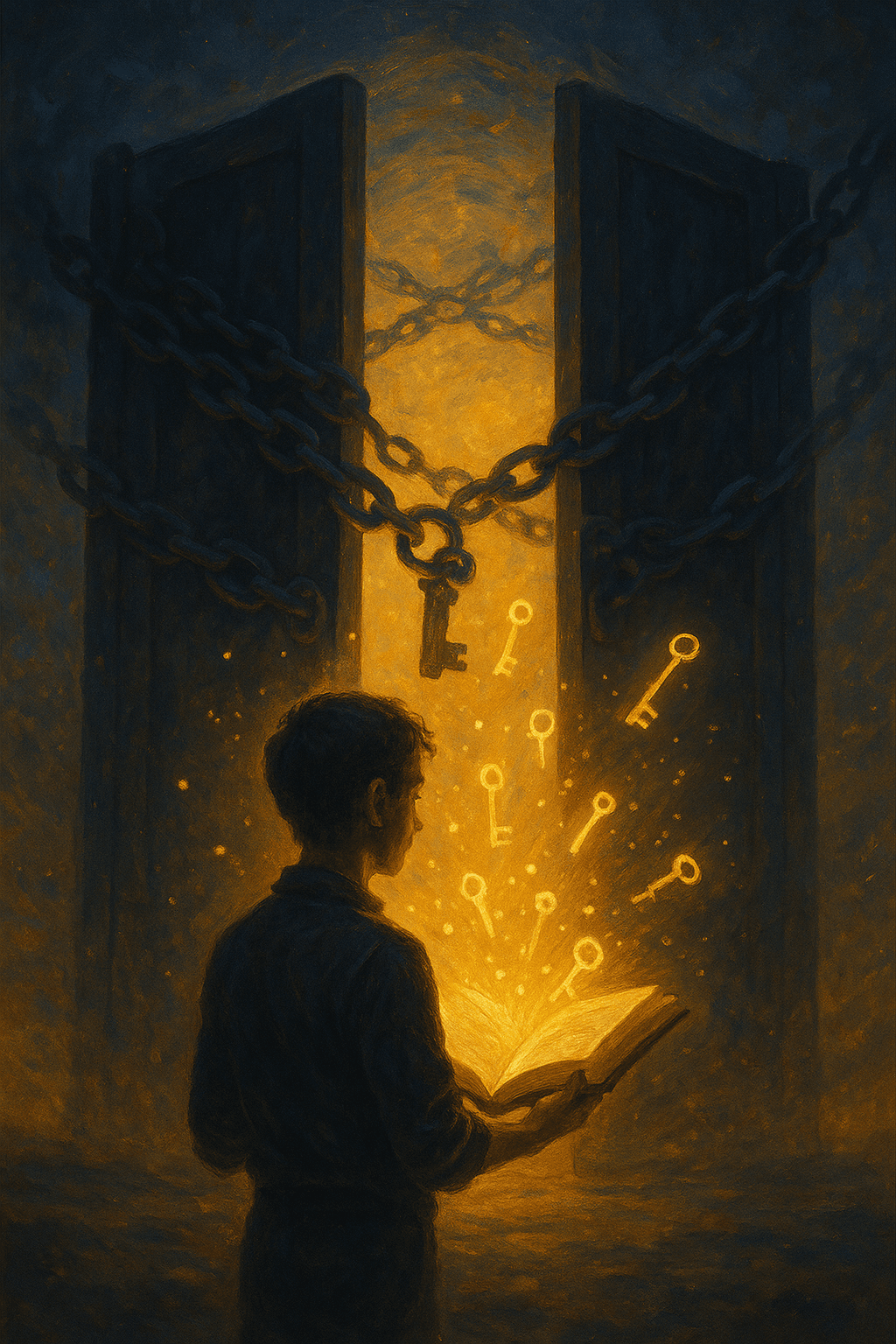
Claim education as your instrument; with knowledge, open the doors that bind. — Frederick Douglass
—What lingers after this line?
Douglass’s Life Behind the Metaphor
When Frederick Douglass urges us to “claim education as your instrument,” he speaks from the hard-earned authority of a man born into slavery who escaped through self-taught literacy. In his *Narrative of the Life of Frederick Douglass* (1845), he recalls how secretly learning to read transformed his sense of self, turning vague dissatisfaction into a clear understanding of injustice. Thus, his metaphor of doors that bind is not abstract rhetoric; it reflects iron barriers he personally confronted—laws, chains, and customs designed to keep enslaved people ignorant. By calling education an instrument, he frames knowledge not as a luxury but as a practical tool he once wielded to carve a path from bondage toward autonomy.
Education as Instrument, Not Ornament
Describing education as an instrument shifts it from decoration to action. Rather than a status symbol or mere credential, Douglass positions learning as something you pick up and use, like a hammer or compass. This view counters the idea that schooling exists only to impress others or secure titles. Instead, education becomes a working mechanism to question unfair rules, improve one’s livelihood, and make sense of the world. In this light, a textbook, a conversation, or even a single new concept can function as a lever, prying open constraints that once seemed immovable.
The Doors That Bind: Visible and Invisible
The “doors that bind” evoke prison cells and plantation gates, but Douglass’s phrase also gestures to less visible barriers. Legal prohibitions on teaching enslaved people to read were one kind of door; social prejudice and economic exclusion were others. Today, these doors may appear as underfunded schools, biased expectations, or digital divides that restrict who can access information. Yet, the image of a door implies that barriers have hinges—points of possible movement. Education, then, becomes the key that fits these hinges, allowing individuals and communities to push back against structures that once seemed permanently locked.
From Personal Liberation to Collective Change
Douglass’s own journey shows how personal learning can ripple outward into public transformation. Once literate, he not only escaped slavery but also became a formidable orator and abolitionist, using his knowledge of law, philosophy, and scripture to challenge pro-slavery arguments in public debates. Similarly, movements from women’s suffrage to civil rights have depended on educated voices capable of articulating injustice and envisioning alternatives. In this way, each person who claims education as an instrument becomes part of a larger orchestra, contributing to a collective effort to unbolt doors for others as well.
Claiming Knowledge in the Present Tense
Finally, Douglass’s use of the imperative—“claim”—underscores that education is not passively received; it is actively seized. Whether through formal schooling, online resources, or community mentorship, the act of claiming requires initiative and persistence, especially for those whom society sidelines. Yet as Malala Yousafzai’s advocacy for girls’ education demonstrates (*I Am Malala*, 2013), even modest learning spaces can cultivate world-changing courage. Douglass’s challenge therefore remains urgent: by deliberately pursuing and applying knowledge, individuals can turn education into a living instrument, continually unlocking new doors in their own lives and in the structures that shape us all.
One-minute reflection
What does this quote ask you to notice today?
Related Quotes
6 selectedEducation is the most powerful weapon which you can use to change the world. — Nelson Mandela, South Africa.
Nelson Mandela, South Africa.
Mandela emphasizes that education equips individuals with knowledge and skills necessary to effect transformative changes in society. It is a tool for empowerment and social progress.
Read full interpretation →As the soil, however rich it may be, cannot be productive without cultivation, so the mind without culture can never produce good fruit. — Seneca the Younger
Seneca the Younger
Seneca the Younger compares the mind to fertile soil, making a deceptively simple point: natural potential alone is not enough. Even the richest earth yields little if it is left untilled, neglected, or overrun.
Read full interpretation →The most important investment you can make is in your own education. — Morgan Housel
Morgan Housel
Morgan Housel’s statement reframes investment away from stocks, property, or savings accounts and toward something far more durable: personal knowledge. At first glance, education may seem less tangible than financial as...
Read full interpretation →Move toward what frightens you; there you will find the lessons that free you. — Desmond Tutu
Desmond Tutu
Desmond Tutu’s line reframes fear from a warning that says “don’t go” into a directional signal that says “look here.” What frightens us often marks the edge of our growth—where our skills, identities, or assumptions are...
Read full interpretation →Stand firm for learning and the world will open its doors. — Malala Yousafzai
Malala Yousafzai
Malala Yousafzai’s line marries resolve with possibility, suggesting that education rewards those who persist through resistance, boredom, or fear. To stand firm is not only to defend a principle in public but also to re...
Read full interpretation →Intelligence plus character—that is the goal of true education. — Martin Luther King Jr., United States.
Martin Luther King Jr., United States.
This quote emphasizes the importance of a well-rounded education that goes beyond intellectual achievement. True education should cultivate both knowledge and moral character.
Read full interpretation →More From Author
More from Frederick Douglass →The soul that is within me no man can degrade. — Frederick Douglass
Frederick Douglass’s line insists that there is a core of personhood that cannot be seized, even when everything else is threatened. He points to an inward refuge—“the soul that is within me”—where identity and worth rem...
Read full interpretation →Use the weight of every no as a lever to reach toward a new yes. — Frederick Douglass
Frederick Douglass frames rejection not as a dead end but as potential energy. A “no” carries weight—social pressure, disappointment, fatigue—and he suggests that this heaviness can be redirected rather than merely endur...
Read full interpretation →Rise each time with gratitude for the lesson and hunger for the next step. — Frederick Douglass
Douglass frames “rise each time” as an intentional stance rather than a lucky outcome. In his view, setbacks are inevitable, but our posture afterward is not: we can either remain where the blow landed or stand again wit...
Read full interpretation →Refuse to be a spectator of your life; be its craftsman. — Frederick Douglass
Frederick Douglass’s line draws a sharp boundary between merely witnessing our days and actively shaping them. To be a “spectator” is to let circumstances, other people, or fear decide the direction of our time; to be a...
Read full interpretation →