
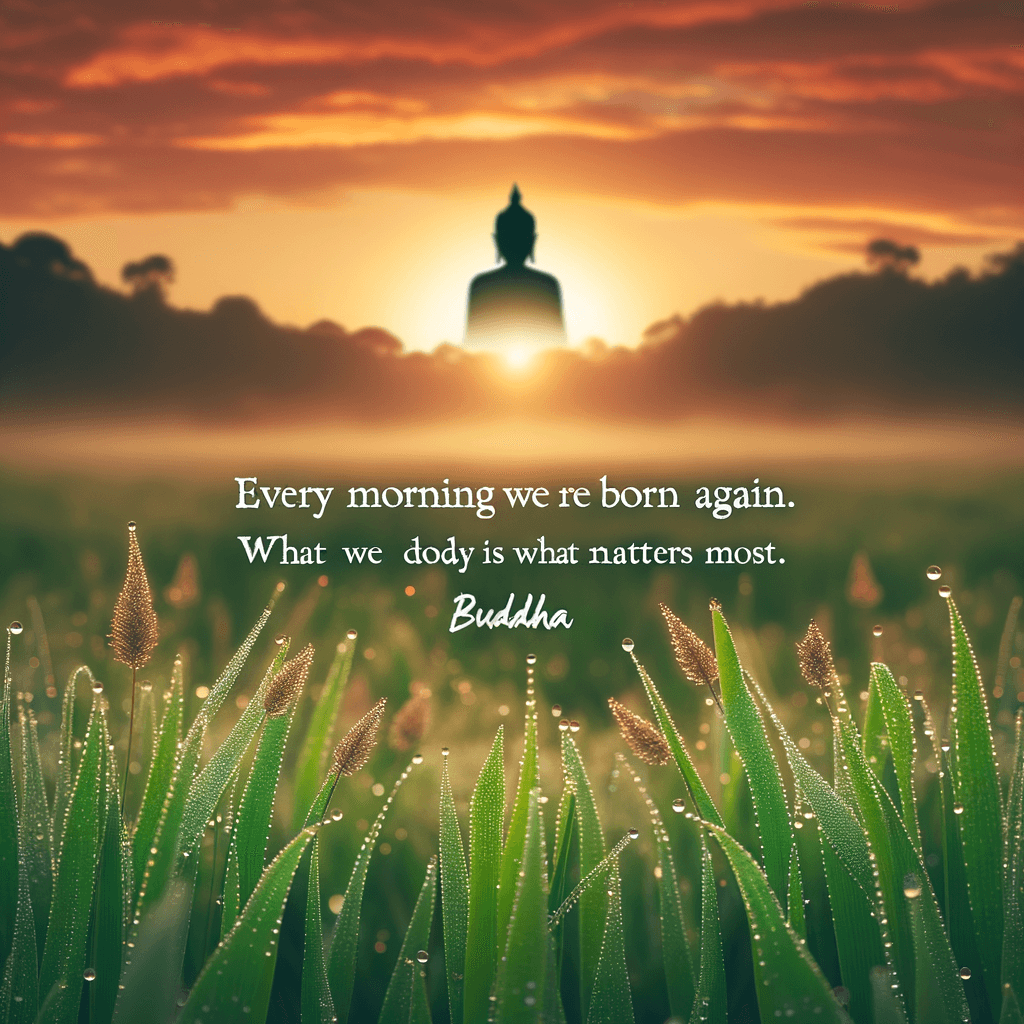
Each morning we are born again. What we do today is what matters most. - Buddha
—What lingers after this line?
Daily Renewal
This quote suggests that each day offers a fresh start, an opportunity to begin anew, free from the burdens of past mistakes or achievements.
Importance of the Present
It highlights the significance of living in the present moment. What we choose to do today carries the most weight and shapes our future, emphasizing the power of 'now'.
Mindfulness and Conscious Living
The quote encourages mindfulness and being fully engaged in the activities and decisions of today. By focusing on the present, we cultivate a more conscious approach to life.
Opportunity for Change
It underscores the idea that every day is an opportunity for personal growth and transformation. We are not bound by our past but can choose to make positive changes at any moment.
Philosophical and Spiritual Insight
Buddha’s teachings often focus on the transient nature of life and the importance of seizing the present moment. This quote reflects the core Buddhist principles of impermanence and the continuous potential for rebirth and renewal.
One-minute reflection
Why might this line matter today, not tomorrow?
Related Quotes
6 selectedDo not dwell in the past, do not dream of the future, concentrate the mind on the present moment. - Buddha
Buddha
This quote emphasizes the practice of mindfulness, which involves being fully present and engaged in the current moment, rather than getting lost in thoughts about the past or the future.
Read full interpretation →Every morning we are born again. What we do today is what matters most.
Unknown
This quote emphasizes the idea that each day provides a new opportunity for growth and change, similar to being reborn. It suggests that we should view each day as a fresh start.
Read full interpretation →Each sunset gives us a new opportunity to start again.
Unknown
This quote suggests that with each sunset, the conclusion of a day brings the chance to start again the following day. It emphasizes the cyclical nature of time and the idea that each day is a fresh start.
Read full interpretation →Every dawn is a new beginning.
Unknown
This statement suggests that each new day brings an opportunity for a fresh start. It implies that past actions and mistakes can be left behind, offering a chance to begin anew with optimism.
Read full interpretation →In the mist of every morning, lies the miracle of a new day.
Unknown
This quote emphasizes the idea that each morning brings a fresh start and a new opportunity. It highlights the daily renewal that comes with the dawn, setting the tone for potential and hope.
Read full interpretation →Every moment is a fresh beginning. — T.S. Eliot
T. S. Eliot
This quote highlights the idea that each moment is an opportunity to start anew. Life is filled with endless possibilities, and we can always make a fresh start regardless of past experiences.
Read full interpretation →More From Author
More from Buddha →To keep the body in good health is a duty, otherwise we shall not be able to keep our mind strong and clear. — Buddha
At its core, this saying presents physical care not as vanity or indulgence, but as a duty. The body is treated as the necessary ground on which mental clarity stands, so neglecting it becomes more than a personal lapse—...
Read full interpretation →However many holy words you read, however many you speak, what good will they do you if you do not act upon them? — Buddha
Buddha’s question cuts through spiritual comfort by shifting attention from what we consume—holy texts and pious speech—to what we embody. Reading and reciting can feel like progress because they are visible and repeatab...
Read full interpretation →Better than a thousand hollow words, is one word that brings peace. — Buddha
Buddha’s saying begins with a simple comparison: quantity versus consequence. A thousand words can impress, distract, or even manipulate, yet still remain “hollow” if they do not reduce suffering or clarify the mind.
Read full interpretation →The way is not in the sky. The way is in the heart. — Buddha
Buddha’s line redirects spiritual seeking away from distant, external places—“the sky”—and toward the intimate terrain of lived experience. Instead of imagining truth as something hidden in the heavens or guarded by spec...
Read full interpretation →