
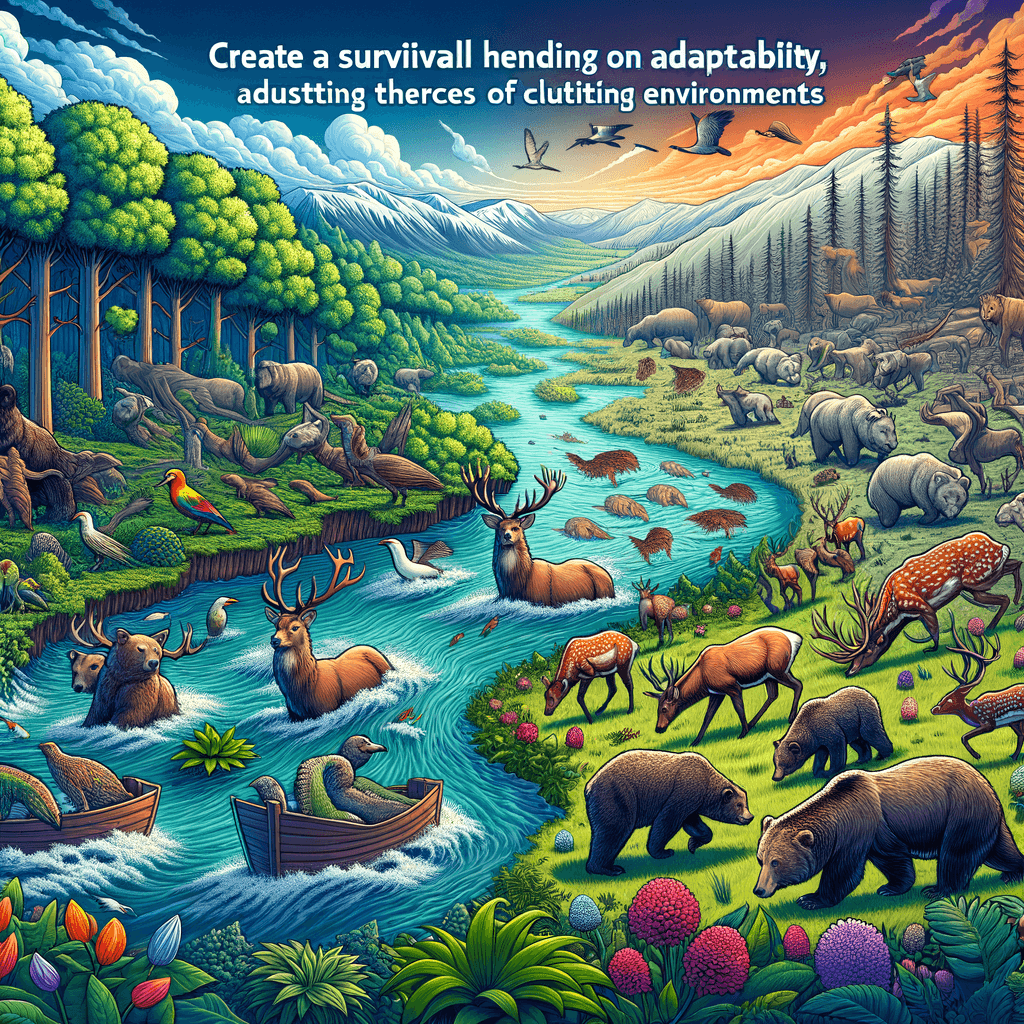
It is not the strongest of the species that survive, nor the most intelligent, but the one most responsive to change. — Charles Darwin
—What lingers after this line?
Adaptability in Nature
This quote highlights the critical role of adaptability in the survival of species. It suggests that those who can adjust to their environment and learn from changes are more likely to thrive.
Evolutionary Perspective
Darwin’s thoughts reflect his broader theory of evolution, which emphasizes that survival is less about strength or intelligence and more about the ability to respond effectively to environmental challenges.
Change as a Constant
The quote implies that change is a constant factor in ecosystems, and those who embrace it rather than resist it stand the best chance of survival, emphasizing the importance of flexibility.
Implications for Society and Individuals
Beyond biological species, this idea can be applied to individuals and societies, suggesting that those who are open to change and willing to evolve—whether in their skills, beliefs, or practices—are more likely to succeed.
Historical Context
Charles Darwin, a naturalist and biologist of the 19th century, is best known for his contributions to the understanding of evolution through natural selection, fundamentally shaping biological sciences and our comprehension of human nature.
One-minute reflection
What feeling does this quote bring up for you?
Related Quotes
6 selectedIt is not the strongest of the species that survive, nor the most intelligent, but the one most responsive to change. — Charles Darwin
Charles Darwin
Darwin’s line unsettles an intuitive assumption: that survival is a prize reserved for the strongest bodies or the cleverest minds. Instead, it points to a more practical definition of success—fit is not a permanent trai...
Read full interpretation →Your greatest strength lies in your ability to adapt. — Charles Darwin
Charles Darwin
This quote reflects a key idea from Darwin's theory of evolution — that adaptability is more crucial for survival than strength or intelligence. Organisms that adjust to changing environments thrive while others perish.
Read full interpretation →Emotional resilience refers to your ability to roll with the punches, adapt to adversity, and bounce back after setbacks. — Bettendorf Counseling Center
Bettendorf Counseling Center
At its core, the Bettendorf Counseling Center’s definition frames emotional resilience as a flexible strength rather than a hard shell. To “roll with the punches” is not to avoid pain or pretend setbacks do not matter; i...
Read full interpretation →The artist is not a solid, static being. The artist is fluid, like water, moving with the tides and changing form. — James McCrae
James McCrae
James McCrae’s image of the artist as fluid immediately challenges the common idea that creative people possess a single, fixed essence. Instead, he suggests that artistry is a process of becoming, not a stable condition...
Read full interpretation →To adapt is to survive. — Charles Darwin
Charles Darwin
This quote reflects Charles Darwin's theory of natural selection, which suggests that organisms that adapt to their environments are more likely to survive and reproduce.
Read full interpretation →The mind adapts and converts to its own purposes the obstacle to our acting. — Marcus Aurelius
Marcus Aurelius
At its heart, Marcus Aurelius’s line expresses a central Stoic conviction: external events do not fully determine our lives; rather, our judgments about them shape what they become. In his Meditations (c.
Read full interpretation →More From Author
More from Charles Darwin →It is not the strongest of the species that survive, nor the most intelligent, but the one most responsive to change. — Charles Darwin
Darwin’s line unsettles an intuitive assumption: that survival is a prize reserved for the strongest bodies or the cleverest minds. Instead, it points to a more practical definition of success—fit is not a permanent trai...
Read full interpretation →To adapt is to survive. — Charles Darwin
This quote reflects Charles Darwin's theory of natural selection, which suggests that organisms that adapt to their environments are more likely to survive and reproduce.
Read full interpretation →Your greatest strength lies in your ability to adapt. — Charles Darwin
This quote reflects a key idea from Darwin's theory of evolution — that adaptability is more crucial for survival than strength or intelligence. Organisms that adjust to changing environments thrive while others perish.
Read full interpretation →A man who dares to waste one hour of time has not discovered the value of life. — Charles Darwin
The quote stresses that time is one of our most valuable resources, and wasting it implies a lack of appreciation for life itself.
Read full interpretation →