
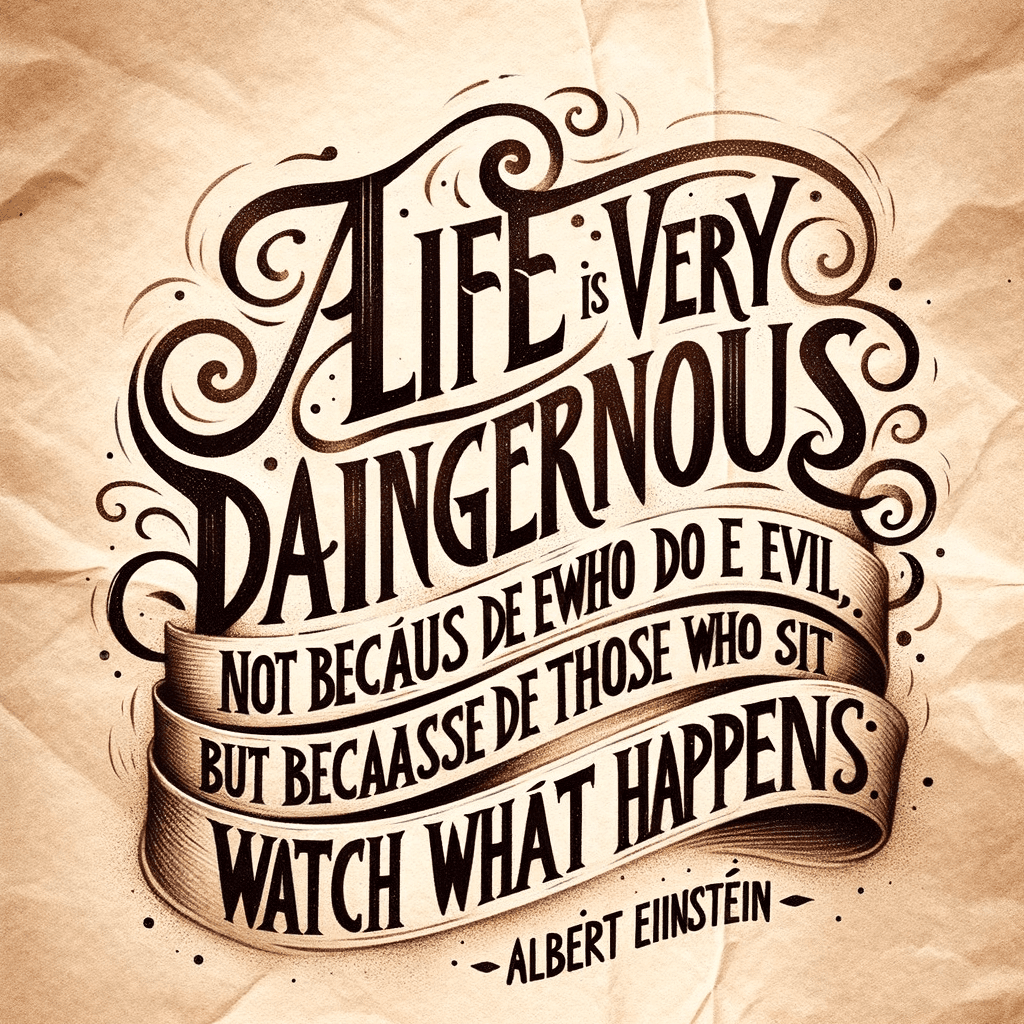
Life is very dangerous. Not because of the people who do evil, but because of those who sit and watch what happens. - Albert Einstein
—What lingers after this line?
Moral Responsibility
This quote emphasizes the moral responsibility of individuals to act against wrongdoing. It's not just the perpetrators of evil who are to blame for the consequences, but also those who choose to remain passive and do nothing.
Complicity and Inaction
Einstein points out that inaction in the face of evil is a form of complicity. Those who witness evil and choose not to act are, in a sense, enabling it by allowing it to continue unchecked.
Power of Collective Action
The quote underscores the power of collective action and the importance of individuals standing up against injustice. When people come together to confront evil, they can create significant positive change.
Ethical Imperative
Einstein's words serve as an ethical imperative, urging people to take a stand against evil whenever they encounter it. Silence and passivity are portrayed as dangerous because they permit the perpetuation of harm.
Sociopolitical Context
Albert Einstein lived through tumultuous times, including two World Wars and the rise of totalitarian regimes. His experiences likely shaped his belief in the importance of active opposition to evil and wrongdoing.
One-minute reflection
What's one small action this suggests?
Related Quotes
6 selectedYou have to do the best you can. This is our sacred human responsibility. — Albert Einstein
Albert Einstein
Einstein emphasizes the importance of always striving to do one’s best, regardless of the circumstances. This mindset fosters growth, perseverance, and success.
Read full interpretation →In the end, we will remember not the words of our enemies, but the silence of our friends. - Martin Luther King Jr.
Martin Luther King Jr.
This quote highlights the profound impact that silence and inaction from friends can have, often more so than the words or actions of adversaries.
Read full interpretation →A person may cause evil to others not only by his actions but by his inaction, and in either case he is justly accountable to them for the injury. — John Stuart Mill
John Stuart Mill
This quote highlights the idea that people bear moral responsibility not only for their direct actions but also for failing to act when action is necessary. Inaction can be as harmful as wrongful deeds.
Read full interpretation →To know what you can now do, is to know what you should do. — John Dewey
John Dewey
This quote suggests that understanding our capabilities comes with a sense of responsibility. Once we recognize what we are capable of, we should take action accordingly.
Read full interpretation →Act with intention, for every action shapes the world. — Aeschylus
Aeschylus
This quote emphasizes the importance of acting with purpose and awareness. Every decision and deed has consequences that extend beyond the individual, influencing the world around them.
Read full interpretation →The greatest offense is to do nothing when you could. — Publilius Syrus
Publilius Syrus
This quote highlights that choosing not to act, especially when one has the ability to help or make a difference, is itself a serious offense.
Read full interpretation →More From Author
More from Albert Einstein →Be a loner. That gives you time to wonder, to search for the truth. Have holy curiosity. Make your life worth living. — Albert Einstein
At first glance, Einstein’s advice to “be a loner” may sound like a rejection of society, yet his deeper point is about protecting the inner space where thought can mature. Solitude gives a person room to hear their own...
Read full interpretation →The best of community does give one a deep sense of belonging and well-being; and in that sense, community takes away loneliness. — Albert Einstein
Einstein’s observation begins with a quiet but profound insight: loneliness is not solved merely by being around other people, but by feeling meaningfully connected to them. In his phrasing, the “best of community” offer...
Read full interpretation →It is entirely possible that behind the perception of our senses, worlds are hidden of which we are unaware. — Albert Einstein
At first glance, Einstein’s remark invites intellectual humility. He suggests that what we see, hear, and touch may represent only a thin surface of reality, not its full depth.
Read full interpretation →It is not that I'm so smart, it's just that I stay with problems longer. — Albert Einstein
At first glance, Einstein’s remark sounds like modesty, yet it does more than downplay genius. By saying he simply ‘stays with problems longer,’ he shifts attention from innate talent to sustained effort, suggesting that...
Read full interpretation →