
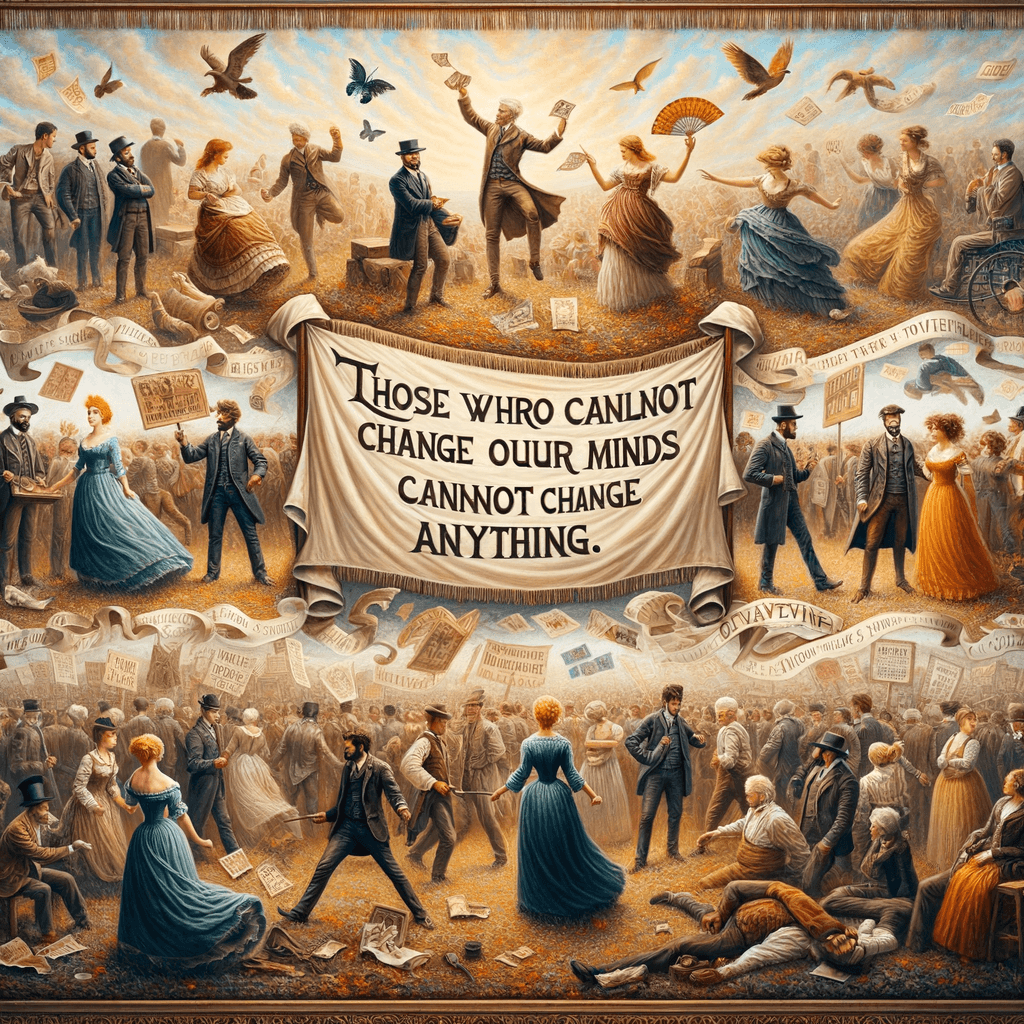
Those who cannot change their minds cannot change anything. — George Bernard Shaw
—What lingers after this line?
Importance of Open-Mindedness
This quote highlights the necessity of being open to new ideas and perspectives. To initiate any significant change in the world, one must first be willing to change their own beliefs and thoughts.
Mindset and Transformation
Shaw emphasizes that change starts within. A fixed mindset can prevent individuals from adapting to new circumstances, hindering personal and societal progress.
Influence of Thought on Action
The quote implies that thoughts and beliefs are the foundation of actions. To change actions and outcomes, one must begin by altering their mindset, illustrating the connection between internal beliefs and external reality.
Resistance to Change
It also draws attention to the common resistance people have toward changing their views. This resistance can be detrimental, as it limits their ability to grow and make meaningful changes in their lives and communities.
Historical Context
George Bernard Shaw was an influential playwright and critic known for his wit and social commentary in the late 19th and early 20th centuries. This quote reflects his advocacy for reform and progressive thinking during a time of significant social change.
One-minute reflection
What feeling does this quote bring up for you?
Related Quotes
6 selectedWhen you cannot achieve what you want, it is better to change your attitude. - Terence
Terence
This quote underscores the importance of being adaptable in the face of challenges. When faced with obstacles that prevent you from achieving your goals, adjusting your perspective or approach can lead to new solutions a...
Read full interpretation →Progress is impossible without change, and those who cannot change their minds cannot change anything. — George Bernard Shaw, Ireland. This quote highlights the necessity of adaptability and the willingness to embrace change as a catalyst for progress. It resonates with diverse perspectives globally, making it a compelling choice for an expressive visual representation.
George Bernard Shaw, Ireland. This quote highlights the necessity of adaptability and the willingness to embrace change as a catalyst for progress. It resonates with diverse perspectives globally, making it a compelling choice for an expressive visual representation.
This quote emphasizes that change is a fundamental requirement for progress. Without adapting and shifting our perspectives, it becomes impossible to achieve any form of advancement.
Read full interpretation →To improve is to change; to be perfect is to change often. — Winston S. Churchill, United Kingdom. This quote emphasizes the importance of adaptability and continuous improvement, encouraging individuals to embrace change as a pathway to growth and success. Its universal message resonates with diverse audiences globally, making it an excellent choice for an engaging and expressive visual representation.
Winston S. Churchill, United Kingdom. This quote emphasizes the importance of adaptability and continuous improvement, encouraging individuals to embrace change as a pathway to growth and success. Its universal message resonates with diverse audiences globally, making it an excellent choice for an engaging and expressive visual representation.
This quote highlights the necessity of being open to change as a means of personal and professional development. Adaptability is portrayed as a key trait for those seeking to grow and improve in various aspects of life.
Read full interpretation →The world as we have created it is a process of our thinking. It cannot be changed without changing our thinking. — Albert Einstein
Albert Einstein
This quote emphasizes the significant impact our thoughts have on the world around us. It suggests that our external reality is shaped by and mirrors our mindset, beliefs, and perceptions.
Read full interpretation →Emotional resilience refers to your ability to roll with the punches, adapt to adversity, and bounce back after setbacks. — Bettendorf Counseling Center
Bettendorf Counseling Center
At its core, the Bettendorf Counseling Center’s definition frames emotional resilience as a flexible strength rather than a hard shell. To “roll with the punches” is not to avoid pain or pretend setbacks do not matter; i...
Read full interpretation →The artist is not a solid, static being. The artist is fluid, like water, moving with the tides and changing form. — James McCrae
James McCrae
James McCrae’s image of the artist as fluid immediately challenges the common idea that creative people possess a single, fixed essence. Instead, he suggests that artistry is a process of becoming, not a stable condition...
Read full interpretation →More From Author
More from George Bernard Shaw →If you cannot get rid of the family skeleton, you may as well make it dance. — George Bernard Shaw
At first glance, Shaw’s line turns a grim image into a comic one. A “family skeleton” suggests old scandals, inherited flaws, or embarrassing truths that refuse to stay buried; yet instead of denying them, he proposes ma...
Read full interpretation →Families are like fudge — mostly sweet with a few nuts. — George Bernard Shaw
George Bernard Shaw’s quip immediately turns family into something familiar and edible: fudge, a confection associated with comfort, celebration, and indulgence. At first glance, the comparison is playful, yet it quickly...
Read full interpretation →In life, it is not about finding oneself, but about creating oneself. - George Bernard Shaw
This quote differentiates between finding and creating yourself. It implies that personal identity and purpose are not pre-existing but rather something you build through experiences, choices, and actions.
Read full interpretation →Don't wait for opportunity. Create it. — George Bernard Shaw
This quote emphasizes the importance of being proactive. Instead of passively waiting for chances to come your way, it encourages taking actions to generate your own opportunities.
Read full interpretation →