
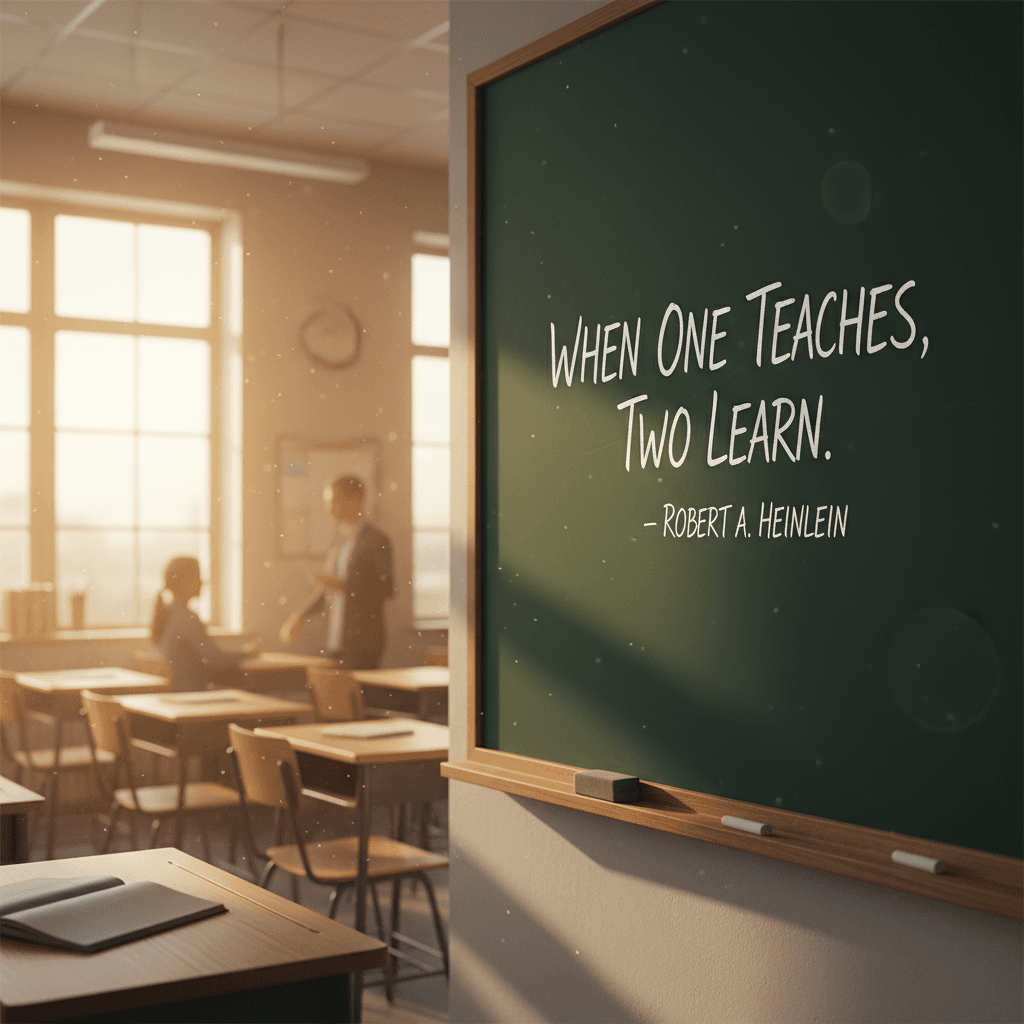
When one teaches, two learn. — Robert A. Heinlein
—What lingers after this line?
The Reciprocity of Instruction
Heinlein’s aphorism captures a quiet truth: teaching is never a one-way transfer. The moment we try to explain an idea to someone else, we discover the edges of our own understanding. Questions from learners expose ambiguities we glossed over, while the very act of organizing thoughts into a narrative forces latent assumptions into the open. Thus, teaching is both service and self-audit, creating a loop where explanation refines knowledge and curiosity fuels deeper inquiry. From this vantage, the classroom becomes a shared workshop rather than a stage, and the teacher’s learning is not a byproduct but a core feature of the process, naturally leading us to ask why explanation changes the explainer.
Why Explaining Rewires Understanding
Cognitive science offers several mechanisms. Retrieval practice strengthens memory by pulling knowledge out rather than merely rereading it; Karpicke and Roediger (2008) showed this “testing effect” reliably enhances retention. Likewise, the generation effect—producing answers instead of receiving them—improves recall (Slamecka & Graf, 1978). When teachers explain, they self-explain: they connect ideas, surface causal links, and repair gaps. Roscoe and Chi (2007) distinguish shallow “knowledge-telling” from deeper “knowledge-building,” the latter being where tutors truly learn. Extending this, Fiorella and Mayer (2013, 2014) found that preparing to teach can itself boost learning, even before the lesson is delivered. Consequently, teaching orchestrates retrieval, generation, and elaboration in one activity, turning knowledge from static to usable.
Dialogue from Socrates to Heinlein
Historically, the insight predates modern classrooms. Plato’s Meno (c. 380 BC) shows Socrates guiding a slave boy to geometric truths through carefully staged questions, illustrating how teaching-by-questioning clarifies the teacher’s own concepts. Medieval disputations continued this dialogic tradition, as objections and replies sharpened arguments; Thomas Aquinas structured the Summa to learn by answering his strongest critics first. In each case, the teacher’s learning occurs in the crucible of dialogue, where counterexamples must be met and definitions refined. This lineage sets the stage for contemporary pedagogies that formalize dialogue, demonstrating that Heinlein’s claim rests on a long, cross-generational practice of learning through the act of instruction.
Modern Methods that Harness the Effect
Contemporary classrooms build on these dynamics. Eric Mazur’s Peer Instruction (1997) has students commit to an answer, then teach peers before voting again; the ensuing explanations lift understanding for both explainer and listener. Cooperative structures like the jigsaw classroom (Aronson et al., 1978) assign each student expertise to teach, ensuring everyone both instructs and learns. Beyond formal methods, the popular “Feynman Technique” asks learners to explain a concept simply, reveal gaps, and iterate—an approachable path to the same end. Across these approaches, the throughline is deliberate explanation under social accountability, which converts passive familiarity into active, transferrable knowledge.
Communities Where Teachers Become Students
Outside school walls, the pattern persists. In medical training, the “see one, do one, teach one” ethos crystallizes learning through immediate instruction, while code reviews and open-source documentation similarly compel explainers to debug their own understanding. On Q&A forums like Stack Overflow, writing a clear answer often uncovers edge cases, prompting authors to test and revise code before posting. Even “rubber duck debugging” shows that articulating a problem—as if teaching an inanimate listener—can reveal the solution. These practices demonstrate that communities thrive when explanation is normalized, because each teacher’s clarifications ripple outward as shared competence.
Designing for Mutual Learning
To make Heinlein’s principle actionable, structure environments where everyone explains. Rotate roles so novices routinely teach back key steps; in health settings, the “teach-back” method confirms understanding and educates both parties. Build frequent, low-stakes prompts for prediction, justification, and peer tutoring so retrieval and generation become habits, not hurdles. Finally, scaffold with Vygotsky’s Zone of Proximal Development (1978): pair learners so each can stretch just beyond current ability with guided support. In this design, teaching ceases to be a terminal act and becomes a catalyst—ensuring that whenever one teaches, two, and often many more, learn.
One-minute reflection
Why might this line matter today, not tomorrow?
Related Quotes
6 selectedBy learning you will teach; by teaching you will learn. — Latin Proverb
Latin Proverb
This proverb highlights the cyclical relationship between learning and teaching, suggesting that both are interconnected processes.
Read full interpretation →The delicate balance of mentoring someone is not creating them in your own image, but giving them the opportunity to create themselves. — Steven Spielberg
Steven Spielberg
At its heart, Spielberg’s remark reframes mentoring as an act of stewardship rather than control. A mentor may offer knowledge, discipline, and encouragement, yet the goal is not to reproduce a younger version of oneself...
Read full interpretation →A mentor is someone who allows you to see the hope inside yourself. — Oprah Winfrey
Oprah Winfrey
Oprah Winfrey’s line reframes hope as an internal resource rather than an external gift. A mentor, in this view, isn’t a savior who supplies confidence from the outside; instead, they help you recognize what has been the...
Read full interpretation →Giving is not a subtraction; it is an intentional multiplication. We rise the highest when we are busy clearing the path for the person behind us. — Proverb
Proverb
The proverb begins by overturning a common fear: that giving makes us smaller. In this framing, generosity is not a zero-sum exchange where one person’s gain requires another’s loss.
Read full interpretation →Design tools of progress, then teach others to craft them too. — Ada Lovelace
Ada Lovelace
Ada Lovelace’s line frames progress not as an accident of history but as a deliberate artifact—something designed. The word “tools” is pivotal: it suggests systems, methods, and instruments that let human capability comp...
Read full interpretation →Transform your struggles into questions, and let your answers teach others. — Fyodor Dostoevsky
Fyodor Dostoevsky
Dostoevsky’s line urges a subtle but profound shift: instead of merely enduring hardship, we are invited to interrogate it. When we ask, “What is this pain showing me?” or “What choice led here?”, we move from passive su...
Read full interpretation →More From Author
More from Robert A. Heinlein →