
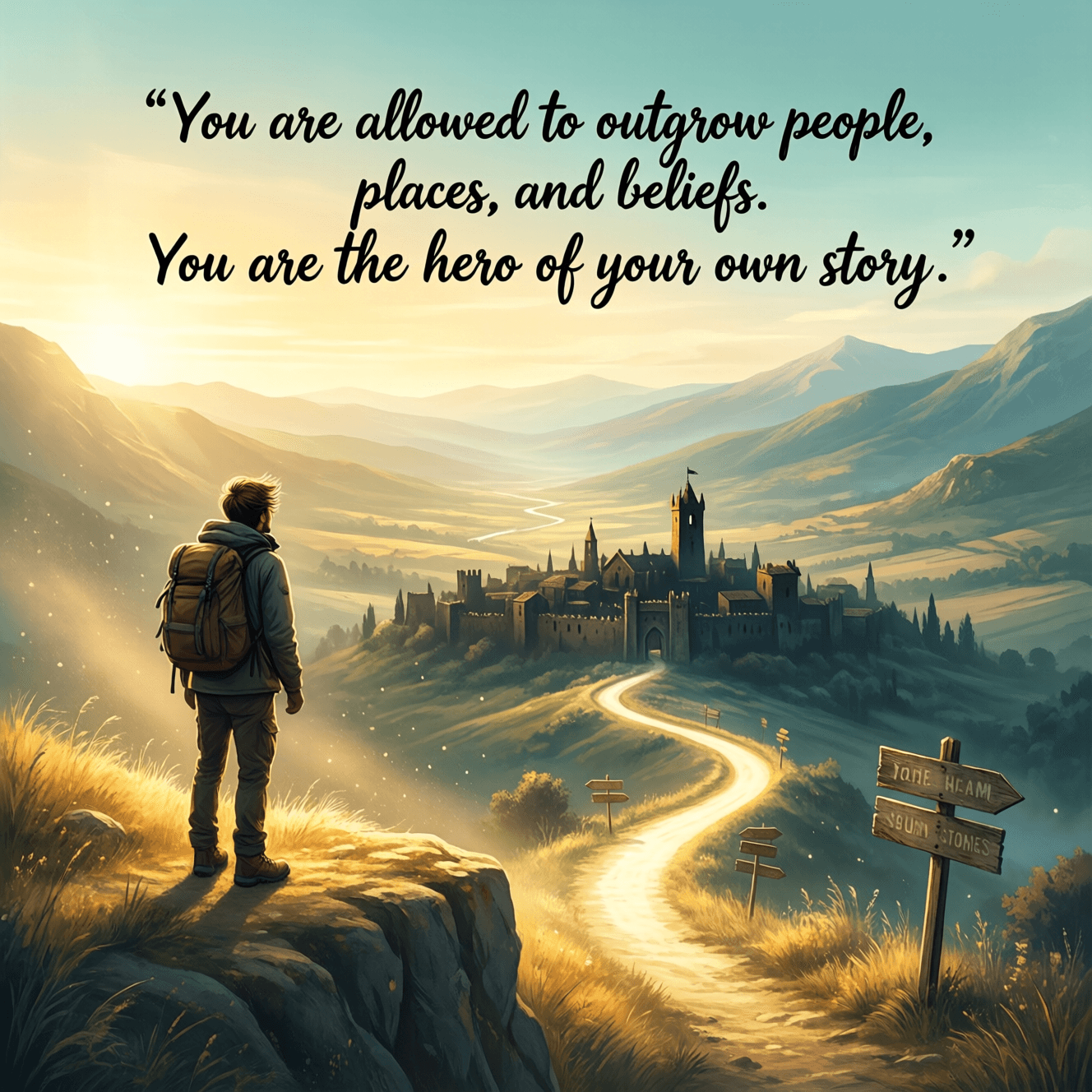
You are allowed to outgrow people, places, and beliefs. You are the hero of your own story. — Nedra Glover Tawwab
—What lingers after this line?
Permission to Evolve
Nedra Glover Tawwab’s words begin with a quiet but radical kind of permission: you are allowed to change. Many people treat their earlier choices—friendships, hometown identities, long-held convictions—as contracts they must honor forever, even when those things no longer fit. By framing growth as something you are “allowed” to do, she highlights how guilt and social pressure can make evolution feel like betrayal. From there, the quote implies a simple truth about being human: development is not a deviation from the path; it is the path. When your needs, values, or understanding deepens, staying the same may be less loyal and more self-abandoning.
Outgrowing People Without Villains
Moving from inner permission to outer relationships, “outgrowing people” challenges the idea that every connection must be preserved to be meaningful. Sometimes you and a friend were perfectly matched for a season—shared struggles, shared humor, shared proximity—but the foundation shifts as one or both of you change. That doesn’t require anyone to be cruel or wrong; it can be a natural divergence. Even so, the grief is real. You may mourn the version of yourself who once fit effortlessly in that circle. Yet acknowledging the mismatch can be an act of respect: for what the relationship was, and for who you are becoming.
Leaving Places and the Identities They Carry
Next, Tawwab includes “places,” pointing to how environments shape identity. A city, a workplace, a family home, or even a social scene can offer belonging while also setting invisible limits: what’s considered ambitious, acceptable, or possible. Outgrowing a place often means you’re no longer willing to shrink your life to match its expectations. This isn’t only about geography; it’s about context. Changing your surroundings can make growth sustainable, because the cues around you—routines, norms, and opportunities—start reinforcing the person you’re trying to become rather than pulling you back into old roles.
Revising Beliefs as Strength, Not Betrayal
Then comes the most intimate category: beliefs. People often cling to old ideas because changing them can feel like admitting you were naive, disloyal, or misguided. But intellectual and emotional maturity frequently involves refining what you think and why you think it. James’s pragmatic philosophy in *Pragmatism* (1907) frames truth as something tested in lived experience, suggesting that revising beliefs can be a sign of honest engagement with reality. As you learn more—about yourself, others, and the world—your values may sharpen, soften, or shift. The goal isn’t to constantly reinvent yourself, but to remain responsive rather than rigid.
Becoming the Hero, Not the Side Character
With that groundwork laid, Tawwab’s second line reframes agency: “You are the hero of your own story.” It counters the common habit of narrating life from the perspective of other people’s needs—trying to be the good child, the agreeable partner, the reliable friend, the low-maintenance employee. In that script, your desires become supporting details. Seeing yourself as the hero doesn’t mean becoming self-centered; it means taking responsibility for your arc. Heroes make choices, face consequences, and grow. Importantly, they stop asking for permission to matter.
Boundaries as the Plot Device of Growth
Finally, the quote implies a practical mechanism for this transformation: boundaries. You cannot outgrow people, places, or beliefs without changing what you tolerate, what you prioritize, and what you repeatedly return to. Tawwab’s own work, including *Set Boundaries, Find Peace* (2021), emphasizes that boundaries are not punishments; they are clarifying decisions about access to your time, energy, and trust. As those boundaries solidify, your life begins to read differently—less like a series of reactions and more like a chosen storyline. And that is what makes the closing claim feel true: the hero is the person who keeps writing forward.
One-minute reflection
What does this quote ask you to notice today?
Related Quotes
6 selectedLearning to love yourself is like learning to walk – essential, life-changing, and the only way to stand tall. — Vironika Tugaleva
Vironika Tugaleva
Vironika Tugaleva’s comparison begins with a simple but powerful truth: self-love is not a luxury, but a basic human necessity. Just as walking allows a child to move through the world with growing independence, learning...
Read full interpretation →The most gifted members of the human species are at their creative best when they cannot have their way, and must compensate for what they miss by realizing and cultivating their capacities. — Bryant H. McGill
Bryant H. McGill
Bryant H. McGill’s observation begins with a striking reversal: gifted people may not reach their highest potential when everything comes easily, but when something blocks their path.
Read full interpretation →A mind grows by staying with difficulty long enough for the experience to change it. — Mary Catherine Bateson
Mary Catherine Bateson
Mary Catherine Bateson’s observation begins with a quiet but demanding truth: the mind does not grow merely by encountering difficulty, but by remaining with it. Challenge becomes transformative only when we resist the u...
Read full interpretation →Consistency is a superpower. — Ryan Holiday
Ryan Holiday
Ryan Holiday’s line begins with a deceptively simple idea: greatness is rarely built through dramatic gestures. More often, it emerges from repeated actions that seem ordinary in isolation but become extraordinary over t...
Read full interpretation →Confidence is silent. Insecurities are loud. — Unknown (Wait—skip/replace with: True nobility is being superior to your former self. — Ernest Hemingway)
Ernest Hemingway
At its core, Hemingway’s line redefines nobility as an inward achievement rather than a social rank. Instead of measuring worth by wealth, pedigree, or dominance over others, it points to a quieter standard: becoming bet...
Read full interpretation →You are under no obligation to be consistent with the person you were yesterday. — James McCrae
James McCrae
At its core, James McCrae’s line challenges the quiet pressure to remain legible to others. Many people feel bound to opinions, habits, or identities simply because they once claimed them, as though consistency were a mo...
Read full interpretation →More From Author
More from Nedra Glover Tawwab →Stop shrinking yourself to make others comfortable. Your peace is worth more than their approval. — Nedra Glover Tawwab
Nedra Glover Tawwab’s words begin with a quiet but powerful warning: when we constantly make ourselves smaller to keep others comfortable, we often pay with our confidence, honesty, and emotional well-being. This kind of...
Read full interpretation →It is not a sign that you are doing something wrong to need a break; it is a sign that you are human. — Nedra Glover Tawwab
At its core, Nedra Glover Tawwab’s quote rejects the harsh belief that constant productivity is the measure of worth. Instead, it reframes the need for a break as evidence of our basic humanity: bodies tire, minds overlo...
Read full interpretation →The most powerful relationship you will ever have is the relationship with yourself. — Nedra Glover Tawwab
Nedra Glover Tawwab’s quote places self-relationship at the center of human life, suggesting that every other bond is filtered through the one we have with ourselves. In other words, the way we speak to ourselves, interp...
Read full interpretation →Boundaries are not walls to keep others out, but gates to protect your own nervous system. — Nedra Glover Tawwab
At first glance, boundaries are often mistaken for rejection, distance, or emotional coldness. Yet Nedra Glover Tawwab’s image of gates rather than walls shifts the entire meaning: boundaries are not built to punish othe...
Read full interpretation →