
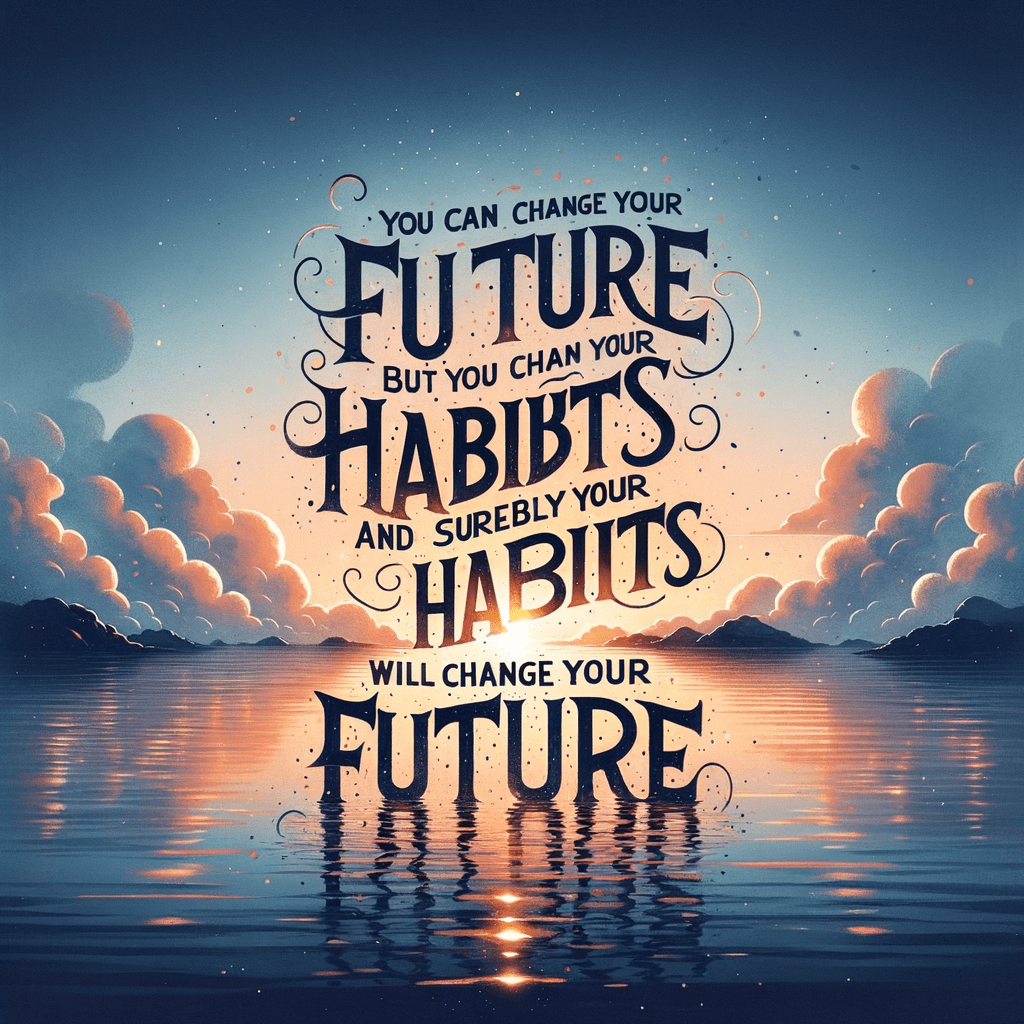
You cannot change your future, but you can change your habits, and surely your habits will change your future. — A.P.J. Abdul Kalam
—What lingers after this line?
Power of Habits
This quote highlights the idea that while one cannot directly alter the future, focusing on changing daily habits can lead to significant transformations over time.
Future Uncertainty
The statement acknowledges the uncertainty of the future; it implies that the future is influenced more by our choices and actions in the present than by mere wishes or desires.
Action Over Inaction
It emphasizes the importance of taking proactive steps in life. Instead of lamenting the inability to change predetermined outcomes, individuals can take charge by altering their everyday behaviors.
Cumulative Impact of Small Changes
The quote suggests that small, consistent changes in habits can accumulate over time, eventually leading to significant changes in one’s circumstances and future.
Philosophy of A.P.J. Abdul Kalam
As a visionary leader, A.P.J. Abdul Kalam, former President of India, often spoke about the potential of individuals to shape their destinies through knowledge and positive actions, which resonates through this quote.
One-minute reflection
What does this quote ask you to notice today?
Related Quotes
6 selectedIf you want to change your life, you have to change your habits. Your daily routine is the only thing that creates your future. — Aristotle
Aristotle
The quote frames personal change as a practical, repeatable process rather than a single dramatic breakthrough. If your life is the sum of what you repeatedly do, then habits become the hidden architecture shaping your o...
Read full interpretation →Every man can be, if he so desires, the sculptor of his own soul. — A.P.J. Abdul Kalam
A. P. J. Abdul Kalam
This quote highlights the idea that everyone has the potential for self-improvement and growth. It emphasizes that individuals hold the power to shape their own character and destiny.
Read full interpretation →You cannot command things, but you can command yourself. — Michael D. Pollock
Michael D. Pollock
At first glance, Michael D. Pollock’s line draws a sharp boundary between the outer world and the inner one.
Read full interpretation →Consistency beats intensity every single time. If your morning maintenance takes more than twenty minutes to execute, you will abandon it by July. — Dr. Elliot Ford
Dr. Elliot Ford
At its heart, Dr. Elliot Ford’s quote argues that the best routine is not the most impressive one, but the one a person can actually repeat.
Read full interpretation →If you want to master a habit, you must first master the art of showing up when you least want to. — James Clear
James Clear
At its heart, James Clear’s statement shifts attention away from talent or motivation and toward reliability. A habit is not truly formed when action feels easy; rather, it takes shape when a person follows through despi...
Read full interpretation →A boundary is not a wall; it is a door with a lock that you control. — Annie Wright
Annie Wright
At first glance, Annie Wright’s quote corrects a common misunderstanding: people often treat boundaries as acts of distance or punishment, when in fact they are tools of intentional relationship. A wall shuts everyone ou...
Read full interpretation →More From Author
More from A. P. J. Abdul Kalam →Thinking is the capital, Enterprise is the way, Hard Work is the solution. — A.P.J. Abdul Kalam
A.P.J. Abdul Kalam’s line reads like a compact strategy: first cultivate the inner resource of thought, then convert it into action through enterprise, and finally sustain progress with hard work.
Read full interpretation →To succeed in your mission, you must have single-minded devotion to your goal. — A. P. J. Abdul Kalam
This quote emphasizes the necessity of maintaining a clear and singular focus on one’s goals. It suggests that distractions and divided attention can hinder the path to success.
Read full interpretation →Let us sacrifice our today so that our children can have a better tomorrow. — A. P. J. Abdul Kalam
This quote emphasizes the importance of selflessness in our actions today for the benefit of future generations. It highlights the noble idea of sacrificing personal benefits for the greater good.
Read full interpretation →Mistakes should be examined, learned from, and discarded; not denied, or ignored. — A.P.J. Abdul Kalam
The quote emphasizes the importance of acknowledging and analyzing mistakes so that valuable lessons can be drawn. It advises people to treat mistakes as learning opportunities rather than sources of shame.
Read full interpretation →