
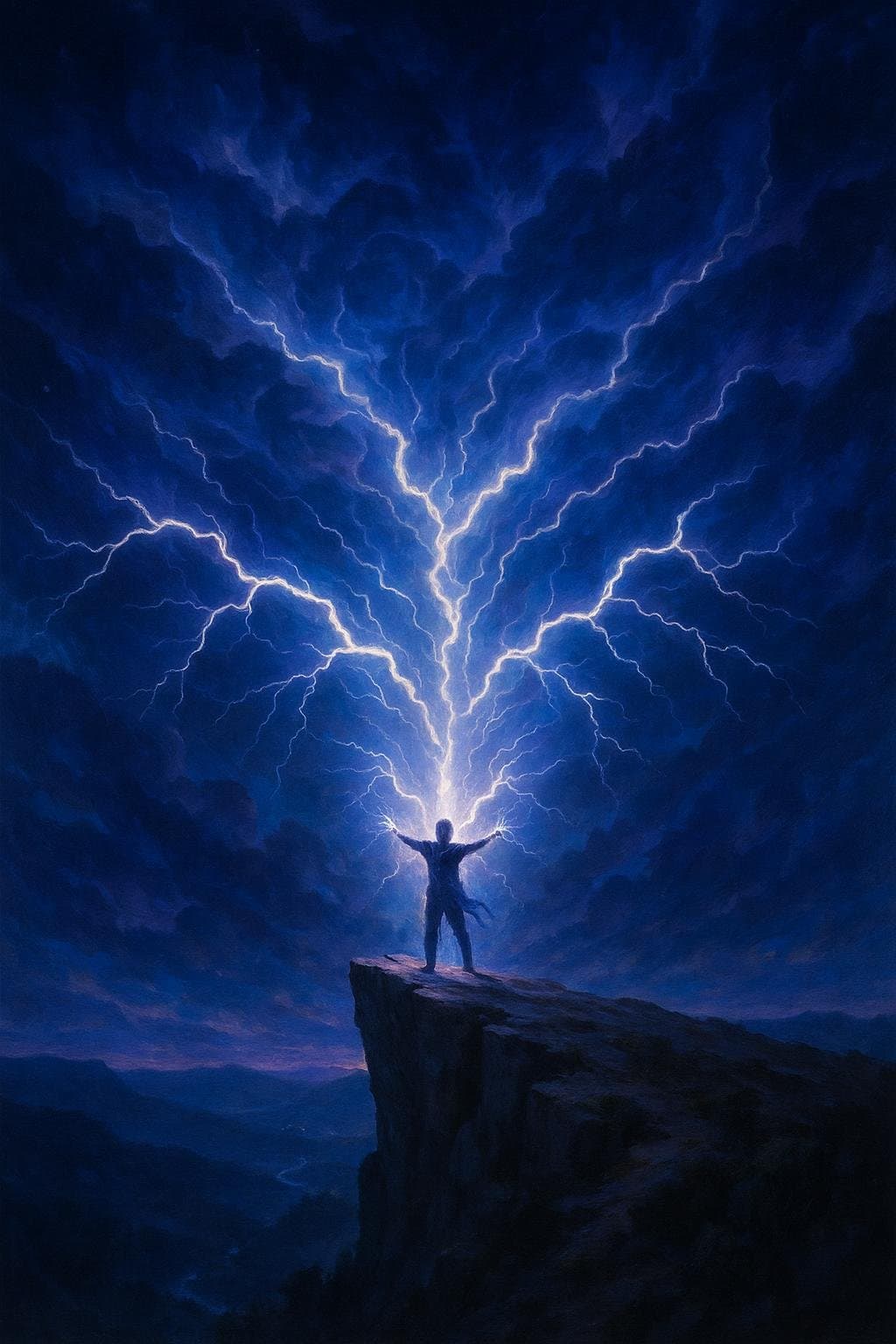
You must be the lightning, and then the lightning will come to you. — Mevlana Jalaluddin Rumi
—What lingers after this line?
Embodying Energy Before Receiving It
Rumi’s evocative metaphor equates our inward state with the forces we attract. To 'be the lightning' is to embody the very dynamism, brilliance, and passion we seek from the world. This principle aligns with the adage ‘like attracts like’; before expecting external inspiration or enlightenment, we must first cultivate it within ourselves. In this spirit, Rumi suggests that action precedes reward—echoing his mystical insistence on personal transformation as the precondition for outer change.
Mystical Roots in Sufi Philosophy
Transitioning from imagery to philosophy, Rumi’s words are steeped in the Sufi tradition, where the seeker’s inner journey mirrors the divine forces at play in the cosmos. Sufis like Rumi taught that seeking union with the divine involves becoming receptive—by kindling inner light, one becomes worthy of higher revelation. Thus, 'the lightning will come to you' if you have made yourself into a vessel strong enough to bear it.
Manifesting Versus Waiting
Expanding this notion, Rumi’s wisdom stands in contrast to passive longing. Instead of waiting for a spark from outside—a mentor, a breakthrough, or sudden luck—he urges us to actively generate our own energy and enthusiasm. This concept is echoed in countless traditions; for instance, the Zen maxim 'the teacher appears when the student is ready' implies awakening is a result of readiness cultivated from within.
Modern Reflections and Self-Actualization
This call to proactive creation resonates with modern theories of self-actualization. Psychologist Abraham Maslow (1943) identified self-initiated growth as central to human flourishing: only when individuals claim agency and ignite their own development can they attract opportunities and inspiration. Rumi’s lightning analogy thus prefigures these contemporary insights about inner readiness paving the way for transformation.
Consequences of Becoming the Lightning
Ultimately, by challenging us to embody the energy we desire, Rumi champions self-reinvention over passive hope. Those who ‘become the lightning’ often inspire those around them and catalyze change in their environment. Like a storm, inner intensity not only attracts further energy but also illuminates the path for others—transforming both self and the wider world in the process.
One-minute reflection
Why might this line matter today, not tomorrow?
Related Quotes
6 selectedWhat is behind your eyes holds more power than what is in front of them. — Gary Zukav
Gary Zukav
At its core, Gary Zukav’s quote argues that the mind’s inner landscape—beliefs, memories, expectations, and values—has greater influence than external appearances. What we carry ‘behind our eyes’ determines how we interp...
Read full interpretation →When you do not seek or need approval, you are at your most powerful. — Caroline Myss
Caroline Myss
Caroline Myss’s statement points to a simple but radical shift: real power begins when a person no longer organizes life around being liked, praised, or validated. In that moment, the center of gravity moves inward.
Read full interpretation →You must be the lightning, and then the lightning will come to you. — Mevlana Jalaluddin Rumi
Mevlana Jalaluddin Rumi
Rumi’s quote urges us to move beyond passive longing, suggesting that to attract brilliance or change, we must first embody those very qualities ourselves. Rather than waiting for inspiration or miracles to arrive, he en...
Read full interpretation →You must be the lightning, and then the lightning will come to you. — Mevlana Jalaluddin Rumi
Mevlana Jalaluddin Rumi
Rumi’s declaration, 'You must be the lightning, and then the lightning will come to you,' serves as a potent metaphor linking inner transformation with outer experience. Lightning, a force both brilliant and unpredictabl...
Read full interpretation →Mastering others is strength. Mastering yourself is true power. — Lao Tzu
Lao Tzu
Lao Tzu draws a sharp distinction between the power we exert outwardly and the power we cultivate inwardly. To “master others” is to influence, persuade, command, or outmaneuver—abilities that can look impressive because...
Read full interpretation →Act with integrity and you will be irresistible. — Auliq Ice
Auliq Ice
This quote highlights the essential nature of integrity, suggesting that being honest and ethical in one's actions naturally attracts others. Integrity is seen as a magnet for genuine relationships.
Read full interpretation →More From Author
More from Mevlana Jalaluddin Rumi →You must be the lightning, and then the lightning will come to you. — Mevlana Jalaluddin Rumi
Rumi’s quote urges us to move beyond passive longing, suggesting that to attract brilliance or change, we must first embody those very qualities ourselves. Rather than waiting for inspiration or miracles to arrive, he en...
Read full interpretation →You must be the lightning, and then the lightning will come to you. — Mevlana Jalaluddin Rumi
Rumi’s declaration, 'You must be the lightning, and then the lightning will come to you,' serves as a potent metaphor linking inner transformation with outer experience. Lightning, a force both brilliant and unpredictabl...
Read full interpretation →