
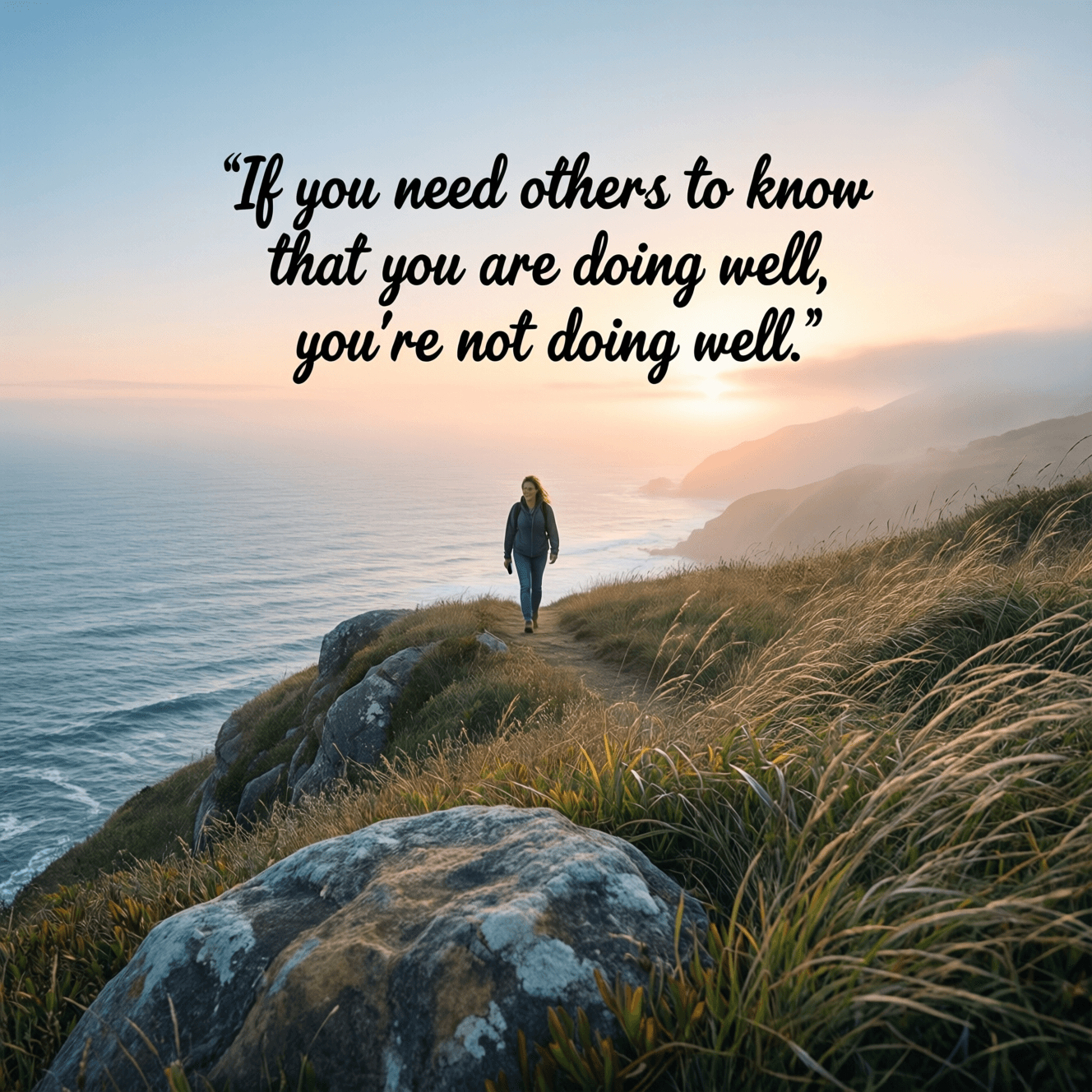
If you need others to know that you are doing well, you're not doing well. — Nassim Nicholas Taleb
—What lingers after this line?
The Hidden Test of Well-Being
Taleb’s line frames a deceptively simple diagnostic: genuine stability tends to be quiet, while insecurity often needs an audience. If “doing well” requires constant broadcasting—through status updates, humblebrags, or repeated reassurance—it may indicate that the achievement hasn’t translated into internal confidence. In that sense, the need to be seen doing well becomes evidence that well-being is still conditional. From this starting point, Taleb nudges the reader to separate outcomes from identity. A promotion, a new habit, or a financial win can be real, yet the emotional dependence on others’ recognition suggests the person is still negotiating their worth rather than inhabiting it.
Status, Signaling, and Social Currency
Moving from the personal to the social, the quote echoes the logic of signaling: people display traits not only to enjoy them, but to be perceived as having them. Thorstein Veblen’s idea of “conspicuous consumption” in The Theory of the Leisure Class (1899) describes how displays of wealth can function less as comfort and more as proof. Taleb’s point extends that logic to emotional and professional life—success becomes a badge to be validated. Consequently, the performance can displace the substance. When the audience’s reaction becomes the metric, choices drift toward what looks impressive rather than what actually improves life, turning well-being into a reputational project.
External Validation as a Form of Dependence
From there, the quote reads like a warning about psychological outsourcing. If self-assessment is delegated to other people’s applause, then well-being rises and falls with unpredictable feedback. Modern psychology often contrasts intrinsic motivation with extrinsic motivation; when goals depend heavily on external rewards, the drive can become brittle, easily disrupted by criticism or silence. This is why Taleb’s phrasing is so sharp: needing others to certify that you’re fine implies you don’t fully believe it yourself. The dependence may not look like misery on the surface, but it behaves like it—an anxious loop of checking, posting, and recalibrating self-worth.
Antifragility and the Quiet Strength of Nonperformance
Next, Taleb’s broader work on “antifragility” (Antifragile, 2012) offers a useful bridge. Antifragile systems gain from stressors and do not require constant protection; likewise, a person who is genuinely doing well can tolerate misunderstanding, lack of recognition, or temporary setbacks without collapsing. Their stability is not proven by constant affirmation but by resilience when affirmation is absent. In contrast, a life that must be continually displayed is often more fragile than it appears. The more one needs the narrative of success to be publicly maintained, the more threatening ordinary fluctuations become, and the less room there is for experimentation, learning, or quiet failure.
The Social Media Amplifier
Then comes the modern accelerant: platforms that reward visibility can transform private satisfaction into public content. Even harmless sharing can slide into a pattern where the dopamine of approval substitutes for the slower rewards of mastery, intimacy, or health. The problem isn’t communication; it’s the subtle shift from living to documenting, where the “proof” starts to matter more than the experience. Over time, this encourages comparative anxiety. If everyone is curating their best moments, the pressure to demonstrate “doing well” intensifies, and Taleb’s test becomes more relevant: the louder the need to assert thriving, the more likely it is compensating for internal doubt.
Practicing Well-Being Without an Audience
Finally, Taleb’s observation points toward a practical ethic: build a life that feels solid in private. That might look like setting goals no one applauds, keeping some achievements unannounced, or measuring progress through consistent habits rather than reactions. In everyday terms, someone who has truly regained health may not feel compelled to advertise it; the reward is waking up with more energy, not being told they look disciplined. This doesn’t demand secrecy or disdain for community—it suggests autonomy. When well-being is internally anchored, sharing becomes optional rather than necessary, and the person can engage with praise as a pleasant extra instead of a vital support beam.
One-minute reflection
What feeling does this quote bring up for you?
Related Quotes
6 selectedTrue security lies in the unrestrained embrace of insecurity — in the recognition that we never really stand on solid ground, and never can. — Oliver Burkeman
Oliver Burkeman
At first glance, Burkeman’s statement sounds self-contradictory: how can security come from insecurity? Yet his point is that much of human anxiety grows from the futile attempt to make life fully controllable.
Read full interpretation →Strength is quiet; only insecurity shouts. — Seneca
Seneca
At its core, Seneca’s line draws a sharp contrast between genuine power and performative force. Real strength does not need applause, intimidation, or constant display; instead, it rests securely in itself.
Read full interpretation →Confidence is silent. Insecurities are loud. — Aja Monet
Aja Monet
At first glance, Aja Monet’s line draws a sharp contrast between two inner states and how they reveal themselves outwardly. Confidence, she suggests, does not need spectacle.
Read full interpretation →Confidence is silent. Insecurities are loud. — Tom Brady
Tom Brady
At first glance, Tom Brady’s line draws a sharp contrast between two inner states: confidence and insecurity. Real confidence does not need constant display because it rests on evidence, preparation, and self-trust.
Read full interpretation →We are doing ourselves no favors when we look to the crowd to tell us where we are. — Erin Loechner
Erin Loechner
Erin Loechner’s line points to a quiet habit many of us treat as normal: using other people’s reactions to locate our worth, success, or direction. When we “look to the crowd,” we hand over the compass, letting likes, pr...
Read full interpretation →If you are tempted to look outside yourself for approval, you have compromised your integrity. — Epictetus
Epictetus
Epictetus compresses a whole Stoic ethic into a blunt caution: the moment you feel pulled to secure someone else’s approval, you risk trading your inner standards for external rewards. In his view, integrity isn’t a repu...
Read full interpretation →More From Author
More from Nassim Nicholas Taleb →The difference between technology and slavery is that slaves are fully aware that they are not free. — Nassim Nicholas Taleb
Taleb’s line works as a moral jolt: if slavery is defined by the loss of freedom, then the crucial difference he highlights is awareness. Enslaved people know their constraint is imposed; the modern technology user may f...
Read full interpretation →Self-discipline is a form of freedom. Freedom from the slavery of your own moods. — Nassim Nicholas Taleb
Taleb’s line begins by flipping a common assumption: freedom is often imagined as fewer rules, fewer obligations, and maximum spontaneity. Yet he suggests that the more decisive liberty is internal—being able to act acco...
Read full interpretation →Difficulty is what wakes up the genius. — Nassim Nicholas Taleb
Taleb’s line suggests that genius is not a constant trait humming quietly in the background; instead, it is often dormant in comfort. When life is predictable, our minds can afford to run on routine, repeating what alrea...
Read full interpretation →To be free of a certain kind of ambition is a necessary condition for being a free man. — Nassim Nicholas Taleb
Taleb’s line begins with a provocation: some ambitions don’t elevate you—they tether you. The “certain kind” matters, because not all striving is corrosive; rather, it’s the ambition that makes your choices hostage to ex...
Read full interpretation →