
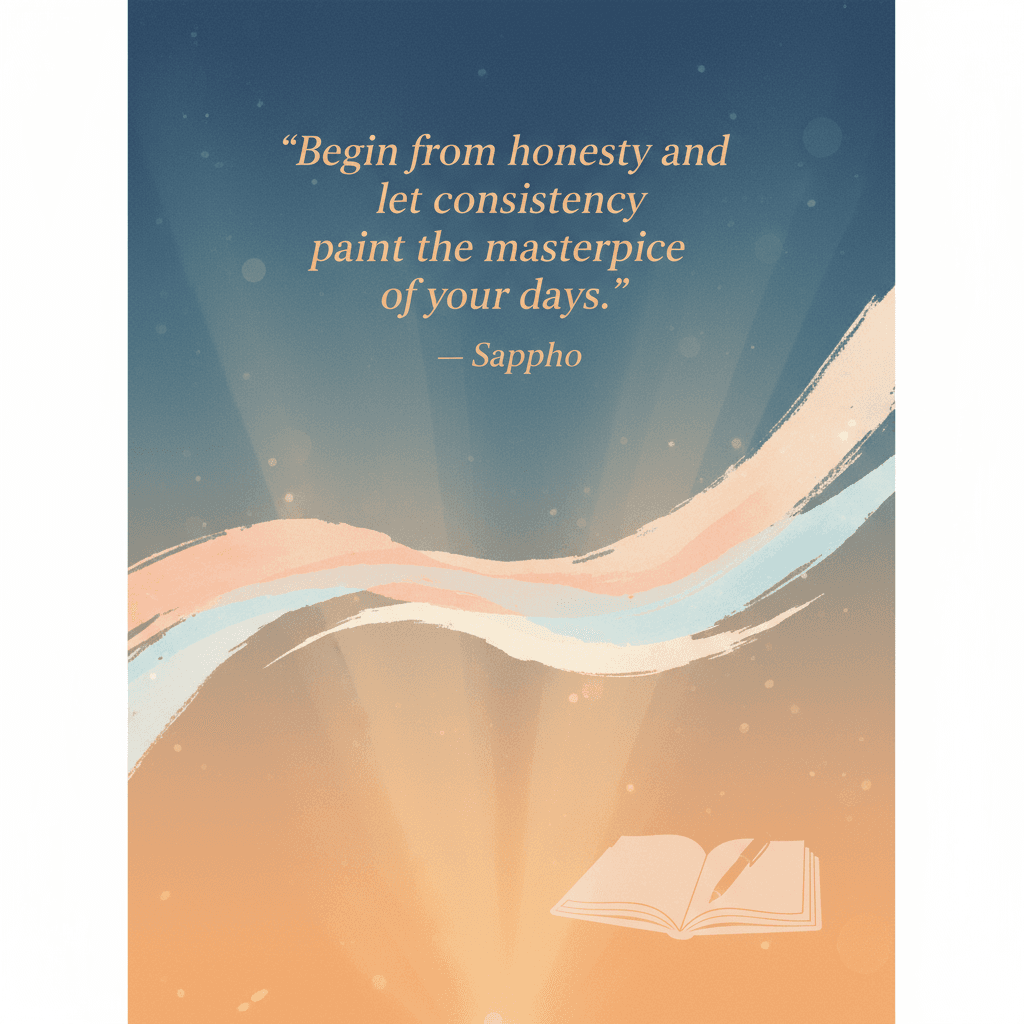
Begin from honesty and let consistency paint the masterpiece of your days. — Sappho
—What lingers after this line?
The First Stroke: Honest Beginnings
Every deliberate life starts with an unflinching look at what is true—about our motives, limits, and hopes. To “begin from honesty” is to clear the canvas, removing the primed gloss of excuses and self-deception so real color can adhere. Honesty gives direction: it narrows the field from what looks impressive to what is actually necessary. Only then can consistency do its quiet work, day after day, turning intention into form.
Sappho’s Lyric Spirit and a Modern Paraphrase
Although this elegant aphorism is often attributed to Sappho, its exact phrasing does not appear in her surviving fragments. Nonetheless, its spirit resonates with her voice: Sappho (c. 630–570 BCE) distilled feeling into lucid, disciplined lines. Fragment 31, with its trembling candor, shows how unsparing truth becomes beauty through craft and repetition. Even if modernized, the quote channels her lesson: authenticity is the pulse; technique is the measure.
Greek Ideas: Truth Unveiled, Virtue Practiced
Classical thought linked truth to unconcealment—aletheia—as if life’s task were to lift veils. Yet it also insisted that virtues harden into character through practice. Aristotle’s Nicomachean Ethics II argues that hexis—stable disposition—emerges from repeated acts aligned with one’s telos. Consistency, then, is not mere stubbornness; it is the method by which honest aims become embodied habits. Once the aim is true, repetition sculpts the self to fit it.
A Canvas Built by Layers, Not Bursts
Artists rarely finish with a single pass; they glaze, scrape, and return. Claude Monet’s haystacks series (1890–91) revisited the same motif across changing light, proving that persistence reveals nuance a single look cannot catch. In the same way, our days become expressive through layered effort: small, faithful strokes that accumulate depth. Consistency does not dazzle in a moment; it illuminates over time.
What Research Says About Habit and Truth
Behavioral science finds that stable environments and repeated cues make actions automatic. Wendy Wood’s Good Habits, Bad Habits (2019) shows how repetition in consistent contexts reduces friction until effort feels natural. Honesty supports this by lowering cognitive dissonance; Leon Festinger (1957) observed that when actions match beliefs, we experience less internal conflict, sustaining effort more easily. Thus, truthful goals and steady routines form a mutually reinforcing loop.
Integrity as Trust You Can Predict
In relationships and work, people judge integrity not only by what you value but by whether you show up the same way tomorrow. The integrative model of organizational trust by Mayer, Davis, and Schoorman (1995) highlights integrity as reliability of principles over time. Honesty declares your principles; consistency proves them visible and predictable. As trust accumulates, collaboration becomes smoother—another compounding effect of steady virtue.
Two Pitfalls: Rigidity and Flicker
Consistency without honesty hardens into rigidity—doing the wrong thing more efficiently. Honesty without consistency flickers—bright declarations that leave no warmth. Crash diets illustrate both: bold vows divorced from realistic patterns collapse into relapse. The antidote is periodic, truthful recalibration—retaining cadence while adjusting course. In practice, that means reviewing commitments with clear eyes and updating the routine without abandoning the rhythm.
Practices that Let Consistency Paint
Begin with an honest inventory: one aim that matters, one constraint you cannot ignore. Translate that aim into a daily minimum—so small it survives bad days (write 50 words, walk 10 minutes, practice scales for 5). Anchor it to a reliable cue, track streaks lightly, and review weekly to refine fit. Over months, these humble deposits layer into texture and tone. Thus, honesty chooses the subject; consistency lays the strokes; your days become the artwork.
One-minute reflection
Where does this idea show up in your life right now?
Related Quotes
6 selectedOne honest sentence can spark a thousand honest days. — Sappho
Sappho
Sappho’s line suggests that honesty, once spoken, is not a fleeting moment but a generative force. One clear, unembellished sentence can become the seed from which an entirely new way of living grows.
Read full interpretation →Paint your days with honesty; even simple colors can become a masterpiece. — Emily Dickinson
Emily Dickinson
This quote presents each day as a blank canvas, awaiting the colors of our choices and attitudes. Rather than reserving creativity for artists alone, it suggests that everyone is constantly painting with actions, words,...
Read full interpretation →Write one honest line each day, and you will build a life of meaning. — Paulo Coelho
Paulo Coelho
To begin, Coelho’s invitation reduces the daunting project of a meaningful life to a single, repeatable gesture: one honest line each day. Habit science suggests that modest, consistent actions compound into outsized res...
Read full interpretation →Consistency is the sum that equals what we become. — Marcus Aurelius
Marcus Aurelius
Marcus Aurelius’ line frames becoming as a kind of moral mathematics: each repeated action adds to the total of a life. Rather than imagining identity as a single grand decision, the quote suggests that character is accu...
Read full interpretation →Consistency is a superpower. — Ryan Holiday
Ryan Holiday
Ryan Holiday’s line begins with a deceptively simple idea: greatness is rarely built through dramatic gestures. More often, it emerges from repeated actions that seem ordinary in isolation but become extraordinary over t...
Read full interpretation →Consistency transforms effort into excellence. — John C. Maxwell
John C. Maxwell
At first glance, Maxwell’s line seems simple, yet it points to a profound truth: excellence rarely arrives through isolated bursts of energy. Instead, it emerges when effort is repeated steadily over time, allowing small...
Read full interpretation →More From Author
More from Sappho →One's own self is well worth knowing. — Sappho
At first glance, Sappho’s brief statement seems simple, yet its force lies in its directness: the self is not a trivial subject but a worthy one. In a world that often rewards attention to status, duty, or appearance, he...
Read full interpretation →Sow a single clear word and let it bloom into a chorus. — Sappho
Sappho’s line begins by shrinking expression down to its smallest unit: a single clear word. The emphasis on clarity suggests intention rather than verbosity, as if meaning can be planted only when it is cleanly chosen.
Read full interpretation →Let desire fuel your craft but let kindness steady the heart. — Sappho
Sappho’s line sets up a deliberate pairing: desire as the engine of making, and kindness as the stabilizer of being. Desire pushes the artist toward intensity—toward risk, experimentation, and the hunger to shape experie...
Read full interpretation →Let your voice fracture the silence; even a small sound reshapes the air. — Sappho
Sappho’s line begins by treating silence not as emptiness, but as a kind of held breath—an atmosphere with shape and tension. When she urges, “Let your voice fracture the silence,” she implies that quiet has weight, and...
Read full interpretation →