
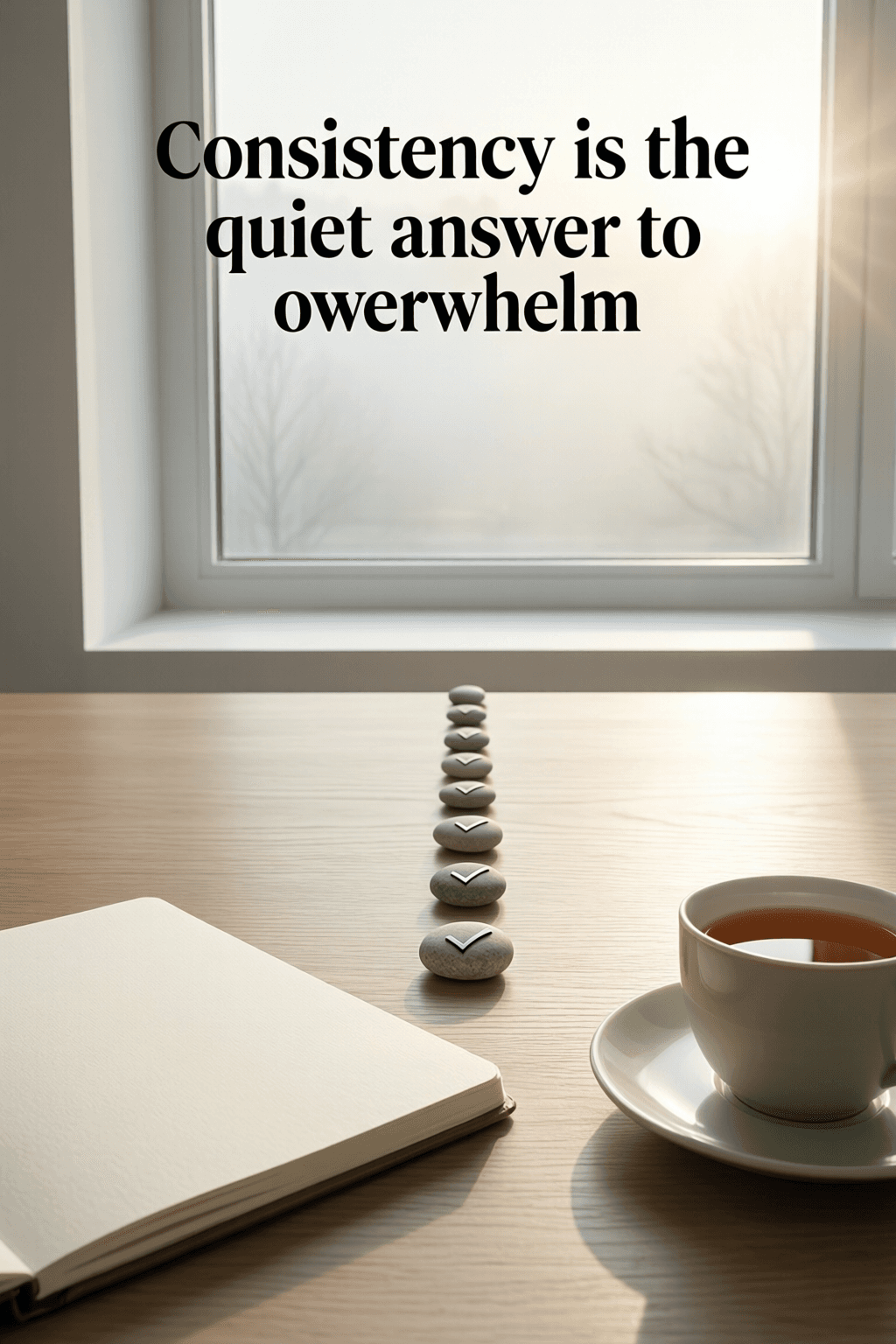
Consistency is the quiet answer to overwhelm. — James Clear
—What lingers after this line?
A Calm Reply to Chaos
At first glance, James Clear’s line reframes overwhelm not as a dramatic crisis but as a condition that can be softened by steady action. Rather than calling for bursts of motivation, he points to consistency as a quieter, more sustainable response. The word “quiet” matters: it suggests that progress often arrives without spectacle, through repeated efforts that gradually restore a sense of control. In that way, the quote challenges a common assumption that big problems require big gestures. Instead, it implies that overwhelm grows when everything feels urgent at once, while consistency reduces that pressure by turning effort into rhythm. What seems too large to face all at once becomes manageable when approached one step at a time.
Why Repetition Reduces Anxiety
Building on that idea, consistency helps because repetition lowers the mental cost of action. When a person decides in advance to write each morning, walk every evening, or review finances every Friday, fewer choices must be made in the moment. Psychologists such as Roy Baumeister and colleagues, in research on decision fatigue (1998–2011), showed how repeated decision-making can drain attention and self-control. Consequently, consistent habits do more than improve productivity; they conserve emotional energy. Overwhelm often comes from feeling forced to constantly reorient oneself. By contrast, a repeated routine creates familiarity, and familiarity tends to calm the mind. What was once intimidating begins to feel ordinary, and that shift is often the beginning of real momentum.
Small Actions, Compounding Results
From there, the quote also points toward the mathematics of gradual improvement. James Clear’s own Atomic Habits (2018) popularized the idea that tiny actions, repeated long enough, produce outsized results. A single page read or one email answered may seem trivial, yet over weeks and months such actions accumulate into finished books, clearer inboxes, and steadier lives. This principle appears far beyond self-help literature. Darren Hardy’s The Compound Effect (2010) makes a similar case: modest behaviors become powerful through duration. Thus, consistency answers overwhelm not by eliminating difficulty overnight, but by proving that progress does not need to be dramatic to be real. Slow gains, precisely because they endure, often outperform heroic but short-lived efforts.
The Discipline Hidden in Simplicity
Even so, consistency should not be mistaken for ease. Its power lies partly in its plainness, which can make it seem unimpressive compared with intense but irregular effort. Yet history repeatedly honors disciplined persistence. Benjamin Franklin’s autobiography (1791) describes his methodical attempts at cultivating virtues through daily tracking, an early illustration of how repeated structure can shape character over time. Therefore, the quote carries a moral undertone as well as a practical one. To be consistent is to trust process over mood, and that trust requires humility. One must accept that meaningful change often comes not from feeling inspired, but from returning to the same useful action even when nothing dramatic seems to be happening.
A Practical Philosophy for Daily Life
Ultimately, Clear’s statement works because it is both comforting and demanding. It comforts by suggesting that overwhelm does not always require reinvention; often it simply requires a next step repeated enough times to matter. At the same time, it demands patience, since consistency rarely offers instant relief. Its rewards are cumulative, not theatrical. Seen this way, the quote becomes a practical philosophy for modern life. In a culture that prizes urgency, optimization, and visible breakthroughs, consistency offers something quieter but more dependable: a way to move forward without panic. The answer to overwhelm, then, is not to do everything at once, but to keep doing the right small thing again tomorrow.
Recommended Reading
As an Amazon Associate, we earn from qualifying purchases.
One-minute reflection
What's one small action this suggests?
Related Quotes
6 selectedConsistency is the quiet, daily hum of progress that eventually drowns out the noise of doubt and external expectations. — James Clear
James Clear
At first glance, James Clear’s quote shifts attention away from dramatic breakthroughs and toward something far less glamorous: repetition. By calling consistency a “quiet, daily hum,” he suggests that meaningful progres...
Read full interpretation →Don't worry about being brilliant; just be consistent. The world is built by people who showed up even when they didn't feel like it. — James Clear
James Clear
At its core, James Clear’s quote pushes back against the modern obsession with exceptional talent. Rather than glorifying brilliance, it elevates consistency—the humble act of returning to the work again and again.
Read full interpretation →The secret to mastery is not intensity, but the grace to show up when you do not feel like it. — James Clear
James Clear
At first glance, James Clear’s line overturns a common myth: that greatness comes from bursts of passion or extreme effort. Instead, he places mastery in the quieter realm of consistency, especially on the days when enth...
Read full interpretation →Consistency is the only bridge between a grand ambition and the reality of a Tuesday afternoon. — James Clear
James Clear
James Clear’s quote begins with a familiar tension: grand ambition is exciting, but ordinary afternoons rarely feel heroic. A big goal lives in the imagination, while a Tuesday afternoon is filled with small choices, dis...
Read full interpretation →If you want to build something that lasts, you must be willing to do the small, quiet things that no one sees for a long, long time. — James Clear
James Clear
At its core, James Clear’s quote argues that durability is rarely created in dramatic moments. Instead, anything built to last—a skill, a business, a relationship, or a body of work—rests on repeated actions that seem to...
Read full interpretation →Consistency is the secret rhythm of mastery. It is not the grand gesture, but the small, repeated act that builds a life. — James Clear
James Clear
At its core, James Clear’s line shifts attention away from dramatic breakthroughs and toward the humble force of repetition. Mastery, in this view, is less a lightning strike than a steady drumbeat: the writer who drafts...
Read full interpretation →More From Author
More from James Clear →Don't worry about being brilliant; just be consistent. The world is built by people who showed up even when they didn't feel like it. — James Clear
At its core, James Clear’s quote pushes back against the modern obsession with exceptional talent. Rather than glorifying brilliance, it elevates consistency—the humble act of returning to the work again and again.
Read full interpretation →Consistency is the quiet, daily hum of progress that eventually drowns out the noise of doubt and external expectations. — James Clear
At first glance, James Clear’s quote shifts attention away from dramatic breakthroughs and toward something far less glamorous: repetition. By calling consistency a “quiet, daily hum,” he suggests that meaningful progres...
Read full interpretation →To do anything to a high standard, you must be prepared to be bored for long periods of time. — James Clear
James Clear’s observation cuts against the modern preference for constant stimulation. At first glance, high achievement looks exciting from the outside, yet the path toward it is usually repetitive, slow, and uneventful...
Read full interpretation →The secret to mastery is not intensity, but the grace to show up when you do not feel like it. — James Clear
At first glance, James Clear’s line overturns a common myth: that greatness comes from bursts of passion or extreme effort. Instead, he places mastery in the quieter realm of consistency, especially on the days when enth...
Read full interpretation →