
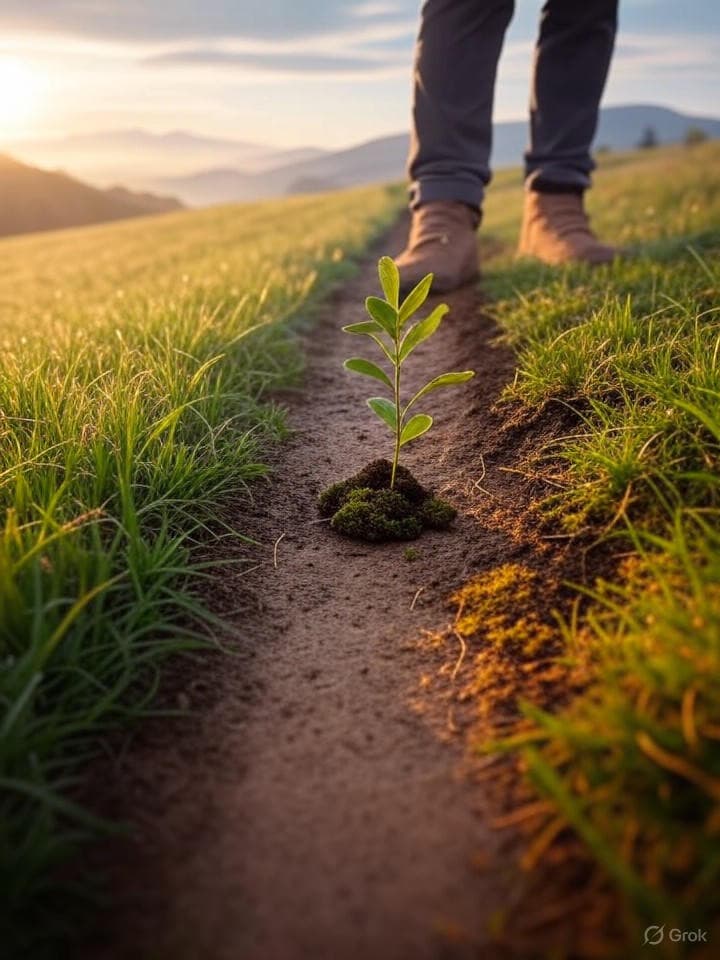
Cultivate a single good habit and your path will widen beneath your feet. — Confucius
—What lingers after this line?
The Confucian Thread of Self-Cultivation
Confucius pairs large transformations with small, steady practices. Read as an image of the Way (dao): as your footing steadies, the road seems to broaden beneath you. The Analects 4.15 notes, “My Way has a single thread running through it”—Zengzi later names that thread as loyalty and reciprocity. One consistent habit is how the thread first catches; it aligns behavior with principle, turning abstract virtue into lived routine. Framed this way, the saying is not about sudden breakthroughs but about traction: a modest daily act that quietly increases your degrees of freedom.
From Ritual to Habit: Li in Daily Life
Building on this, Confucius treats li (ritual propriety) as rehearsal for character. Analects 1.2 urges the young to be filial, respectful, careful, and trustworthy—each a repeatable behavior rather than a rare heroic act. Through such rituals, values migrate from intention to reflex, much as practicing scales makes music more fluent. Over time, these small courtesies reduce friction in daily interactions and make right action easier to choose. Thus, a single good habit is not merely a rule; it is choreography for the soul, training the body-mind to move gracefully without constant deliberation.
Keystone Habits and Expanding Optionality
Extending this idea, modern habit research describes “keystone habits” whose effects cascade. Charles Duhigg’s The Power of Habit (2012) shows how one practice—like exercising—often triggers secondary gains: better sleep, improved mood, even sharper budgeting. In Confucian terms, the path “widens” because the habit lowers costs elsewhere, creating optionality. A daily writing ritual, for instance, builds a portfolio, attracts collaborators, and opens roles that were previously out of reach. The habit does not force the future; it creates more forks in the road and equips you to take them. Opportunity, then, is less luck than the compound interest of consistency.
How Habits Take Root: Aristotle to Neuroscience
Classical philosophy anticipated this. Aristotle’s Nicomachean Ethics II.1 argues that we become just by doing just acts; virtue is formed through habituation. Contemporary models explain the mechanism: cues, routines, and rewards wire loops that the brain favors. BJ Fogg’s Tiny Habits (2019) advocates starting with actions so small they are effortless, while James Clear’s Atomic Habits (2018) popularizes “habit stacking,” anchoring a new behavior to an existing one. Together they show why one sustainable habit beats a dozen grand intentions: small wins reconfigure identity and neurochemistry, making the next right action less costly than the last.
The Social Multipliers of a Single Habit
Moreover, habits ripple through relationships. The Confucian virtue xin (trustworthiness) turns reliability into social capital. In Analects 12.7, Confucius claims a state cannot stand without trust; by analogy, a life cannot flourish without it either. A simple habit—answering messages within a set window or arriving five minutes early—signals dependability, which widens your path via referrals, mentorship, and shared projects. Trust compresses transaction costs, and once others expect you to follow through, doors open with less effort. In this way, one private practice quietly reshapes a public reputation.
Choosing the First Stone on the Road
Selecting a first habit works best when it aligns with purpose and removes a recurrent bottleneck. The Great Learning outlines a sequence—from cultivating the self to ordering the family, governing the state, and bringing peace to the world—suggesting leverage starts close to home. Choose something high-frequency and low-friction: a two-minute planning ritual after morning coffee, a daily paragraph of writing, or a brief cleanup at day’s end. Measurable, finishable actions beat vague ideals. When the habit is well-chosen, it behaves like a key: one turn unlocks many rooms.
Keeping the Path Wide: Reflection and Identity
Finally, continuity keeps the road broad. Zengzi’s practice—“Each day I examine myself on three points” (Analects 1.4)—models brief reflection to reinforce course corrections. Benjamin Franklin’s Autobiography (1791) recounts tracking 13 virtues with a simple log; today’s equivalent is a streak counter and a weekly review. Protect the habit with environment design: lay out cues, reduce friction, and precommit to the smallest viable version on hard days. Most importantly, tie behavior to identity: “I am the kind of person who shows up.” When identity leads, consistency follows—and with it, the widening path the Master describes.
One-minute reflection
What's one small action this suggests?
Related Quotes
6 selectedSmall daily choices build the horizon you will one day stand upon. — Confucius
Confucius
Confucius’ image of a “horizon” turns the future into something solid and reachable, not a distant abstraction. What you eventually see and stand upon is portrayed as the accumulated result of ordinary actions—small, rep...
Read full interpretation →Silence the doubt with a single honest action, then repeat. — Confucius
Confucius
This saying frames doubt not as an enemy to be argued with, but as a kind of inner noise that fades when behavior becomes unmistakably aligned with what you know is right. Instead of waiting for certainty, it proposes a...
Read full interpretation →Shape your habits, and the landscape of your life will change. — Confucius
Confucius
Begin with the image of a landscape: valleys, paths, and rivers that took shape over time. The saying attributed to Confucius suggests our habits act like water, carving channels through the terrain of our days until the...
Read full interpretation →Learning to love yourself is like learning to walk – essential, life-changing, and the only way to stand tall. — Vironika Tugaleva
Vironika Tugaleva
Vironika Tugaleva’s comparison begins with a simple but powerful truth: self-love is not a luxury, but a basic human necessity. Just as walking allows a child to move through the world with growing independence, learning...
Read full interpretation →The most gifted members of the human species are at their creative best when they cannot have their way, and must compensate for what they miss by realizing and cultivating their capacities. — Bryant H. McGill
Bryant H. McGill
Bryant H. McGill’s observation begins with a striking reversal: gifted people may not reach their highest potential when everything comes easily, but when something blocks their path.
Read full interpretation →A mind grows by staying with difficulty long enough for the experience to change it. — Mary Catherine Bateson
Mary Catherine Bateson
Mary Catherine Bateson’s observation begins with a quiet but demanding truth: the mind does not grow merely by encountering difficulty, but by remaining with it. Challenge becomes transformative only when we resist the u...
Read full interpretation →More From Author
More from Confucius →Learning is a lifelong process of unlearning the need for immediate results. Patience is the discipline of trusting the slow, quiet compounding of your efforts. — Confucius
At its core, this saying presents learning not as a race toward instant achievement, but as a gradual reshaping of expectation. The phrase “unlearning the need for immediate results” suggests that education is not only a...
Read full interpretation →Anything worth having is worth waiting for, and everything worth doing is worth doing with patience. — Confucius
At its core, this saying ties value to delay. Confucius suggests that truly meaningful things do not arrive instantly; instead, they ask us to endure uncertainty, effort, and time.
Read full interpretation →A common man marvels at uncommon things. A wise man marvels at the commonplace. — Confucius
Confucius draws a quiet but profound distinction between two kinds of attention. The common man, in this saying, is captivated by what appears exceptional—spectacle, rarity, or public greatness.
Read full interpretation →To learn is to admit you do not know. The moment you stop being a student is the moment your growth ends. — Confucius
Confucius frames learning not as the display of knowledge but as the honest recognition of its limits. In that sense, to learn is to begin with humility: one must first admit, without shame, that there is something missi...
Read full interpretation →