
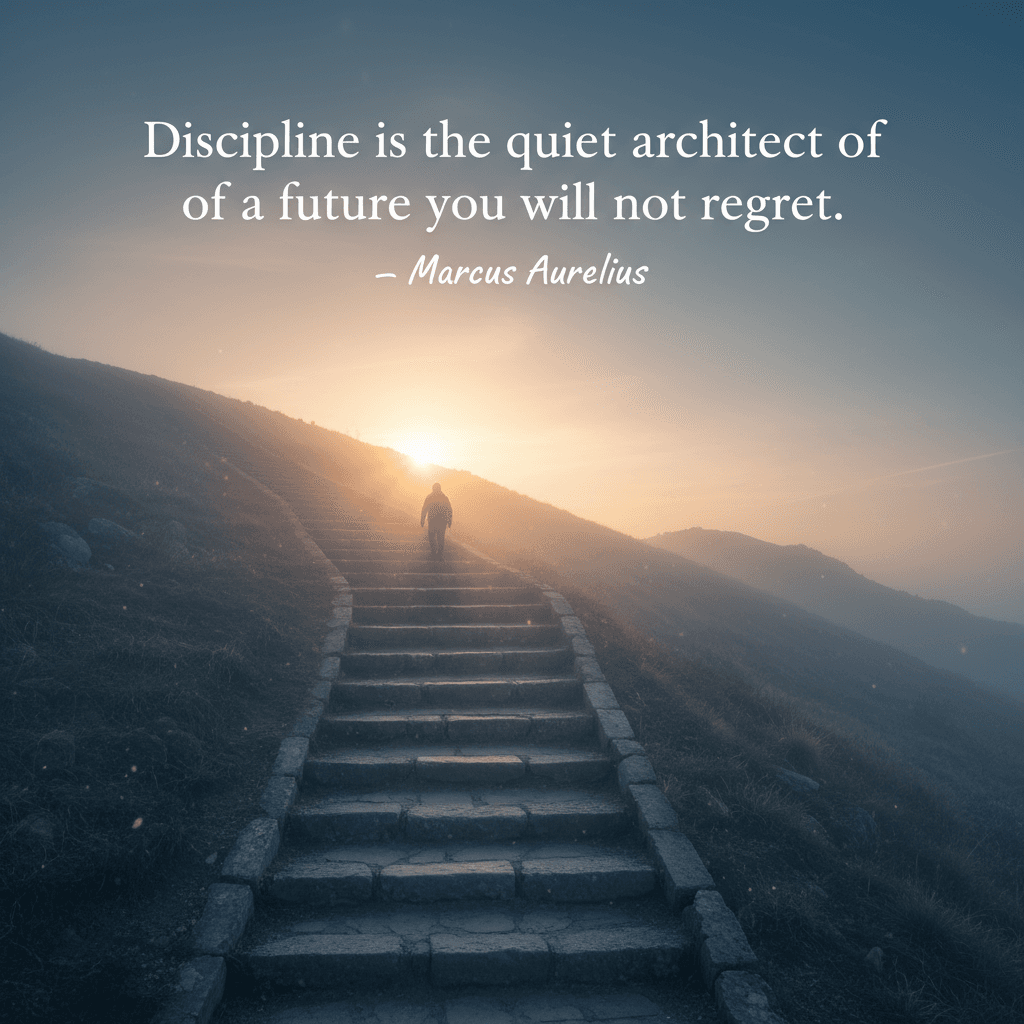
Discipline is the quiet architect of a future you will not regret. — Marcus Aurelius
—What lingers after this line?
The Quiet Architect Metaphor
To begin, calling discipline a quiet architect reframes it from harsh self-denial to patient design. Architects do not shout buildings into existence; they draft blueprints, calculate loads, and return each day to incremental work. Likewise, disciplined choices are small, nearly invisible—what you read before bed, where you place your phone, how you open a meeting—but they determine what your future can bear. Because they operate below the noise of applause, these choices rarely feel heroic. Yet, as with a structure’s foundation, their effects compound, settling and strengthening until, one day, the form of a life stands where a scaffold once was.
Stoic Foundations for Daily Practice
To ground this idea, Stoic practice offers a sturdy precedent. Marcus Aurelius’s Meditations (Book 5.1) shows him rehearsing the morning struggle—get up, do your duty, remember your nature—so that discipline becomes routine rather than drama. Similarly, Epictetus’s Enchiridion (1) distinguishes what is up to us from what is not, directing effort toward controllable actions. In both cases, the emphasis is not on spectacle but on steady alignment: thought, word, and deed moving in one direction. The Stoics thus treat discipline as daily carpentry—shaping character grain by grain—so that when fate tests the structure, it does not sway.
Habit Architecture and Compounding
Extending the metaphor, habits are the beams and joints of disciplined living. Charles Duhigg’s The Power of Habit (2012) maps the cue–routine–reward loop, showing how small redesigns in context cascade into lasting change. James Clear’s Atomic Habits (2018) adds an identity frame: people keep what confirms who they believe they are. Therefore, discipline scales when we build environments and identities that make the right action the easy action—setting cues, shrinking friction, and celebrating tiny wins. Over time, such “compounding” resembles accrued interest: minute deposits of effort grow into substantial capital, which future you can finally spend.
Why Discipline Works Quietly, Not Loudly
Moreover, effective discipline favors silence over spectacle because delayed rewards mature out of sight. The classic “marshmallow test” (Walter Mischel, 1970s) linked delay of gratification to later outcomes; later analyses (Watts, Duncan, and Quan, 2018) revealed socioeconomic factors that moderate this effect. Even so, the central lesson endures: stable contexts and practiced self-control make patience practical. Thus, rather than grand vows, disciplined people design conditions—sleep, social norms, proximity of temptations—that lower the noise floor. In the hush of good conditions, consistency becomes less an act of willpower and more an unobtrusive habit.
Regret Prevention and the Future Self
Looking ahead, discipline’s quiet virtue is that it shields you from foreseeable remorse. Hal Hershfield’s research on future-self continuity (2011) shows that when we feel emotionally connected to our older selves, we save more and make healthier choices. Daniel Gilbert’s Stumbling on Happiness (2006) reminds us that we mispredict what will satisfy us, often chasing intensity over meaning. Discipline, then, acts as a translator between present impulse and future well-being. It structures choices—study now, invest early, apologize promptly—so that when tomorrow arrives, it feels like a gift from a considerate friend, not a bill from a stranger.
Practical Scaffolding for Everyday Discipline
Accordingly, the craft begins with planful friction. Use implementation intentions—“If it’s 6 a.m., then I lace my shoes” (Peter Gollwitzer, 1999)—to attach action to cues. Practice premeditatio malorum from Seneca’s Letters to Lucilius: calmly visualize obstacles, then prebuild responses. Reduce choice overload by batching decisions, and protect energy with sleep and boundaries. Most importantly, review: like an architect’s site walk, a weekly audit exposes hairline cracks before they spread. In this way, discipline is not a mood but an infrastructure—quiet, reliable, and progressively self-reinforcing.
Humane Rigor, Not Harsh Asceticism
Finally, durable discipline is firm yet kind. Research on self-compassion (Kristin Neff, 2003) shows that treating setbacks with curiosity rather than contempt improves persistence. This matters because brittle perfectionism snaps under stress, whereas humane rigor bends and continues. When you miss a day, you restart the next; when a plan fails, you revise the blueprint instead of condemning the builder. Thus the future you do not regret is not spotless but well-constructed—its integrity arising from steady corrections, quietly made, until the life you inhabit matches the one you intended to build.
One-minute reflection
What does this quote ask you to notice today?
Related Quotes
6 selectedRise to the task a moment sooner; tiny discipline defeats great doubt — Marcus Aurelius
Marcus Aurelius
Marcus Aurelius urges an almost imperceptible shift in timing: begin a moment sooner than your mind wants to. Doubt thrives in that small delay, because hesitation invites the imagination to rehearse failures and inflate...
Read full interpretation →Small, steady discipline conquers the peaks that grand plans cannot reach. — Marcus Aurelius
Marcus Aurelius
At the outset, the line attributed to Marcus Aurelius distills the Stoic habit of reducing life to the honorable task at hand. Though the phrasing is modern, its spirit matches Meditations, where he counsels building one...
Read full interpretation →Don't expect to be motivated every day to get out there and make things happen. You won't be. Don't count on motivation. Count on Discipline. — Jocko Willink
Jocko Willink
Jocko Willink’s quote begins with a practical warning: motivation is powerful, but unreliable. Some mornings bring energy, clarity, and ambition; others bring fatigue, distraction, or doubt.
Read full interpretation →Champions are champions not because they do anything extraordinary but because they do the ordinary things better than anyone else. — Chuck Noll
Chuck Noll
At first glance, Chuck Noll’s quote strips greatness of glamour. He argues that champions are not defined by rare, theatrical moments, but by how consistently they execute the basics.
Read full interpretation →The really important kind of freedom involves attention, and awareness, and discipline, and effort, and being able truly to care about other people and to sacrifice for them, over and over, in myriad petty little unsexy ways, every day. — David Foster Wallace
David Foster Wallace
At first glance, freedom often sounds like independence: the ability to do whatever one wants without interference. David Foster Wallace redirects that familiar idea toward something more demanding.
Read full interpretation →The legalistic heart says, 'I will do this thing to gain merit.' The disciplined heart says, 'I will do this thing because I love and want to please.' — Kent Hughes
Kent Hughes
Kent Hughes frames two inner motives that can produce the same outward behavior while arising from very different spiritual centers. On one side stands the legalistic heart, which treats obedience as a transaction: do th...
Read full interpretation →More From Author
More from Marcus Aurelius →If anyone can refute me—show me I'm making a mistake or looking at things from the wrong perspective—I'll gladly change. — Marcus Aurelius
Marcus Aurelius begins from a position that appears modest but is actually deeply disciplined: he is willing to be corrected. Rather than treating disagreement as an insult, he frames it as an opportunity to see more cle...
Read full interpretation →The art of life is more like the wrestler's art than the dancer's; stand ready and firm to meet sudden and unexpected onsets. — Marcus Aurelius
Marcus Aurelius contrasts two arts to clarify what living well demands. A dancer suggests elegance, rhythm, and practiced beauty; a wrestler, by contrast, suggests balance under pressure, resistance, and constant readine...
Read full interpretation →How much time he gains who does not look to see what his neighbour says or does or thinks, but only at what he does himself, to make it just and holy. — Marcus Aurelius
Marcus Aurelius argues that a great deal of life is wasted in watching other people—what they say, what they do, and even what they might be thinking. Instead, he recommends a disciplined inward turn: focus on your own c...
Read full interpretation →Sometimes, protecting your peace is the better choice. — Marcus Aurelius
At first glance, the saying frames peace not as passivity but as discipline. To protect one’s peace is to recognize that not every conflict deserves entry into the mind.
Read full interpretation →