
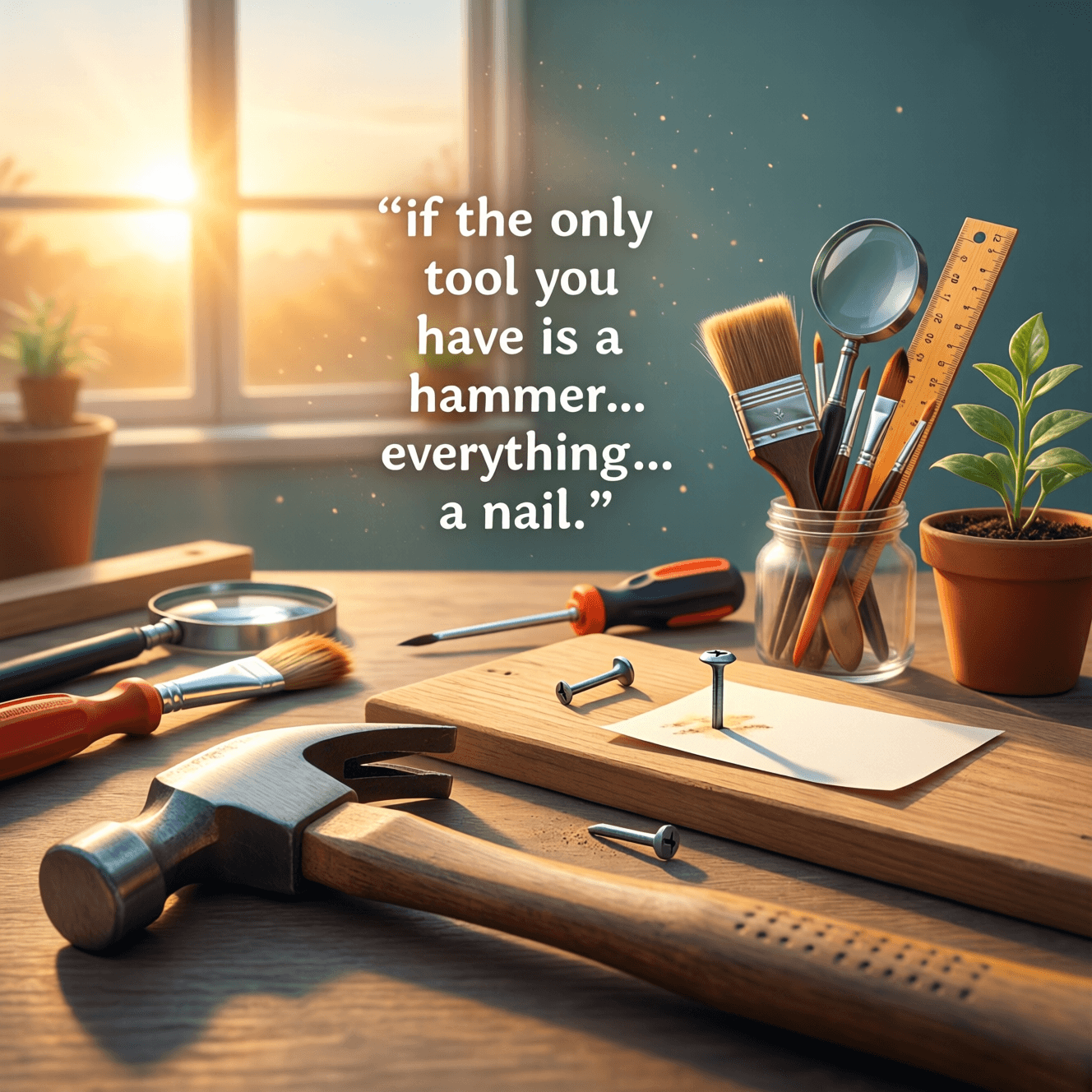
I suppose it is tempting, if the only tool you have is a hammer, to treat everything as if it were a nail. – Abraham Maslow
—What lingers after this line?
Maslow’s Warning About Overreach
Maslow’s line captures a common mental shortcut: when we rely heavily on one method, we start forcing every situation to fit it. The “hammer” isn’t just a literal tool—it’s any favored framework, skill, or habit that has worked before. From that starting point, it becomes easy to assume the next problem must be the same kind of problem, even when it isn’t. This is the subtle danger Maslow points to: competence can become a constraint. What begins as efficiency—using what you know—can drift into overreach, where the tool dictates the diagnosis rather than the reality shaping the response.
How Tools Become Lenses
Once a tool proves successful, it tends to become a lens, shaping what we notice and what we ignore. In other words, the hammer doesn’t merely solve problems—it starts defining them. A manager trained to optimize metrics may see every issue as a performance gap; a lawyer may see each conflict as a dispute to be argued; an engineer may see human friction as a process failure. Building on Maslow’s point, this lens effect can feel rational because it is consistent. Yet the consistency is precisely the trap: repeated use creates familiarity, and familiarity can masquerade as truth.
The Comfort of Single-Method Solutions
A single reliable tool offers psychological comfort. It reduces uncertainty, speeds up decisions, and protects us from the vulnerability of admitting, “I don’t yet know how to handle this.” Consequently, the hammer-and-nail tendency often intensifies under stress, when people default to what is most practiced. This is where Maslow’s observation becomes more than witty—it becomes diagnostic. The temptation he names is not just intellectual but emotional: we cling to one approach because it provides control, even if that control is ill-suited to the problem at hand.
Modern Echoes: Cognitive Bias and Expertise
In contemporary terms, Maslow’s idea aligns with what psychologists describe as cognitive biases that narrow judgment. Daniel Kahneman’s work in *Thinking, Fast and Slow* (2011) explores how quick, familiar heuristics can overpower slower, more contextual reasoning. Similarly, expertise can create “trained incapacity,” where knowing one domain well makes alternative perspectives harder to access. Extending Maslow’s metaphor, the more specialized the hammer becomes, the more persuasive it feels. Unfortunately, persuasion is not accuracy, and high confidence can coexist with a poor fit between tool and task.
Consequences of Treating Everything Like a Nail
When every problem is treated as a nail, solutions become repetitive, blunt, and sometimes destructive. A school that responds to every challenge with punishment may escalate behavioral issues; a company that answers every dip with layoffs may weaken long-term resilience; a person who handles all discomfort by “fixing” may miss moments that call for listening instead. Maslow’s metaphor hints at an important escalation: misclassification leads to misaction. The harm often isn’t immediate—it can appear as gradual erosion of trust, missed opportunities, or systems that grow brittle because they were managed with force rather than fit.
Cultivating a Fuller Toolbox
The practical implication is not to abandon the hammer but to add tools and, just as importantly, to pause before choosing one. Curiosity becomes a kind of meta-skill: asking what type of problem this is, what success would look like, and what constraints matter most. Over time, this habit weakens the reflex to impose one solution universally. Returning to Maslow’s temptation, the antidote is variety plus humility. A broader toolkit—methods, perspectives, and voices—makes it easier to see that some situations need a screwdriver, some need a level, and some need no tool at all, only patience and understanding.
One-minute reflection
What does this quote ask you to notice today?
Related Quotes
6 selectedIf you only have a hammer, you tend to see every problem as a nail. — Abraham Maslow
Abraham Maslow
This quote highlights the danger of relying on limited tools or approaches. When someone is restricted to just one method or way of thinking, every issue appears to fit that framework, regardless of whether it’s the most...
Read full interpretation →Every man takes the limits of his own field of vision for the limits of the world. — Arthur Schopenhauer
Arthur Schopenhauer
The quote points out that people tend to believe their personal view is the only reality.
Read full interpretation →The greatest deception men suffer is from their own opinions. — Leonardo da Vinci
Leonardo da Vinci
Leonardo da Vinci’s observation underscores a timeless psychological pitfall: human beings are often their own worst deceivers. Instead of being misled primarily by others, we frequently fall victim to the illusions and...
Read full interpretation →In any given moment we have two options: to step forward into growth or to step back into safety. — Abraham Maslow
Abraham Maslow
This quote emphasizes the importance of making choices that foster personal and professional development. Moving forward implies embracing challenges and learning experiences that contribute to growth.
Read full interpretation →What is necessary to change a person is to change his awareness of himself. — Abraham Maslow
Abraham Maslow
This quote highlights that genuine and lasting personal change begins with a shift in how one perceives themselves. Understanding one's identity, values, and beliefs is the foundation for transformation.
Read full interpretation →What a man can be, he must be. — Abraham Maslow
Abraham Maslow
This quote reflects the concept of self-actualization in Maslow's hierarchy of needs. It suggests that individuals have an innate drive to realize their potential and become the best version of themselves.
Read full interpretation →More From Author
More from Abraham Maslow →In any given moment we have two options: to step forward into growth or to step back into safety. — Abraham Maslow
This quote emphasizes the importance of making choices that foster personal and professional development. Moving forward implies embracing challenges and learning experiences that contribute to growth.
Read full interpretation →If you only have a hammer, you tend to see every problem as a nail. — Abraham Maslow
This quote highlights the danger of relying on limited tools or approaches. When someone is restricted to just one method or way of thinking, every issue appears to fit that framework, regardless of whether it’s the most...
Read full interpretation →What is necessary to change a person is to change his awareness of himself. — Abraham Maslow
This quote highlights that genuine and lasting personal change begins with a shift in how one perceives themselves. Understanding one's identity, values, and beliefs is the foundation for transformation.
Read full interpretation →What a man can be, he must be. — Abraham Maslow
This quote reflects the concept of self-actualization in Maslow's hierarchy of needs. It suggests that individuals have an innate drive to realize their potential and become the best version of themselves.
Read full interpretation →