
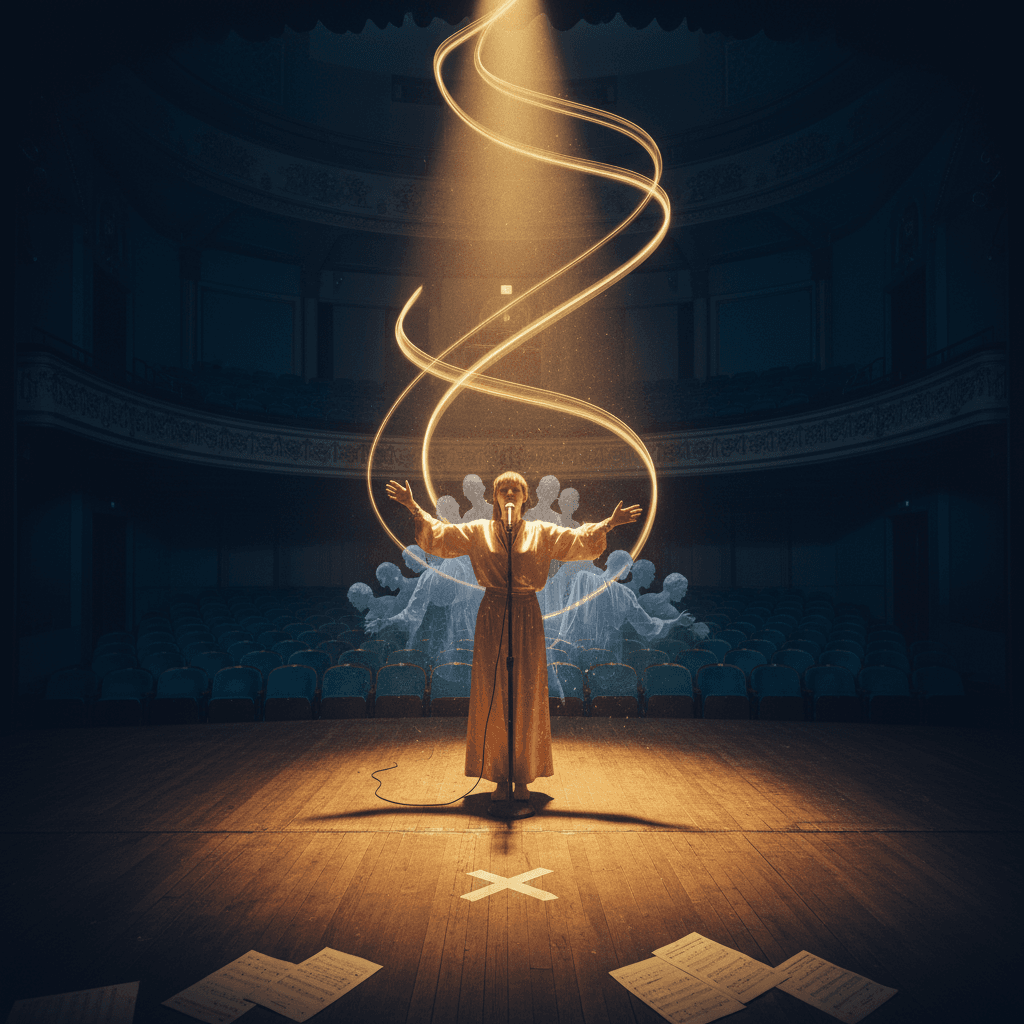
Turn hesitation into rehearsal; practice frees the voice of action. — Max Ehrmann
—What lingers after this line?
The Pivot from Pause to Preparation
Max Ehrmann’s dictum reframes hesitation not as failure but as a starting line. Instead of treating the pause before action as a void, he recasts it as a rehearsal space where skill, confidence, and intention are built. In this light, practice is not merely repetition; it is a liberating force that gives shape to our impulses and turns them into purposeful motion. As a result, what once felt like stalling becomes structured preparation, and the “voice of action” emerges—clear, grounded, and ready to be heard.
How Practice Calms the Fear Circuit
To move from doubt to doing, the brain must learn safety. Repeated, graduated exposure reduces threat responses, allowing the prefrontal cortex to regulate the amygdala. Research on fear and extinction learning (Joseph LeDoux, The Emotional Brain, 1996) shows that controlled encounters with stressors lower physiological arousal over time. In practical terms, rehearsal shrinks the unknown: scripts become familiar, contingencies predictable, and errors informative rather than alarming. Thus, practice does not merely add skill; it subtracts fear, making action feel less like a leap and more like a step.
Historical Proof: Demosthenes and Deliberate Constraint
History offers vivid evidence that rehearsal frees expression. Plutarch’s Life of Demosthenes (c. 100 AD) recounts how the Athenian orator practiced speeches with pebbles in his mouth and trained his voice against ocean waves. These constraints, seemingly harsh, heightened control and clarity when it mattered. By pushing harder in rehearsal than in performance, Demosthenes turned hesitation—born of a weak voice and ridicule—into commanding presence. His story shows how disciplined practice manufactures the courage that idealism alone cannot supply.
The Mechanics of Deliberate Practice
Moving from folklore to framework, Anders Ericsson’s work on deliberate practice demonstrates that targeted, feedback-rich drills build expert performance (Ericsson & Pool, Peak, 2016). Rather than rote repetition, effective rehearsal isolates sub-skills, sets stretch goals, and closes the loop with immediate corrections. This structure frees the “voice of action” by automating mechanics, so attention can shift from “How do I do this?” to “What do I say or create now?” In short, mastery accelerates expression because fluency reduces cognitive load.
Micro-Rehearsals and If–Then Plans
Yet large goals often stall in ambiguity; therefore, shrink rehearsal. Peter Gollwitzer’s implementation intentions (1999) show that if–then plans—“If it’s 8 a.m., then I draft the first sentence”—prime behavior at the right moment. Paired with mental contrasting and WOOP (Oettingen, 2014), micro-rehearsals convert vague intent into reliable action scripts. By practicing transitions—starting, continuing after interruption, and finishing—you transform the friction points that feed hesitation into practiced moves that carry you forward.
Artistic Freedom Built on Scales and Games
Artists exemplify how rehearsal unlocks spontaneity. Viola Spolin’s Improvisation for the Theater (1963) uses structured games to train attention and trust, yielding fluid performances that feel effortless. Similarly, jazz improvisers internalize patterns so creativity can leap without stumbling; Paul Berliner’s Thinking in Jazz (1994) documents how deep practice of scales, voicings, and call-and-response yields freedom on stage. Thus, constraint in rehearsal births liberty in performance—an apparent paradox resolved by skill made second nature.
From Practice to Public Action
Finally, practice reshapes identity through mastery experiences, raising self-efficacy (Albert Bandura, 1977). Small wins accumulate (Karl Weick, 1984), converting self-doubt into evidence-based confidence. Start with brief, repeatable reps—one paragraph, one cold call, one prototype—and let feedback refine the next iteration. As the loop accelerates, hesitation loses its grip; action speaks not because fear vanishes, but because practice has given your voice something steady to say.
One-minute reflection
What does this quote ask you to notice today?
Related Quotes
6 selectedNo matter how full a reservoir of maxims one may possess, if one has not taken advantage of every concrete opportunity to act, one's character may remain entirely unaffected. — William James
William James
At first glance, William James draws a sharp line between knowing and becoming. A person may store up countless moral sayings, noble principles, and wise resolutions, yet these remain largely ornamental if they never pas...
Read full interpretation →No one masters his craft the first day. — Johannes Brahms
Johannes Brahms
At its core, Brahms’s remark reminds us that every serious craft starts in awkwardness rather than brilliance. The first day is rarely a moment of mastery; instead, it is a confrontation with limits, uncertainty, and the...
Read full interpretation →A garden is not made by singing 'Oh, how beautiful,' and sitting in the shade. — Rudyard Kipling
Rudyard Kipling
Kipling’s line immediately cuts through passive appreciation. Simply admiring a garden, however sincerely, does nothing to plant seeds, pull weeds, or carry water.
Read full interpretation →You cannot afford to live in potential for the rest of your life; at some point, you have to unleash it. — Eric Thomas
Eric Thomas
Eric Thomas’s quote begins with a stark warning: potential is not a place to live, only a promise of what might be. In other words, talent, intelligence, or ambition mean very little if they remain dormant.
Read full interpretation →The way to do is to be. — B.K.S. Iyengar
B.K.S. Iyengar
At first glance, B.K.S. Iyengar’s line seems to invert common advice.
Read full interpretation →It is by acts and not by ideas that people live. — Anatole France
Anatole France
At its core, Anatole France’s remark argues that life is sustained by what people actually do, not merely by what they think or proclaim. Ideas may inspire, guide, or justify, yet they remain inert until translated into...
Read full interpretation →More From Author
More from Max Ehrmann →Beyond a wholesome discipline, be gentle with yourself. You are a child of the universe no less than the trees and the stars. — Max Ehrmann
At first glance, Max Ehrmann’s line balances two forces people often separate: discipline and gentleness. He does not reject self-control or moral effort; instead, he insists that a wholesome life should not harden into...
Read full interpretation →You are a child of the universe no less than the trees and the stars; you have a right to be here. — Max Ehrmann
Max Ehrmann’s line, from Desiderata (1927), asserts a radical equilibrium: your existence weighs no less than a cedar’s presence or a star’s light. By placing person and cosmos on the same continuum, he dissolves hierarc...
Read full interpretation →Go placidly amid the noise and haste, and remember what peace there may be in silence. — Max Ehrmann
Max Ehrmann’s Desiderata (1927) opens with a gentle imperative: move through turbulence without letting it move through you. To “go placidly” is not withdrawal but a disciplined way of walking amid “noise and haste,” rem...
Read full interpretation →