
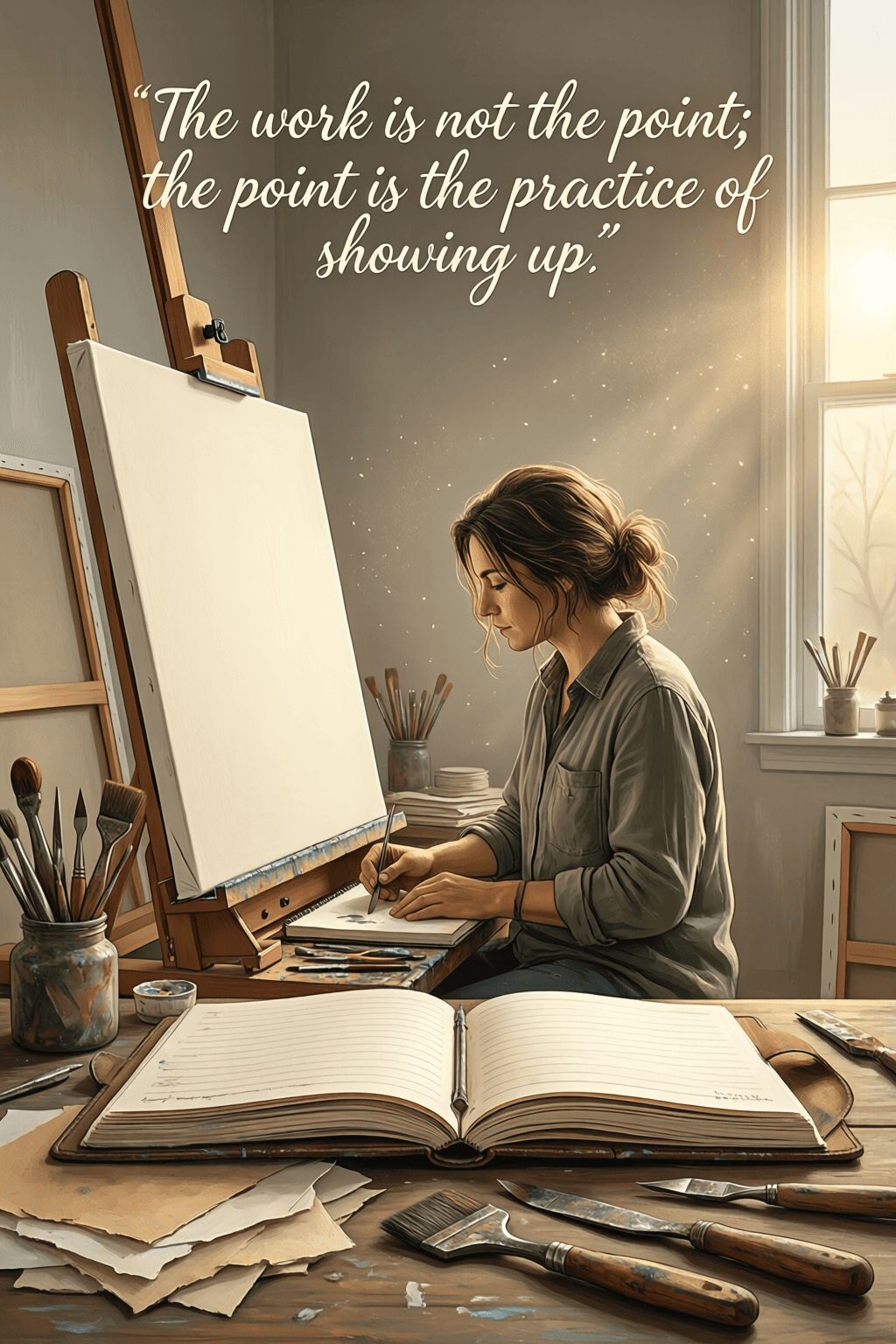
When you are in the middle of a creative block, remember that the work is not the point; the point is the practice of showing up. — Twyla Tharp
—What lingers after this line?
The Heart of the Reminder
Twyla Tharp’s quote shifts attention away from the finished product and toward the habit that makes creation possible in the first place. In the middle of a creative block, it is easy to believe that nothing matters unless something brilliant appears. Instead, Tharp argues that the real purpose is practice: the repeated act of arriving, trying, and staying present even when inspiration refuses to cooperate. This idea is powerful because it removes the drama from blocked moments. Rather than treating them as proof of failure, we can see them as part of the larger rhythm of creative life. In that sense, showing up becomes its own kind of success, laying the groundwork for future breakthroughs.
Why Blocks Feel So Defeating
At first, creative block often feels like a judgment on talent. A blank page, a stalled rehearsal, or an abandoned sketch can seem to say that the artist has somehow lost the essential spark. Yet this is precisely the illusion Tharp pushes against. The block is not the end of the work; rather, it is one of the conditions under which work must continue. Seen this way, frustration becomes less personal and more procedural. Many creators have described this same struggle: in Anne Lamott’s Bird by Bird (1994), she famously defends the value of imperfect first attempts. Her point, much like Tharp’s, is that progress rarely begins with confidence; it begins with endurance.
Practice as a Creative Discipline
From there, the quote opens into a larger philosophy of discipline. Practice is not merely rehearsal for the real event; it is the real event. Dancers, writers, musicians, and painters all depend on routines that may look unremarkable from the outside, yet these repeated actions steadily build fluency, resilience, and trust in one’s process. Twyla Tharp’s own The Creative Habit (2003) makes this principle concrete by emphasizing ritual and routine over waiting for inspiration. In other words, creativity becomes more reliable when it is treated like a practice rather than a miracle. Showing up, then, is how an artist stays in relationship with the craft.
The Freedom of Lowering the Stakes
Once the emphasis moves from masterpiece to practice, a surprising freedom appears. If today’s session does not need to produce something exceptional, then it can still be worthwhile. A few awkward lines, a rough melody, or a failed experiment no longer count as wasted effort; instead, they become evidence that the creative muscles are still being used. This reduced pressure often helps unblock the very mind that felt frozen. As psychologists studying performance and habit have often noted, consistent action can interrupt avoidance patterns more effectively than bursts of motivation. Thus, by lowering the stakes, Tharp’s advice quietly increases the chances that real work will emerge.
A Wider Lesson Beyond Art
Although Tharp speaks from a creative context, the insight extends well beyond art. Athletes train on uninspired days, spiritual traditions emphasize daily devotion, and scholars return to difficult texts long before clarity arrives. Aristotle’s Nicomachean Ethics suggests that excellence is formed through repeated action, a notion that fits naturally with Tharp’s insistence on practice over immediate results. Ultimately, the quote offers a humane standard for any demanding pursuit. We do not always control the quality of a given day’s output, but we can control whether we return. In that return lies the deeper accomplishment: not perfection, but fidelity to the practice itself.
One-minute reflection
Why might this line matter today, not tomorrow?
Related Quotes
6 selectedThe way to do a great deal is to keep on doing a little. The way to do nothing at all is to be continually resolving that you will do everything. — C.H. Spurgeon
C.H. Spurgeon
Spurgeon’s statement begins with a practical paradox: great accomplishments are rarely born from dramatic bursts of effort, but from the steady repetition of small acts. By saying that “a great deal” is done by “doing a...
Read full interpretation →Dreams can come true, but there is a secret. They are realized through the magic of persistence, determination, commitment, passion, practice, focus, and hard work. — Harsha Bhogle
Harsha Bhogle
Harsha Bhogle’s words begin by dismantling the illusion that dreams come true by luck alone. Although achievement can look magical from the outside, he reminds us that the real enchantment lies in ordinary habits repeate...
Read full interpretation →The spring that keeps running is more valuable than the jug which bottoms out each day. We unlock that spring by patiently working at our task and giving our best effort every time. — Henri Matisse
Henri Matisse
Matisse’s image contrasts two kinds of value: the jug that must be refilled each day and the spring that continues to flow from within. At first glance, the jug seems useful, but its usefulness is limited by its emptines...
Read full interpretation →Consistency is the jewel worth wearing; it is the anchor worth weighing; it is the thread worth weaving. — Charles Swindoll
Charles Swindoll
At first glance, Charles Swindoll’s line turns consistency into three vivid objects: a jewel, an anchor, and a thread. Each image adds a different dimension to the same virtue.
Read full interpretation →Don't worry about being brilliant; just be consistent. The world is built by people who showed up even when they didn't feel like it. — James Clear
James Clear
At its core, James Clear’s quote pushes back against the modern obsession with exceptional talent. Rather than glorifying brilliance, it elevates consistency—the humble act of returning to the work again and again.
Read full interpretation →The brick walls are there for a reason... to give us a chance to show how badly we want something. — Randy Pausch
Randy Pausch
At first glance, Randy Pausch’s line turns frustration into meaning. Rather than treating barriers as pointless interruptions, he frames them as tests that reveal the seriousness of our intentions.
Read full interpretation →More From Author
More from Twyla Tharp →It is through the process of creating that we discover who we are, not by waiting for a finished masterpiece to tell us. — Twyla Tharp
Twyla Tharp’s insight begins with a reversal of a common assumption: we often imagine that identity arrives fully formed and then expresses itself through art, work, or achievement. Instead, she argues that we come to kn...
Read full interpretation →Creativity is a habit, and the best creativity is the result of good work habits. — Twyla Tharp
At first glance, Twyla Tharp’s quote challenges the popular myth that creativity arrives as a sudden flash of genius. Instead, she reframes it as something built through repetition, structure, and deliberate effort.
Read full interpretation →The artist is a filter; they must be alone with themselves, not the algorithm, to hear what is actually worth saying. — Twyla Tharp
Twyla Tharp’s remark begins with a striking image: the artist as a filter rather than a loudspeaker. In that view, creative work does not emerge from sheer output but from a disciplined inward process that separates nois...
Read full interpretation →True mastery begins when you stop waiting for the feeling of inspiration and start relying on the engine of your own commitment. — Twyla Tharp
Twyla Tharp’s statement reframes mastery as a choice rather than a mood. At first glance, inspiration seems like the natural beginning of great work, yet Tharp argues that real progress starts later—when a person stops w...
Read full interpretation →