
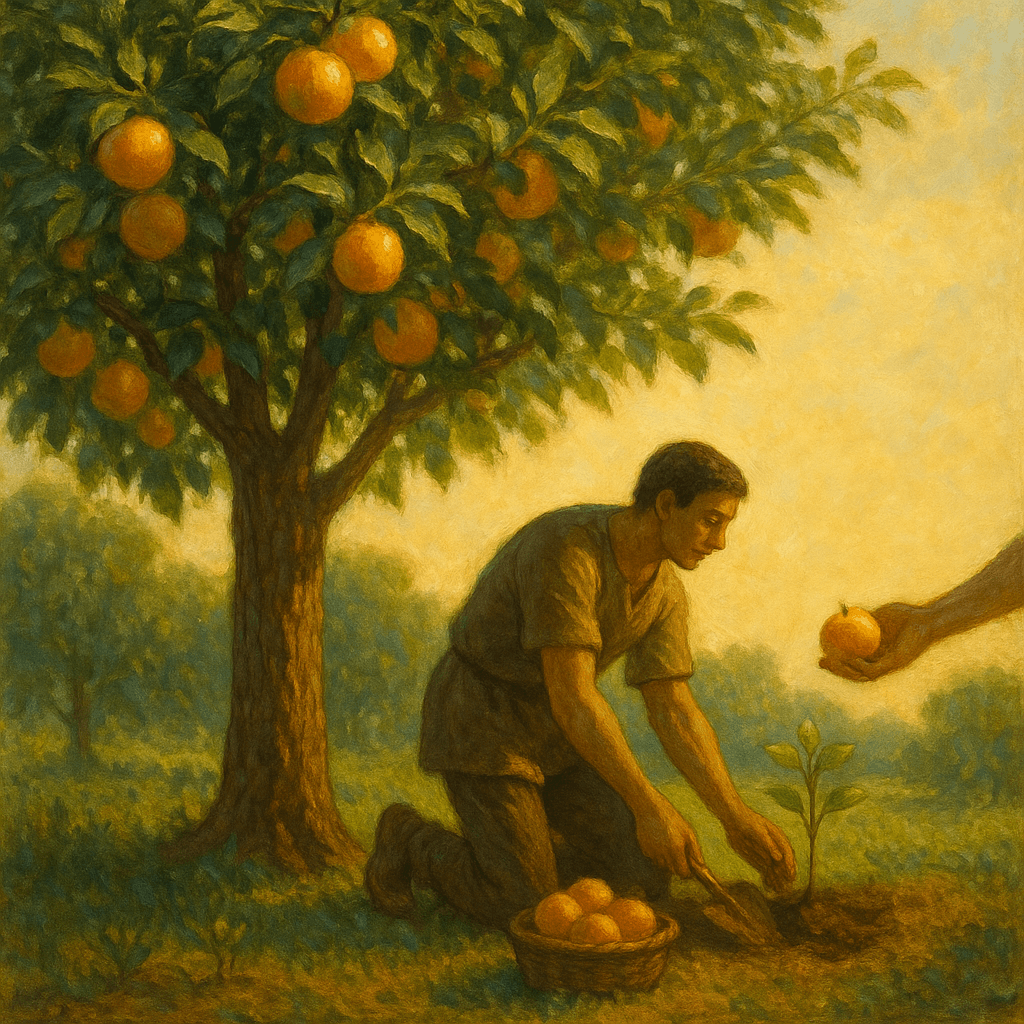
A tree is known by its fruit; a man by his deeds. — Saint Basil
—What lingers after this line?
The Root of the Proverb
Saint Basil’s observation draws on age-old imagery, comparing human conduct to the natural world. Just as a tree’s fruit reveals its type and health, so too are people’s true natures exposed through their actions. This metaphor has echoed through many cultures, emphasizing that essence is made evident only through external results, not mere appearance or intent.
Biblical and Philosophical Resonances
Building on this idea, the Christian Gospels, such as Matthew 7:16, echo similar sentiments, stating, ‘By their fruits you shall know them.’ Saint Basil, rooted in early Christian theology, channels this wisdom to stress the importance of virtue in daily life. Meanwhile, Aristotle in his *Nicomachean Ethics* argued that virtue arises from habit—a concept linking good character directly to repeated good deeds.
Actions versus Words
Transitioning to the practical, Saint Basil’s insight warns against taking words at face value. Deeds, not declarations, testify to integrity—a concept that has often informed leadership and trust. For instance, Abraham Lincoln famously said, ‘Actions speak louder than words,’ reinforcing that one’s behavior is the ultimate evidence of character. Empty promises, unbacked by effort, carry little weight.
Social Judgement and Reputation
Furthermore, society routinely forms judgments based on observable behavior. Reputations, whether of honesty or duplicity, emerge from patterns people witness over time. In the workplace, for example, diligent employees earn respect, much as a fruitful tree earns admiration. Conversely, those whose actions contradict their pledges risk mistrust and social alienation.
Inspiring Self-Reflection and Growth
In closing, Saint Basil’s wisdom encourages self-scrutiny. By examining our deeds—as a gardener inspects fruit—we gain insight into our character and room for improvement. This perspective doesn’t simply judge others; it invites us to become the kind of people whose consistent ‘fruit’ inspires trust, respect, and the betterment of community, echoing Saint Basil’s enduring call to virtuous living.
One-minute reflection
Where does this idea show up in your life right now?
Related Quotes
6 selectedConsistency is the sum that equals what we become. — Marcus Aurelius
Marcus Aurelius
Marcus Aurelius’ line frames becoming as a kind of moral mathematics: each repeated action adds to the total of a life. Rather than imagining identity as a single grand decision, the quote suggests that character is accu...
Read full interpretation →No matter how full a reservoir of maxims one may possess, if one has not taken advantage of every concrete opportunity to act, one's character may remain entirely unaffected. — William James
William James
At first glance, William James draws a sharp line between knowing and becoming. A person may store up countless moral sayings, noble principles, and wise resolutions, yet these remain largely ornamental if they never pas...
Read full interpretation →The discipline of desire is the backbone of character. — Will Durant
Will Durant
At first glance, Will Durant’s line suggests that character is not built by suppressing desire, but by governing it. Desire is the engine of human action: it pushes us toward pleasure, ambition, recognition, and comfort.
Read full interpretation →A bird is known by its song and a man by his deeds. — Miguel de Cervantes
Miguel de Cervantes
Cervantes condenses a large moral idea into a vivid comparison: just as a bird announces itself through its song, a person reveals his true nature through action. In other words, identity is not established by claims, ap...
Read full interpretation →We must take care to live not merely a long life, but a full one; for living a long life requires only good fortune, but living a full life requires character. — Seneca
Seneca
Seneca begins by drawing a sharp distinction between duration and depth. A long life, he says, may depend largely on luck—health, safety, and circumstances beyond our control.
Read full interpretation →An exhausted nervous system requires wise rest, not relentless productivity. — Unknown (Attributed to general wellness wisdom in 2026/Discarded; replacing with: The true measure of a person is not where they stand in times of comfort, but rather where they stand during challenges and controversies. — Martin Luther King Jr.)
Martin Luther King Jr.
At its heart, this statement argues that comfort is a poor test of character. When circumstances are easy, many people can appear principled, generous, or brave.
Read full interpretation →More From Author
More from Saint Basil →