
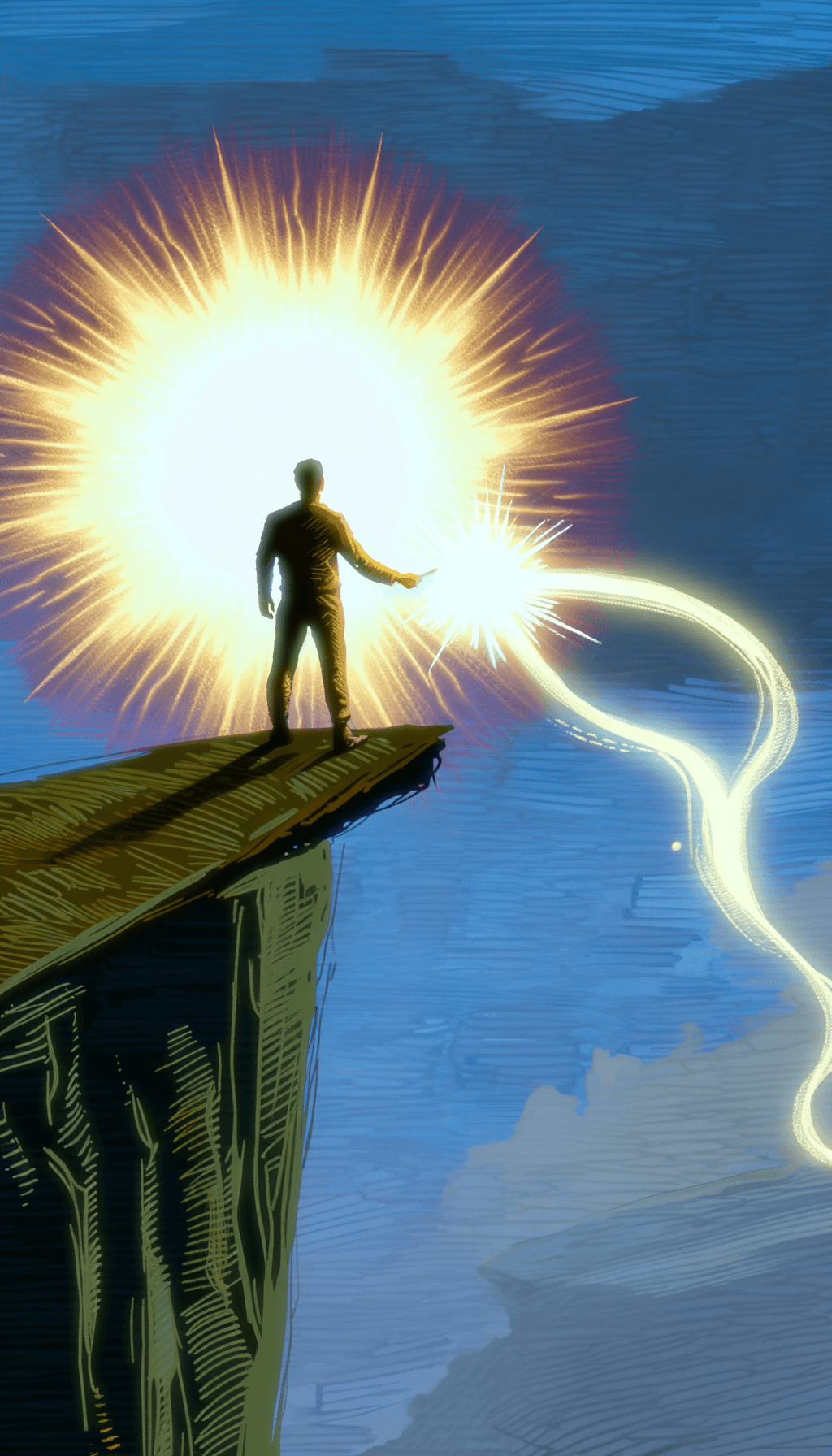
Boldness has genius, power, and magic in it. — Johann Wolfgang von Goethe
—What lingers after this line?
Power of Taking Action
This quote emphasizes that boldness is a crucial element for success. When people take decisive action, they tap into a unique power that can lead to extraordinary achievements.
Creativity and Innovation
The mention of 'genius' suggests that boldness often leads to creative breakthroughs. Those who dare to take risks open the door to new ideas and innovations.
The Transformational Effect of Courage
Goethe associates boldness with 'magic,' suggesting that courageous actions can lead to surprising, almost miraculous, results that were previously unimaginable.
Overcoming Fear and Hesitation
By emphasizing the importance of boldness, Goethe implies that success often demands overcoming fear and hesitation. Decisiveness plays a vital role in achieving one's goals.
Goethe's Perspective on Action and Fate
Johann Wolfgang von Goethe, a prominent German writer and thinker, often explored themes of human potential and destiny. This quote aligns with his belief that action shapes reality more than mere contemplation.
One-minute reflection
Where does this idea show up in your life right now?
Related Quotes
6 selectedDaring ideas are like chessmen moved forward; they may be beaten, but they may start a winning game. — Johann Wolfgang von Goethe
Johann Wolfgang von Goethe
This quote suggests that daring ideas require courage to bring them forward. Like chess moves, bold actions can carry risks, but they also open possibilities for success and progress.
Read full interpretation →The foundation of genius is intelligent consistency. — Henri-Frédéric Amiel
Frédéric Amiel
At first glance, Amiel’s statement challenges the popular image of genius as sudden inspiration or erratic brilliance. Instead, he proposes something steadier: greatness is built on repeated, thoughtful action.
Read full interpretation →If you're not doing some things that are crazy, then you're doing the wrong things. — Francis Ford Coppola
Francis Ford Coppola
At first glance, Francis Ford Coppola’s remark sounds like a celebration of recklessness, yet its deeper point is more demanding than that. He suggests that meaningful work often requires choices that appear irrational t...
Read full interpretation →Life is too short to be subtle — Mary Quant
Mary Quant
Mary Quant’s line begins with a blunt accounting: life is finite, and that fact should change how we show up in the world. If time is scarce, then excessive restraint can become a kind of self-sabotage—postponing honest...
Read full interpretation →I'd rather be a lightning rod than a seismograph. — Ken Kesey
Ken Kesey
Ken Kesey’s line hinges on two instruments that represent opposing ways of moving through life. A seismograph registers tremors; it is designed to detect, record, and translate distant shocks into readable marks.
Read full interpretation →One can never consent to creep when one feels an impulse to soar. — Simone de Beauvoir
Simone de Beauvoir
Simone de Beauvoir’s line begins with a quiet rebellion: once you feel the tug of possibility, “consenting to creep” becomes intolerable. The word consent matters, because it frames smallness as a choice we are pressured...
Read full interpretation →More From Author
More from Johann Wolfgang von Goethe →A really great talent finds its happiness in execution. — Johann Wolfgang von Goethe
Goethe’s remark shifts attention away from talent as mere possession and toward talent as practice. A gift, however impressive, remains incomplete until it is exercised; in this sense, happiness does not come from being...
Read full interpretation →Everybody wants to be somebody; nobody wants to grow. — Johann Wolfgang von Goethe
At first glance, Goethe’s remark exposes a quiet contradiction in human desire: people long for significance, recognition, and identity, yet often resist the difficult transformation such becoming requires. To ‘be somebo...
Read full interpretation →The most original of authors are not so because they advance what is new, but more because they know how to say something as if it had never been said before. — Johann Wolfgang von Goethe
Goethe begins by shifting originality away from mere invention and toward expression. In his view, a writer does not become original simply by producing unheard-of thoughts; rather, originality emerges when familiar trut...
Read full interpretation →In nature we never see anything isolated, but everything in connection with something else which is before it, beside it, under it and over it. — Johann Wolfgang von Goethe
Goethe’s remark begins with a simple observation and expands into a profound worldview: nothing in nature exists alone. Every plant, stone, current, and creature belongs to a web of relations shaped by time, place, and s...
Read full interpretation →