
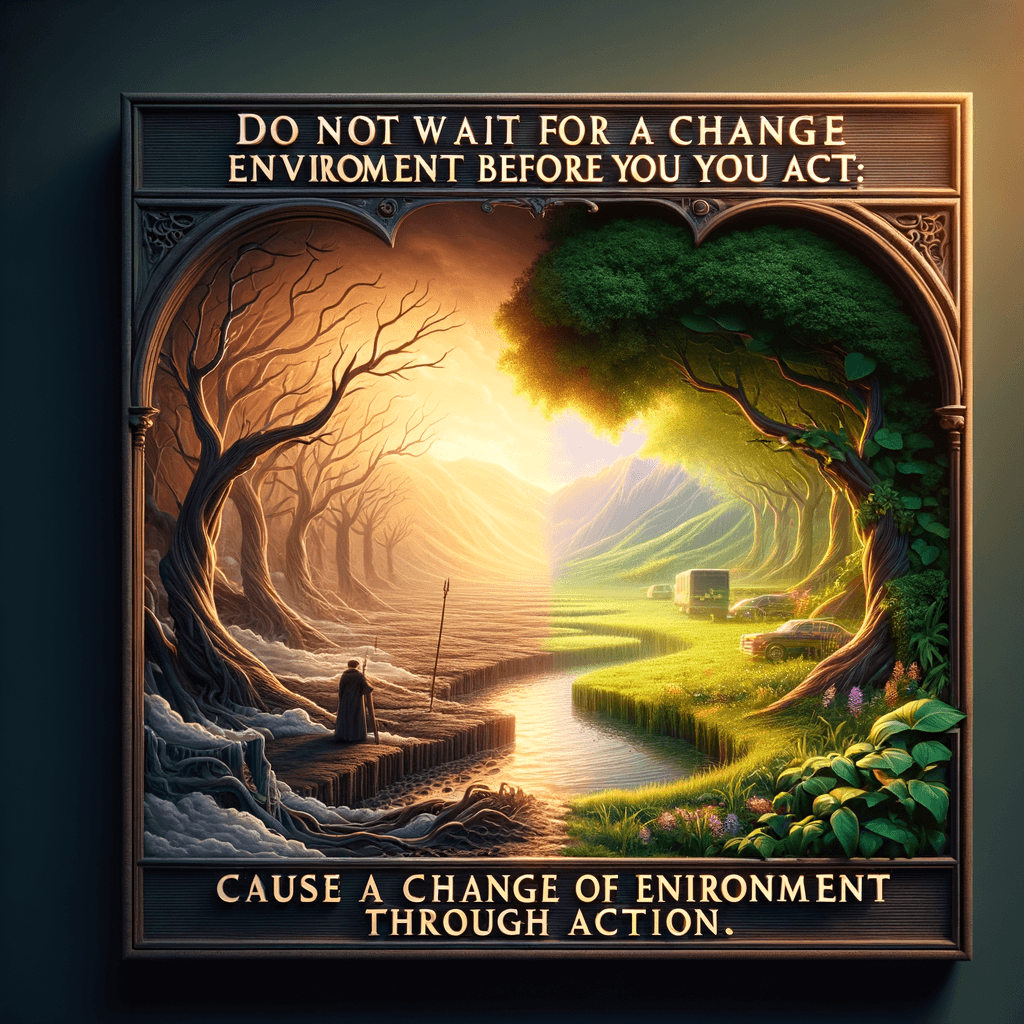
Do not wait for a change of environment before you act; cause a change of environment through action. — William J.H. Boetcker
—What lingers after this line?
Proactivity and Initiative
The quote emphasizes the importance of taking initiative rather than waiting for favorable conditions. It suggests that individuals have the power to create their desired environment through proactive actions.
Empowerment
It highlights personal empowerment and responsibility. By taking action, one can significantly influence their surroundings and circumstances instead of feeling victimized by them.
Self-Determination
The idea encourages self-determination and control over one's life. Rather than being passive, it advocates for being an active agent in shaping one's future.
Overcoming Paralysis by Analysis
The quote advises against overthinking and waiting for the so-called 'perfect moment.' It suggests that waiting can lead to inaction, whereas taking action can generate the change one seeks.
Historical Context
William J.H. Boetcker, an influential American religious leader and public speaker of the early 20th century, was known for his motivational and inspirational messages. This quote reflects his belief in the power of individual effort and action.
One-minute reflection
What's one small action this suggests?
Related Quotes
6 selectedYou cannot command things, but you can command yourself. — Michael D. Pollock
Michael D. Pollock
At first glance, Michael D. Pollock’s line draws a sharp boundary between the outer world and the inner one.
Read full interpretation →A boundary is not a wall; it is a door with a lock that you control. — Annie Wright
Annie Wright
At first glance, Annie Wright’s quote corrects a common misunderstanding: people often treat boundaries as acts of distance or punishment, when in fact they are tools of intentional relationship. A wall shuts everyone ou...
Read full interpretation →Begin, therefore, from little things. — Seneca
Seneca
Seneca’s brief instruction, drawn from his Stoic outlook, turns attention away from grand ambitions and toward manageable first steps. By saying, “Begin, therefore, from little things,” he suggests that progress is rarel...
Read full interpretation →The flame doesn't appear before the match. It is always action that creates the fire. — Napoleon Hill
Napoleon Hill
Napoleon Hill’s image is simple but forceful: a flame does not mysteriously appear on its own; it requires the friction of a struck match. In the same way, desire, talent, and intention remain dormant until they are tran...
Read full interpretation →When you feel like you are at a dead end, remember that you are at a place where you can choose a different path. — Haemin Sunim
Haemin Sunim
At first glance, a dead end feels like failure, as though movement itself has been denied. Yet Haemin Sunim’s insight gently reverses that impression: what seems like a wall may actually be a point of decision.
Read full interpretation →The boundaries of your life are merely a creation of the self. — Robin Sharma
Robin Sharma
Robin Sharma’s line reframes “boundaries” as something less like a fence in the world and more like a frame in the mind. What we often call limits—who we are, what we can do, what we deserve—can be stories we repeat unti...
Read full interpretation →More From Author
More from William J.H. Boetcker →