
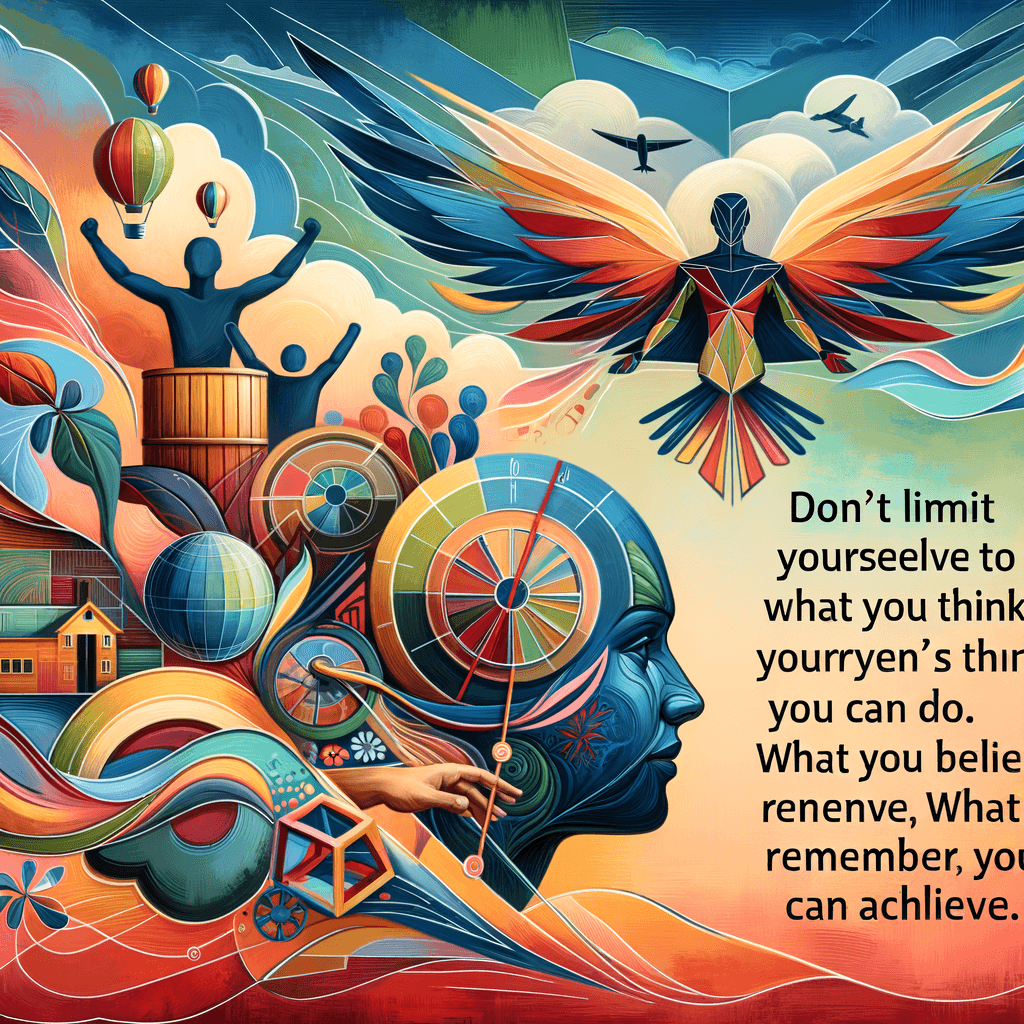
Don't limit yourself. Many people limit themselves to what they think they can do. You can go as far as your mind lets you. What you believe, remember, you can achieve. — Mary Kay Ash
—What lingers after this line?
Self-Belief and Potential
This quote highlights the significant role that self-belief plays in achieving one's potential. It encourages individuals to trust in their abilities and not be constrained by self-imposed limitations.
Mental Barriers
Mary Kay Ash points out that many people set boundaries for themselves based on their own perceptions. She emphasizes that these mental barriers are often the biggest obstacles to success.
Power of the Mind
The quote suggests that the mind is incredibly powerful in determining how far one can go. By fostering positive thoughts and a strong belief in one's capabilities, individuals can overcome challenges and accomplish great things.
Achieving Goals
Ash's words serve as a motivational reminder that belief in oneself is a critical factor in the pursuit of goals. By believing in their potential, people can achieve far more than they initially thought possible.
Inspirational Impact
As a successful businesswoman and founder of Mary Kay Cosmetics, Mary Kay Ash's insights are backed by her own experiences of overcoming limitations and achieving success. Her quote is meant to inspire and empower others to adopt a mindset of limitless possibilities.
Practical Application
The quote urges individuals to challenge their own limits by setting ambitious goals and cultivating a mindset of perseverance and determination. It encourages proactive effort to break free from self-doubt and embrace the potential for growth and success.
One-minute reflection
What feeling does this quote bring up for you?
Related Quotes
6 selectedBelieve in your infinite potential. Your only limitations are those you set upon yourself. — Roy T. Bennett
Roy T. Bennett
This quote emphasizes the importance of having confidence in oneself. Believing in your potential is the first step toward achieving greatness.
Read full interpretation →Believe in your infinite potential. Your only limitations are those you set upon yourself. — Roy T. Bennett
Roy T. Bennett
This quote encourages individuals to have confidence in their unlimited potential. It emphasizes the importance of believing in one's abilities to achieve greatness and push beyond perceived limitations.
Read full interpretation →Your limitation—it's only your imagination. — Unknown
Unknown
This quote suggests that the limitations you perceive in yourself and your abilities are often created by your own mind. It encourages individuals to realize that most of their constraints are not real but imagined.
Read full interpretation →You are not starting over. You're starting wiser. — Meredith Eastwood
Meredith Eastwood
At first glance, Meredith Eastwood’s line gently challenges the fear that often accompanies change. To say, “You are not starting over,” is to reject the idea that every setback erases what came before.
Read full interpretation →If you are not crashing, you are corroding. Growth requires the courage to be challenged, not just the comfort of being safe. — Jaime Raul Zepeda
Jaime Raul Zepeda
At first glance, Zepeda frames life as a choice between impact and erosion. To be “crashing” suggests collision with difficulty, experimentation, and the visible mess of effort; by contrast, “corroding” evokes a quieter...
Read full interpretation →You can, if you believe you can. — George Reeves
George Reeves
At first glance, George Reeves’s line seems almost circular: you can, if you believe you can. Yet that apparent simplicity is precisely its force.
Read full interpretation →More From Author
More from Mary Kay Ash →