
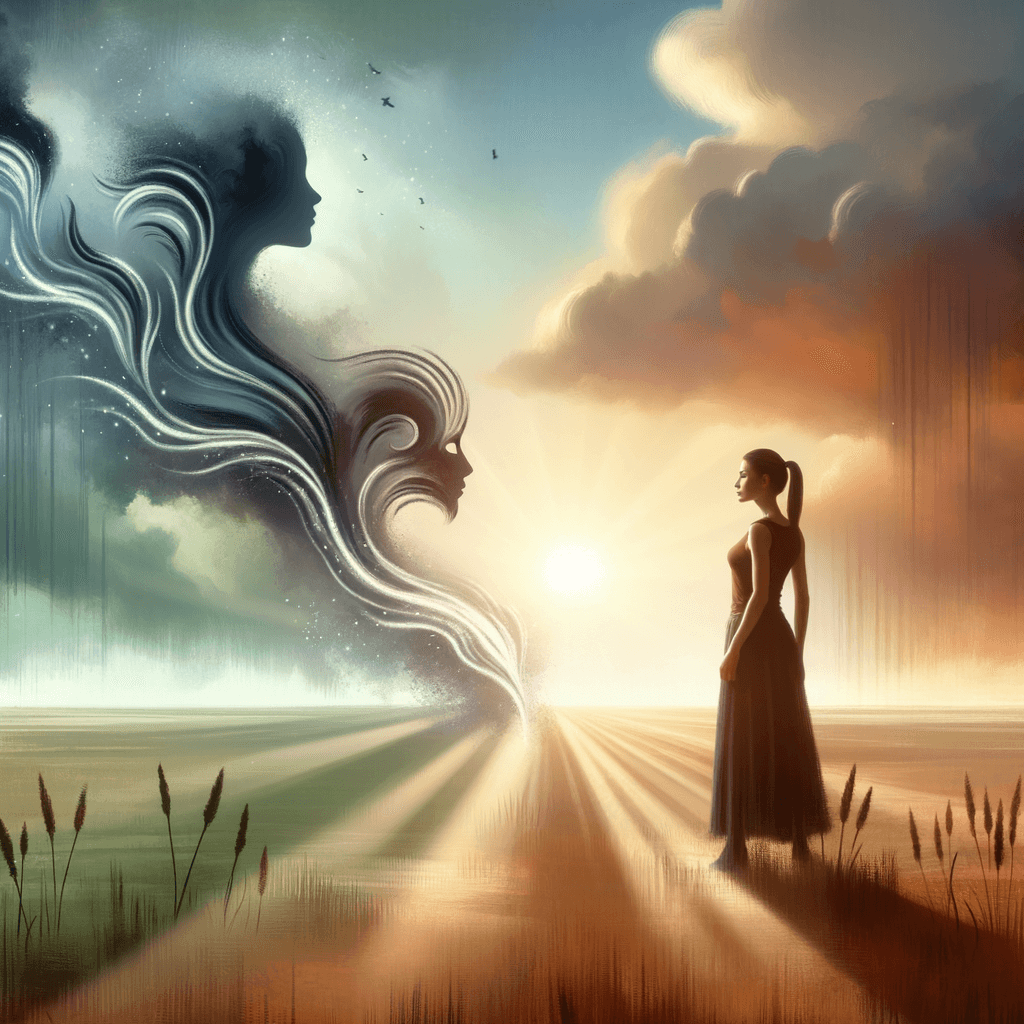
Fears are nothing more than a state of mind. — Napoleon Hill
—What lingers after this line?
Mental Nature of Fear
This quote suggests that fear is not a physical or external force, but something that originates in the mind. It implies that fear is subjective and can be controlled or overcome by changing one's mindset.
Power of Perception
The quote emphasizes how fear is often a product of perception rather than reality, reinforcing the idea that we can choose how we perceive and respond to situations.
Personal Empowerment
By framing fear as a mental construct, the quote encourages individuals to take responsibility for their fears and empowers them to conquer those fears by mastering their thoughts.
Overcoming Limiting Beliefs
The idea that fear is just a state of mind implies that fears can be challenged and dismantled. Therefore, it's possible to break free from limiting beliefs and realize one's potential.
Historical/Author Context
Napoleon Hill, a pioneer in personal development and self-improvement, wrote extensively about the role of mindset in achieving success. This quote aligns with his broader philosophy that our thoughts shape our reality.
One-minute reflection
What does this quote ask you to notice today?
Related Quotes
6 selectedYou don't have to bully yourself out of feeling fear. You just have to move while it's still there. — Annie Wright
Annie Wright
At its core, Annie Wright’s quote challenges the common belief that courage begins only after fear has disappeared. Instead, it reframes fear as something that can accompany action rather than prevent it.
Read full interpretation →The economy can take your money. A crisis can take your opportunities. But fear can take your judgment—and that is the loss most people never recover from. — Epictetus
Epictetus
At first glance, this saying draws a sharp line between what happens to us and what happens within us. Money can vanish in a recession, and opportunities can disappear when markets collapse, yet Epictetus argues that the...
Read full interpretation →The obsession with being 'productive' is just a mask for fear. True discipline is the courage to do what is necessary while leaving behind what is merely loud. — Ryan Holiday
Ryan Holiday
At first glance, Ryan Holiday’s quote challenges a deeply admired ideal: productivity. In many workplaces and digital spaces, being constantly busy is treated as proof of worth.
Read full interpretation →The soul is a garden; whatever you plant in it will grow. Your thoughts are the seeds of your reality. — Sister Shivani
Sister Shivani
Sister Shivani’s metaphor begins with a simple but powerful image: the soul is not a fixed object but a living garden. In that sense, the inner self is always receiving impressions, storing tendencies, and responding to...
Read full interpretation →Perfectionism is a fear that kills more dreams, businesses, and joyful lives than I believe is countable. — Beth Kempton
Beth Kempton
At first glance, perfectionism can look like discipline, ambition, or high standards. Yet Beth Kempton’s quote reframes it as something darker: a form of fear that disguises itself as virtue.
Read full interpretation →Gratitude is not a passive emotion; it is an active discipline that changes the chemistry of your day. — Mel Robbins
Mel Robbins, United States.
At first glance, gratitude can seem like a warm but temporary emotion, something that appears when circumstances go well. Mel Robbins’ quote challenges that assumption by defining gratitude as a discipline—an intentional...
Read full interpretation →More From Author
More from Napoleon Hill →If you don't control what you think, you can't control what you do. Simply, self-discipline enables you to think first and act afterward. — Napoleon Hill
Napoleon Hill’s statement begins with a simple but demanding premise: behavior does not appear out of nowhere, but grows from thought. If the mind is scattered, impulsive, or ruled by fear, then action will likely follow...
Read full interpretation →Everything that is created in the world is first created in the mind, then brought into reality through persistent care. — Napoleon Hill
Napoleon Hill’s statement begins with a bold premise: every created thing exists first as an idea before it becomes an object, achievement, or institution. In this view, the mind is not merely a place of private reflecti...
Read full interpretation →If you do not conquer self, you will be conquered by self. — Napoleon Hill
Napoleon Hill’s statement turns the self into both battlefield and opponent. At first glance, it sounds severe, yet its logic is simple: if we do not govern our impulses, fears, and habits, those inner forces will quietl...
Read full interpretation →The flame doesn't appear before the match. It is always action that creates the fire. — Napoleon Hill
Napoleon Hill’s image is simple but forceful: a flame does not mysteriously appear on its own; it requires the friction of a struck match. In the same way, desire, talent, and intention remain dormant until they are tran...
Read full interpretation →