
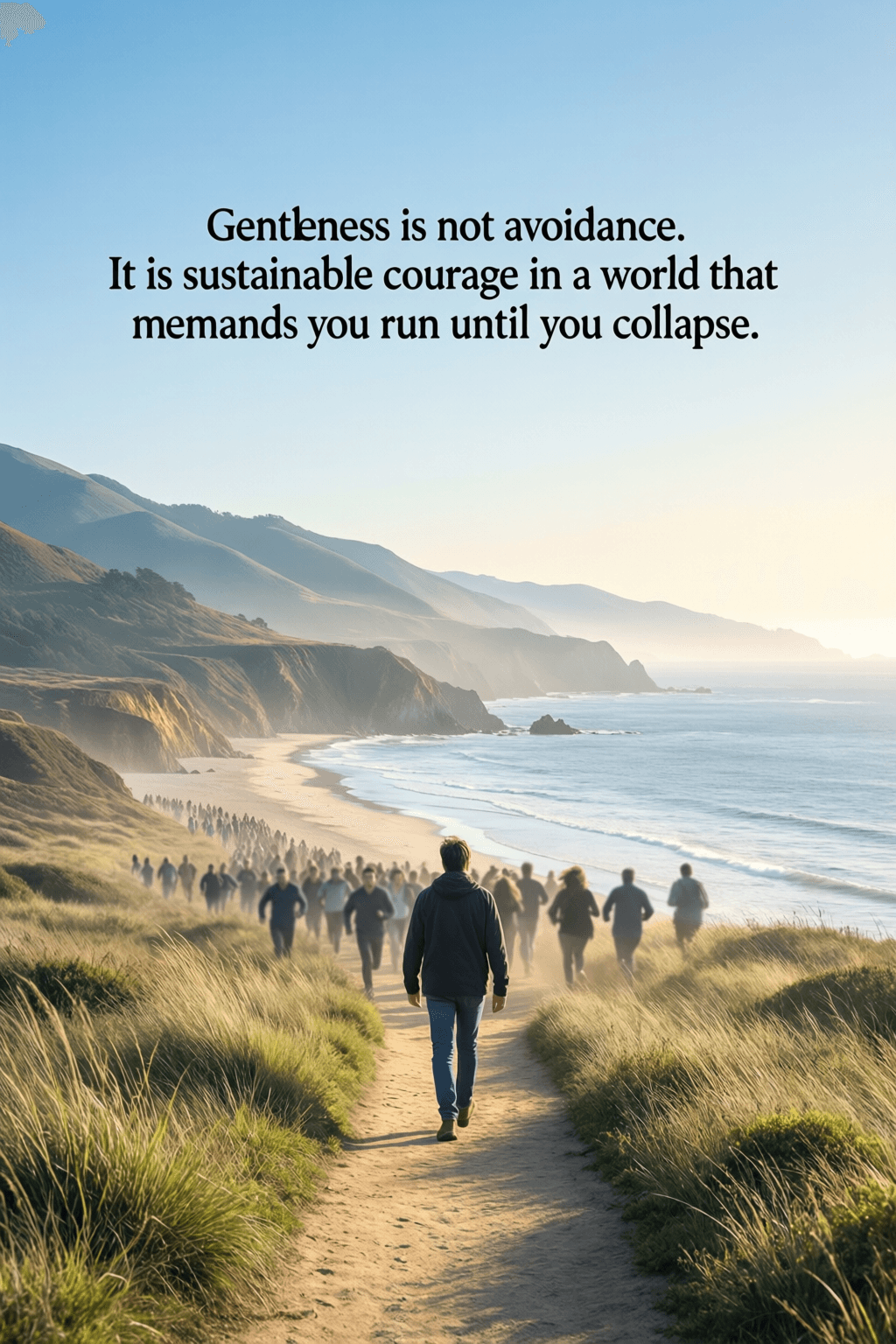
Gentleness is not avoidance. It is sustainable courage in a world that demands you run until you collapse. — Tessa Williams
—What lingers after this line?
Redefining What Gentleness Means
At first glance, gentleness is often mistaken for passivity, retreat, or a refusal to face difficulty. Yet Tessa Williams overturns that assumption by presenting gentleness as a deliberate stance rather than an escape. In her framing, it is not avoidance at all; instead, it is a way of meeting life without surrendering one’s inner steadiness. This distinction matters because many cultures praise hardness as proof of strength. By contrast, Williams suggests that real resilience can look quiet, measured, and humane. Gentleness, then, becomes a disciplined choice to remain open and thoughtful even when pressure invites panic, aggression, or emotional shutdown.
Courage That Can Last
From that starting point, the quote shifts from definition to endurance. Williams does not praise dramatic bursts of bravery that burn brightly and disappear; she praises courage that can be sustained over time. In this sense, gentleness is a form of strength that protects a person from being consumed by the very struggles they are trying to survive. This idea echoes Aristotle’s Nicomachean Ethics (4th century BC), where virtue lies not in excess but in a practiced mean. Sustainable courage is neither reckless overexertion nor fearful withdrawal. Rather, it is the ability to continue acting with integrity day after day, without turning self-destruction into a badge of honor.
A Critique of Exhaustion Culture
Just as importantly, the quote points outward to the social world. Williams describes a culture that demands relentless motion—one that celebrates people for running until they collapse. In such an environment, exhaustion is often normalized, and rest can be treated as weakness. Her words expose the cruelty hidden inside that expectation. Seen this way, gentleness becomes quietly rebellious. It refuses the logic that human worth must be proven through depletion. Modern discussions of burnout, including the World Health Organization’s classification of burnout as an occupational phenomenon in 2019, reinforce this warning: constant overdrive does not create flourishing; it erodes it.
Strength Without Self-Violence
As the idea deepens, Williams invites us to separate discipline from self-harm. Many people have learned to confuse pushing through with moral virtue, as if kindness toward oneself were indulgent. Her quote challenges that belief by implying that courage does not require cruelty, especially cruelty directed inward. This insight recalls Audre Lorde’s declaration in A Burst of Light (1988) that caring for oneself is “an act of political warfare.” Although Lorde writes from a specific social and political struggle, the broader principle resonates here: preserving oneself can be an act of resistance. Gentleness is therefore not softness in the pejorative sense, but a refusal to let survival depend on self-erasure.
How Gentleness Appears in Daily Life
Consequently, the quote is not merely philosophical; it offers a practical ethic. Gentleness may appear in setting boundaries, speaking firmly without humiliation, pausing before reacting, or choosing rest before collapse forces it upon us. These are not glamorous gestures, yet they often require more courage than dramatic displays of toughness. A simple example can make this clearer: the worker who declines one more impossible task, the parent who apologizes instead of escalating, or the student who stops equating sleeplessness with ambition. In each case, gentleness does not avoid reality; rather, it engages reality wisely enough to remain intact.
A More Human Model of Resilience
Ultimately, Williams offers a vision of resilience that is deeply humane. Instead of imagining strength as endless acceleration, she imagines it as a capacity to continue without losing compassion for oneself and others. That shift changes the moral picture entirely: survival is no longer measured by how much pain one can absorb, but by how faithfully one can endure without becoming hardened beyond recognition. In the end, the quote argues that gentleness is not the opposite of bravery but one of its highest forms. It allows a person to persist in a punishing world while refusing the world’s demand that endurance must always look like collapse postponed.
One-minute reflection
What's one small action this suggests?
Related Quotes
6 selectedTo be soft is to be powerful. — Rupi Kaur
Rupi Kaur
Rupi Kaur’s line overturns a common assumption: that power must be loud, hard, or domineering. By pairing “soft” with “powerful,” she suggests that strength can be expressed through patience, empathy, and restraint rathe...
Read full interpretation →Carry your intentions gently; force breaks, persistence molds — Henri Nouwen
Henri Nouwen
Henri Nouwen’s line sets two approaches side by side: gentleness and force, patience and pressure. By saying “carry your intentions gently,” he implies that even good desires can become harmful when gripped too tightly,...
Read full interpretation →Make kindness a daily skill; it trains the world to be gentler. — Thich Nhat Hanh
Thich Nhat Hanh
Thich Nhat Hanh frames kindness not as a personality trait you either have or lack, but as a skill—something strengthened through repetition. That shift matters because it moves kindness from the realm of occasional insp...
Read full interpretation →In the twilight of every sunset lies the gentleness of the night.
Unknown
This line highlights the peaceful transition between day and night. Twilight serves as a gentle bridge, easing the shift from the brightness of day to the calm darkness of night.
Read full interpretation →Let your life be a counter-fragrance to the unlovely things that surround you. — John O’Donohue
John O’Donohue
This quote encourages individuals to be a source of positivity in a world that can often be filled with negativity and unpleasantness. It inspires people to counteract the unlovely aspects of life with their own positive...
Read full interpretation →A gentle heart is the true strength of a warrior. — Lao Tzu
Lao Tzu
This quote suggests that true strength is not merely about physical power or aggression but also about kindness and compassion. A warrior's ability to show gentleness while possessing strength is the true mark of mastery...
Read full interpretation →More From Author
More from Tessa Williams →