
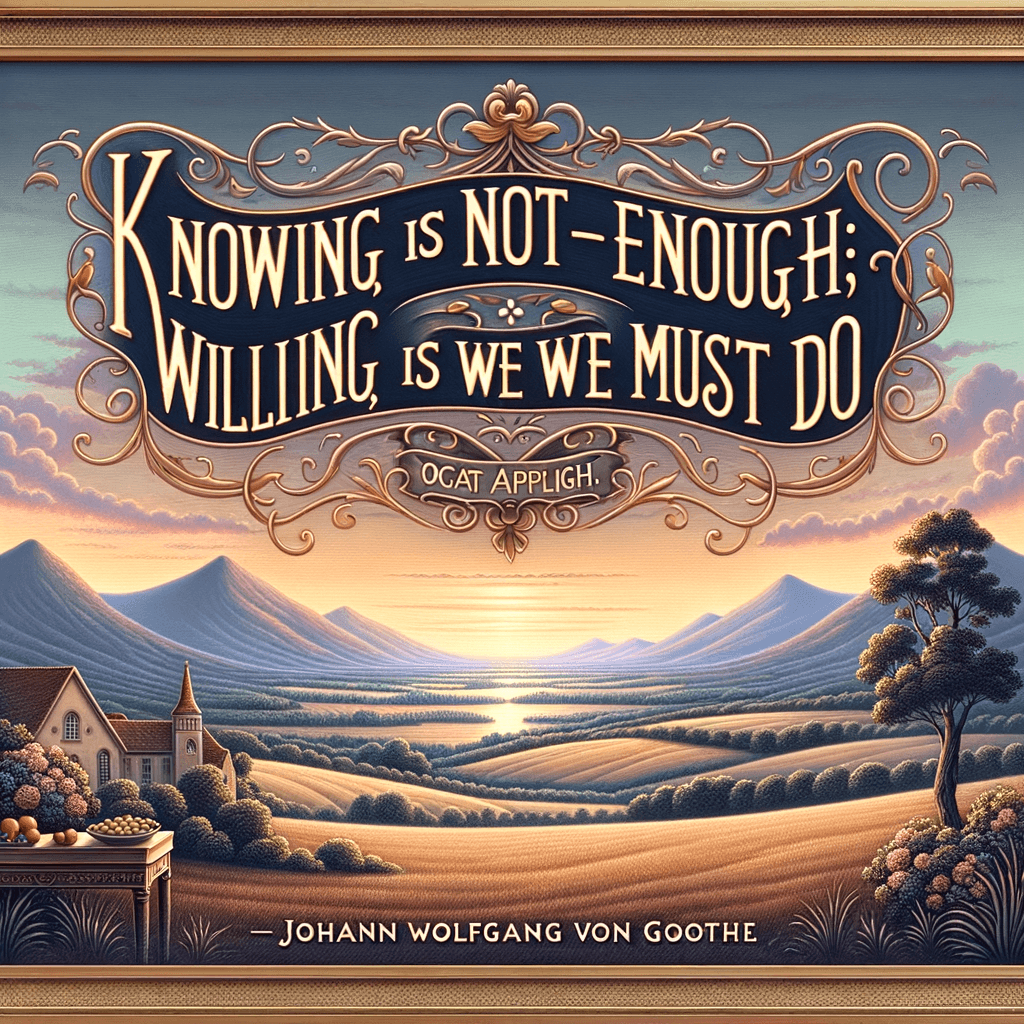
Knowing is not enough; we must apply. Willing is not enough; we must do. — Johann Wolfgang von Goethe
—What lingers after this line?
Application of Knowledge
This quote highlights the importance of putting knowledge into action. Merely understanding or knowing something is insufficient if it is not applied in practical ways to make a difference.
Action Over Intention
It emphasizes that having the willingness to do something is not enough by itself; taking concrete actions to achieve goals is crucial.
Practical Implementation
The quote urges individuals to move beyond theory and intention to practical implementation. It encourages converting ideas into tangible outcomes.
Achievement and Success
For achieving success, both knowledge and willingness are fundamental, but they must be complemented by action. Without application, neither knowledge nor willingness leads to real progress.
Proactive Mindset
A proactive mindset involves not only learning and planning but also executing tasks and plans effectively. Goethe's quote serves as a motivation to adopt such a mindset.
Historical Context
Johann Wolfgang von Goethe was a German writer and statesman in the 18th century. His wide range of works includes literature, science, and philosophy, often exploring the connection between thought and action.
One-minute reflection
What does this quote ask you to notice today?
Related Quotes
6 selectedTake action, and the universe will conspire to help you. — Johann Wolfgang von Goethe, Germany.
Johann Wolfgang von Goethe, Germany.
This quote highlights the importance of taking initiative. It suggests that when one takes the first steps towards their goals, external forces will align to support those efforts.
Read full interpretation →You cannot command things, but you can command yourself. — Michael D. Pollock
Michael D. Pollock
At first glance, Michael D. Pollock’s line draws a sharp boundary between the outer world and the inner one.
Read full interpretation →A boundary is not a wall; it is a door with a lock that you control. — Annie Wright
Annie Wright
At first glance, Annie Wright’s quote corrects a common misunderstanding: people often treat boundaries as acts of distance or punishment, when in fact they are tools of intentional relationship. A wall shuts everyone ou...
Read full interpretation →When you feel like you are at a dead end, remember that you are at a place where you can choose a different path. — Haemin Sunim
Haemin Sunim
At first glance, a dead end feels like failure, as though movement itself has been denied. Yet Haemin Sunim’s insight gently reverses that impression: what seems like a wall may actually be a point of decision.
Read full interpretation →The boundaries of your life are merely a creation of the self. — Robin Sharma
Robin Sharma
Robin Sharma’s line reframes “boundaries” as something less like a fence in the world and more like a frame in the mind. What we often call limits—who we are, what we can do, what we deserve—can be stories we repeat unti...
Read full interpretation →You are the author of your own story. You don't need permission to begin. — Ctrl+Alt+Write
Ctrl+Alt+Write
The quote opens with a bracing premise: your life is not merely something that happens to you, but something you shape. By calling you “the author,” it reframes identity from a fixed description into an ongoing draft—rev...
Read full interpretation →More From Author
More from Johann Wolfgang von Goethe →A really great talent finds its happiness in execution. — Johann Wolfgang von Goethe
Goethe’s remark shifts attention away from talent as mere possession and toward talent as practice. A gift, however impressive, remains incomplete until it is exercised; in this sense, happiness does not come from being...
Read full interpretation →Everybody wants to be somebody; nobody wants to grow. — Johann Wolfgang von Goethe
At first glance, Goethe’s remark exposes a quiet contradiction in human desire: people long for significance, recognition, and identity, yet often resist the difficult transformation such becoming requires. To ‘be somebo...
Read full interpretation →The most original of authors are not so because they advance what is new, but more because they know how to say something as if it had never been said before. — Johann Wolfgang von Goethe
Goethe begins by shifting originality away from mere invention and toward expression. In his view, a writer does not become original simply by producing unheard-of thoughts; rather, originality emerges when familiar trut...
Read full interpretation →In nature we never see anything isolated, but everything in connection with something else which is before it, beside it, under it and over it. — Johann Wolfgang von Goethe
Goethe’s remark begins with a simple observation and expands into a profound worldview: nothing in nature exists alone. Every plant, stone, current, and creature belongs to a web of relations shaped by time, place, and s...
Read full interpretation →