
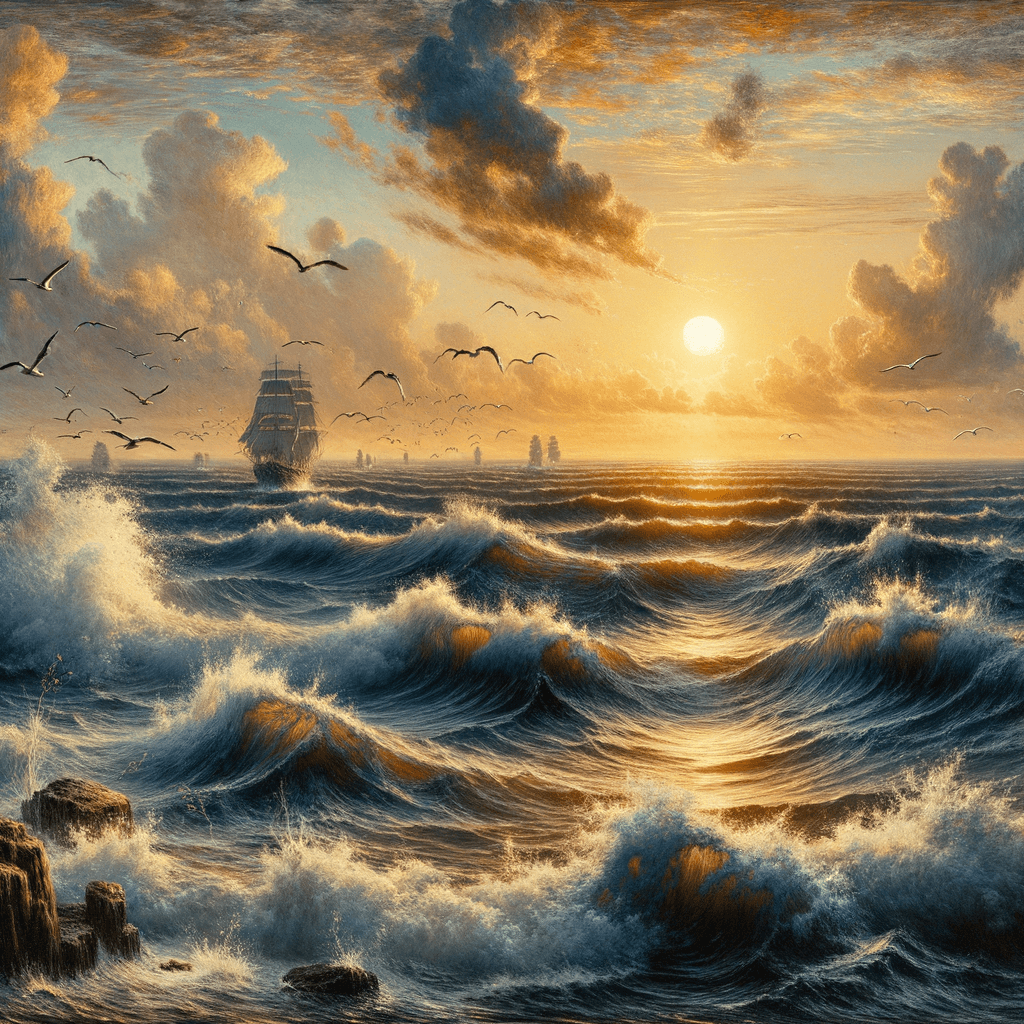
Life is like foam, so one must give oneself like the sea. - Pablo Neruda
—What lingers after this line?
Ephemeral Nature of Life
This quote suggests that life is transient and ever-changing, much like foam that appears and disappears on the sea's surface. Understanding this can shape how we choose to live.
Embracing Life Fully
Neruda encourages us to immerse ourselves fully in life, just as the sea encompasses and produces foam. This implies engaging deeply and passionately in all experiences.
Fluidity and Adaptability
Life, like the sea, is in constant motion and requires adaptability. By comparing oneself to the sea, Neruda underscores the importance of being flexible and resilient in the face of life's uncertainties.
Integration with Life’s Cycles
The sea's foam is a natural result of its rhythms and movements. This suggests that one should align oneself with the natural flow of life's cycles, embracing its peaks and troughs.
Philosophical Perspective
Pablo Neruda, a renowned Chilean poet, often infused his works with deep philosophical insights. This quote reflects his contemplative view on existence, suggesting that understanding the fleeting nature of life can lead to a more meaningful and engaged way of living.
One-minute reflection
What's one small action this suggests?
Related Quotes
6 selectedYour life is a gift, and you are the gift to the world. Share it wisely. — Unknown.
Unknown
This quote emphasizes that life itself is a precious gift, highlighting the importance of cherishing and valuing every moment and experience.
Read full interpretation →True generosity is an offering; given freely and out of pure love. — Ram Dass
Ram Dass
Generosity, according to Ram Dass, is not transactional; it is a selfless act with no expectation of reward.
Read full interpretation →The really important kind of freedom involves attention, and awareness, and discipline, and effort, and being able truly to care about other people and to sacrifice for them, over and over, in myriad petty little unsexy ways, every day. — David Foster Wallace
David Foster Wallace
At first glance, freedom often sounds like independence: the ability to do whatever one wants without interference. David Foster Wallace redirects that familiar idea toward something more demanding.
Read full interpretation →Love is not affectionate feeling, but a steady wish for the loved one's ultimate good as far as it can be obtained. — C.S. Lewis
C.S. Lewis
At first glance, C.S. Lewis challenges one of the most common assumptions about love: that it is mainly a warm feeling.
Read full interpretation →You don't have to be a billionaire to believe you can make a difference. Give your time, give your love, or simply give a smile. — Steve Goodier
Steve Goodier
At its core, Steve Goodier’s quote challenges the idea that influence belongs only to the wealthy or powerful. By placing time, love, and even a smile alongside money, he broadens generosity into something almost anyone...
Read full interpretation →Love is the only way to rescue any life from the insignificance of its own self-absorption. — Iris Murdoch
Iris Murdoch
At the heart of Iris Murdoch’s line is a moral claim: love is not merely a feeling, but a way of turning outward. A life trapped in its own self-importance becomes small, repetitive, and ultimately insignificant because...
Read full interpretation →More From Author
More from Pablo Neruda →Let the rain kiss you. Let the rain beat upon your head with silver liquid drops. — Pablo Neruda
Neruda’s lines open as a gentle imperative: instead of bracing against bad weather, we are asked to welcome it. “Let the rain kiss you” reframes rain as a gesture offered to the body rather than an inconvenience imposed...
Read full interpretation →Build a bridge of resolve and walk across it one brave step at a time. — Pablo Neruda
Neruda’s image begins with a striking implication: resolve is not merely a feeling you wait for, but a structure you build. A bridge doesn’t appear because the river is intimidating; it exists because someone decided to...
Read full interpretation →Let each sunrise find you leaning toward action. — Pablo Neruda
Neruda’s line frames each sunrise as more than scenery; it’s a daily reset that gently pressures us to move. “Leaning” matters because it suggests a posture, not a perfect performance—an inclination toward doing, even be...
Read full interpretation →Make your hands busy with making—words, gardens, music—and life answers back. — Pablo Neruda
Neruda’s line frames creativity less as self-expression and more as initiation: when you keep your hands busy making, you open a channel through which the world can respond. The emphasis on “hands” matters, because it gr...
Read full interpretation →