
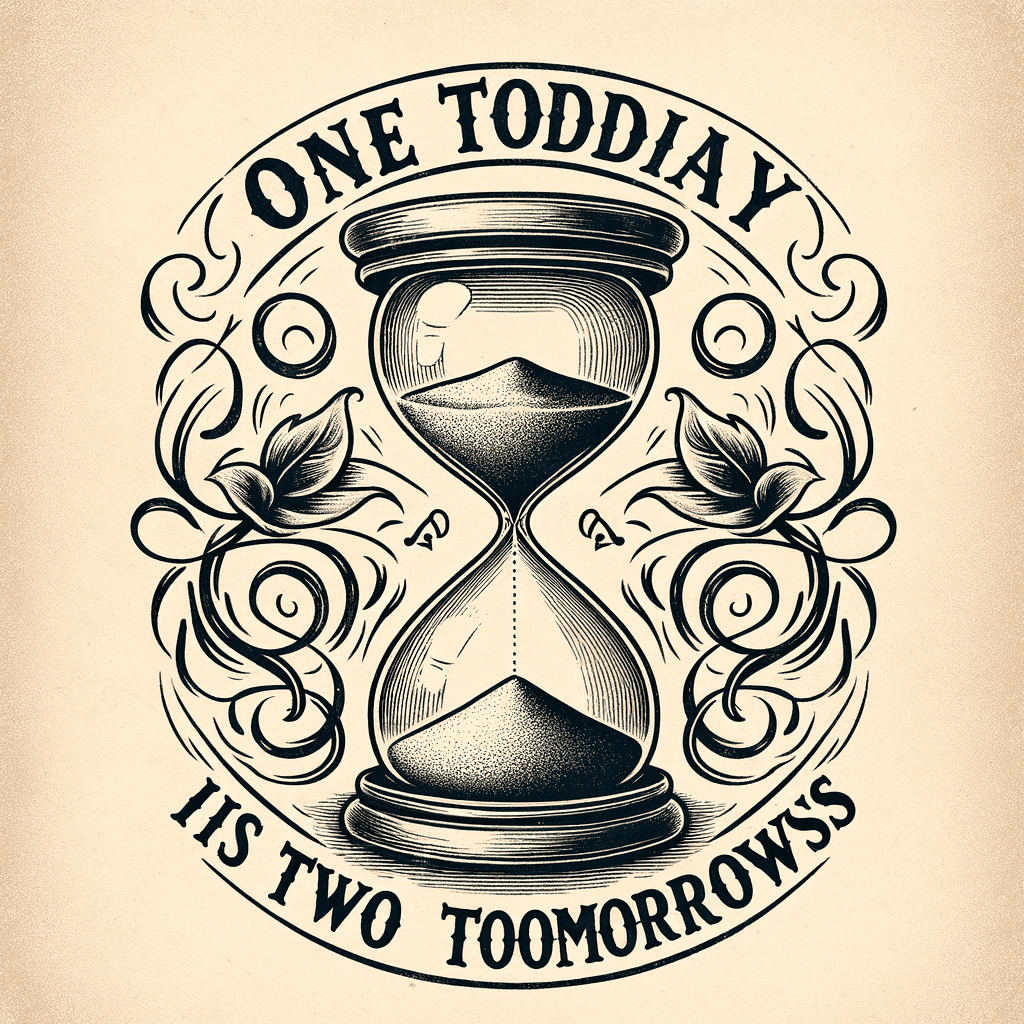
One today is worth two tomorrows. — Benjamin Franklin
—What lingers after this line?
Value of the Present
This quote emphasizes the importance of the present moment. It suggests that what you can accomplish or experience today is more valuable than what lies in the uncertain future.
Procrastination
Franklin advises against procrastination, implying that delaying actions or decisions to the future can diminish their effect. Taking action now is more beneficial and impactful.
Seize the Day
The saying encourages a 'carpe diem' attitude, urging people to make the most of their current opportunities and circumstances rather than waiting for a better time that may never come.
Mindfulness
It underscores the significance of mindfulness—being aware and engaged in the present moment. This approach can lead to greater satisfaction and success.
Benjamin Franklin's Pragmatism
Benjamin Franklin was known for his practical wisdom and this quote reflects his pragmatic mindset. It is advice to live fully and efficiently in the now rather than banking on an uncertain future.
One-minute reflection
What feeling does this quote bring up for you?
Related Quotes
6 selectedLimit your actions to what you can do right now. — Benjamin Franklin
Benjamin Franklin
This quote emphasizes the importance of staying grounded in the present moment. By concentrating on what you can do right now, you channel your energy effectively rather than dwelling on the past or worrying about the fu...
Read full interpretation →Every morning we are born again. What we do today is what matters most.
Unknown
This quote emphasizes the idea that each day provides a new opportunity for growth and change, similar to being reborn. It suggests that we should view each day as a fresh start.
Read full interpretation →Yesterday is history, tomorrow is a mystery, today is a gift, that's why we call it the present.
Unknown
This quote emphasizes the importance of living in the present moment. It suggests that while the past is gone and the future is uncertain, the present is a valuable gift to be cherished and enjoyed.
Read full interpretation →Don't let yesterday take up too much of today. – Will Rogers
Will Rogers
This quote encourages focusing on the present moment rather than dwelling on the past. It suggests that we should not let past experiences and regrets hinder our current well-being and productivity.
Read full interpretation →Yesterday is gone. Tomorrow has not yet come. We have only today. Let us begin. — Mother Teresa
Mother Teresa
This quote emphasizes the importance of focusing on the present moment. Yesterday is already in the past and cannot be changed, and tomorrow is uncertain.
Read full interpretation →Bringing awareness to our breathing, we remind ourselves that we are here now, so we might as well be fully awake for whatever is happening. — Jon Kabat-Zinn
Zinn
Jon Kabat-Zinn’s reflection begins with something deceptively ordinary: the breath. By bringing awareness to inhaling and exhaling, we anchor ourselves in the immediate moment rather than drifting into regret about the p...
Read full interpretation →More From Author
More from Benjamin Franklin →It is easier to suppress the first desire than to satisfy all that follow. — Benjamin Franklin
Benjamin Franklin’s remark turns self-control into a matter of timing. Rather than warning only against excess, he suggests that the earliest moment of temptation is the easiest and most decisive place to act.
Read full interpretation →Whatever is begun in anger, ends in shame. — Benjamin Franklin
At first glance, Benjamin Franklin’s line offers a compact moral lesson, yet its force comes from how accurately it describes human behavior. When something is begun in anger, judgment narrows, pride takes control, and t...
Read full interpretation →It is easier to prevent bad habits than to break them. — Benjamin Franklin
At its core, Benjamin Franklin’s remark captures a simple but enduring truth: habits are far easier to avoid at the beginning than to undo once they become routine. A repeated action gradually slips beneath conscious cho...
Read full interpretation →He that cannot obey, cannot command. — Benjamin Franklin
At its core, Benjamin Franklin’s statement argues that authority is not truly earned by status alone. A person who has never learned to follow rules, accept correction, or work within a larger order lacks the discipline...
Read full interpretation →